

136
4 Wavepacket Dynamics and Geometrical Relaxation
E r T =
∞
0
E r E tot e
−E tot /K B T
ρ(E tot ) dE tot
∞
0 e −E tot /K B T ρ(E tot ) dE tot
(4.28)
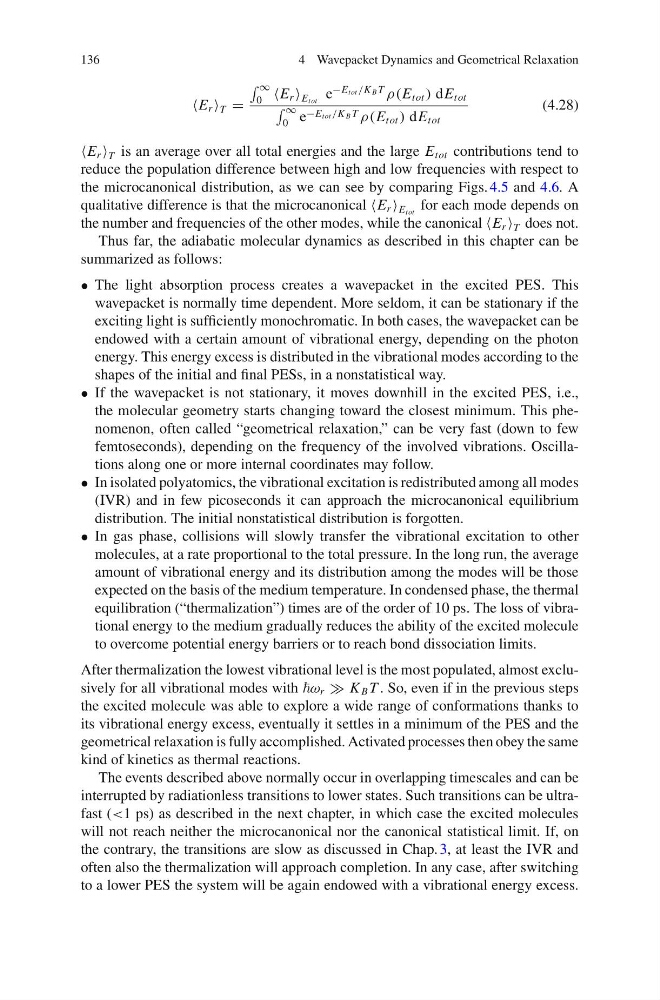
E r T is an average over all total energies and the large E tot contributions tend to
reduce the population difference between high and low frequencies with respect to
the microcanonical distribution, as we can see by comparing Figs. 4.5 and 4.6. A
qualitative difference is that the microcanonical E r E tot for each mode depends on
the number and frequencies of the other modes, while the canonical E r T does not.
Thus far, the adiabatic molecular dynamics as described in this chapter can be
summarized as follows:
• The light absorption process creates a wavepacket in the excited PES. This
wavepacket is normally time dependent. More seldom, it can be stationary if the
exciting light is sufficiently monochromatic. In both cases, the wavepacket can be
endowed with a certain amount of vibrational energy, depending on the photon
energy. This energy excess is distributed in the vibrational modes according to the
shapes of the initial and final PESs, in a nonstatistical way.
• If the wavepacket is not stationary, it moves downhill in the excited PES, i.e.,
the molecular geometry starts changing toward the closest minimum. This phenomenon, often called “geometrical relaxation,” can be very fast (down to few
femtoseconds), depending on the frequency of the involved vibrations. Oscillations along one or more internal coordinates may follow.
• In isolated polyatomics, the vibrational excitation is redistributed among all modes
(IVR) and in few picoseconds it can approach the microcanonical equilibrium
distribution. The initial nonstatistical distribution is forgotten.
• In gas phase, collisions will slowly transfer the vibrational excitation to other
molecules, at a rate proportional to the total pressure. In the long run, the average
amount of vibrational energy and its distribution among the modes will be those
expected on the basis of the medium temperature. In condensed phase, the thermal
equilibration (“thermalization”) times are of the order of 10 ps. The loss of vibrational energy to the medium gradually reduces the ability of the excited molecule
to overcome potential energy barriers or to reach bond dissociation limits.
After thermalization the lowest vibrational level is the most populated, almost exclusively for all vibrational modes with ω r K B T . So, even if in the previous steps
the excited molecule was able to explore a wide range of conformations thanks to
its vibrational energy excess, eventually it settles in a minimum of the PES and the
geometrical relaxation is fully accomplished. Activated processes then obey the same
kind of kinetics as thermal reactions.
The events described above normally occur in overlapping timescales and can be
interrupted by radiationless transitions to lower states. Such transitions can be ultrafast (<1 ps) as described in the next chapter, in which case the excited molecules
will not reach neither the microcanonical nor the canonical statistical limit. If, on
the contrary, the transitions are slow as discussed in Chap. 3, at least the IVR and
often also the thermalization will approach completion. In any case, after switching
to a lower PES the system will be again endowed with a vibrational energy excess.
4 Wavepacket Dynamics and Geometrical Relaxation
E r T =
∞
0
E r E tot e
−E tot /K B T
ρ(E tot ) dE tot
∞
0 e −E tot /K B T ρ(E tot ) dE tot
(4.28)
E r T is an average over all total energies and the large E tot contributions tend to
reduce the population difference between high and low frequencies with respect to
the microcanonical distribution, as we can see by comparing Figs. 4.5 and 4.6. A
qualitative difference is that the microcanonical E r E tot for each mode depends on
the number and frequencies of the other modes, while the canonical E r T does not.
Thus far, the adiabatic molecular dynamics as described in this chapter can be
summarized as follows:
• The light absorption process creates a wavepacket in the excited PES. This
wavepacket is normally time dependent. More seldom, it can be stationary if the
exciting light is sufficiently monochromatic. In both cases, the wavepacket can be
endowed with a certain amount of vibrational energy, depending on the photon
energy. This energy excess is distributed in the vibrational modes according to the
shapes of the initial and final PESs, in a nonstatistical way.
• If the wavepacket is not stationary, it moves downhill in the excited PES, i.e.,
the molecular geometry starts changing toward the closest minimum. This phenomenon, often called “geometrical relaxation,” can be very fast (down to few
femtoseconds), depending on the frequency of the involved vibrations. Oscillations along one or more internal coordinates may follow.
• In isolated polyatomics, the vibrational excitation is redistributed among all modes
(IVR) and in few picoseconds it can approach the microcanonical equilibrium
distribution. The initial nonstatistical distribution is forgotten.
• In gas phase, collisions will slowly transfer the vibrational excitation to other
molecules, at a rate proportional to the total pressure. In the long run, the average
amount of vibrational energy and its distribution among the modes will be those
expected on the basis of the medium temperature. In condensed phase, the thermal
equilibration (“thermalization”) times are of the order of 10 ps. The loss of vibrational energy to the medium gradually reduces the ability of the excited molecule
to overcome potential energy barriers or to reach bond dissociation limits.
After thermalization the lowest vibrational level is the most populated, almost exclusively for all vibrational modes with ω r K B T . So, even if in the previous steps
the excited molecule was able to explore a wide range of conformations thanks to
its vibrational energy excess, eventually it settles in a minimum of the PES and the
geometrical relaxation is fully accomplished. Activated processes then obey the same
kind of kinetics as thermal reactions.
The events described above normally occur in overlapping timescales and can be
interrupted by radiationless transitions to lower states. Such transitions can be ultrafast (<1 ps) as described in the next chapter, in which case the excited molecules
will not reach neither the microcanonical nor the canonical statistical limit. If, on
the contrary, the transitions are slow as discussed in Chap. 3, at least the IVR and
often also the thermalization will approach completion. In any case, after switching
to a lower PES the system will be again endowed with a vibrational energy excess.