

3.10 Predissociation and Fermi’s Golden Rule
105
0,
1,0
0,0
U 1
U 0
dissociationcoordinate,bohr
energy,a.u.
8
7
6
5
4
3
2
0.16
0.14
0.12
0.1
0.08
0.06
0.04
0.02
0
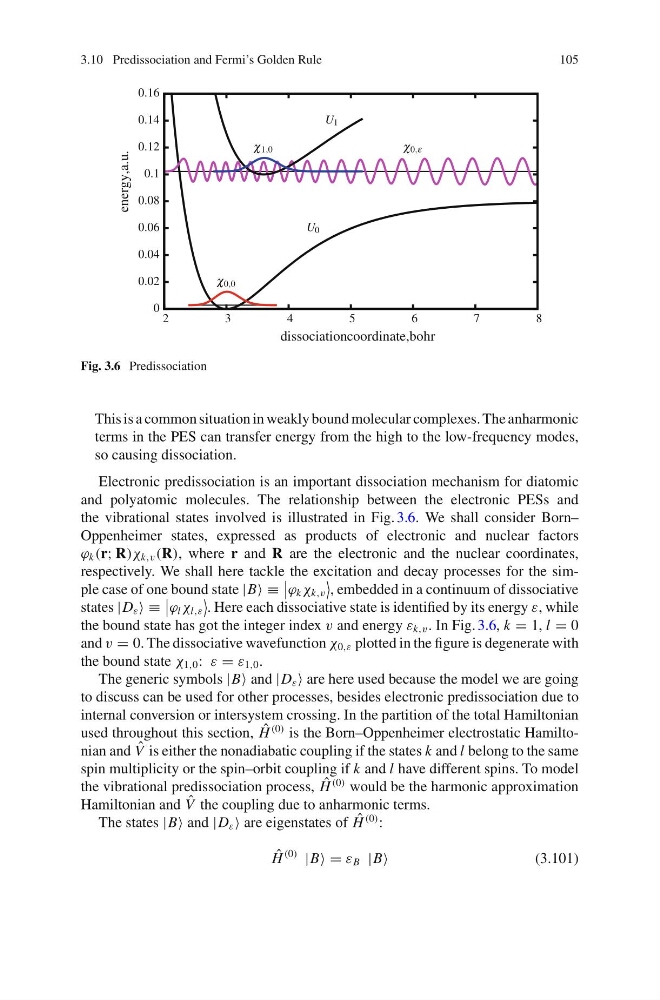
Fig. 3.6 Predissociation
This is a common situation in weakly bound molecular complexes. The anharmonic
terms in the PES can transfer energy from the high to the low-frequency modes,
so causing dissociation.
Electronic predissociation is an important dissociation mechanism for diatomic
and polyatomic molecules. The relationship between the electronic PESs and
the vibrational states involved is illustrated in Fig. 3.6. We shall consider Born–
Oppenheimer states, expressed as products of electronic and nuclear factors
ϕ k (r; R)χ k,v (R), where r and R are the electronic and the nuclear coordinates,
respectively. We shall here tackle the excitation and decay processes for the simple case of one bound state |B ≡
ϕ k χ k,v
, embedded in a continuum of dissociative
states |D ε ≡
ϕ l χ l,ε
. Here each dissociative state is identified by its energy ε, while
the bound state has got the integer index v and energy ε k,v . In Fig. 3.6, k = 1, l = 0
and v = 0. The dissociative wavefunction χ 0,ε plotted in the figure is degenerate with
the bound state χ 1,0 : ε = ε 1,0 .
The generic symbols |B and |D ε are here used because the model we are going
to discuss can be used for other processes, besides electronic predissociation due to
internal conversion or intersystem crossing. In the partition of the total Hamiltonian
used throughout this section, ˆ
H
(0) is the Born–Oppenheimer electrostatic Hamiltonian and ˆ
V is either the nonadiabatic coupling if the states k and l belong to the same
spin multiplicity or the spin–orbit coupling if k and l have different spins. To model
the vibrational predissociation process, ˆ
H
(0) would be the harmonic approximation
Hamiltonian and ˆ
V the coupling due to anharmonic terms.
The states |B and |D ε are eigenstates of ˆ
H
(0) :
ˆ
H
(0)
|B = ε B |B
(3.101)
105
0,
1,0
0,0
U 1
U 0
dissociationcoordinate,bohr
energy,a.u.
8
7
6
5
4
3
2
0.16
0.14
0.12
0.1
0.08
0.06
0.04
0.02
0
Fig. 3.6 Predissociation
This is a common situation in weakly bound molecular complexes. The anharmonic
terms in the PES can transfer energy from the high to the low-frequency modes,
so causing dissociation.
Electronic predissociation is an important dissociation mechanism for diatomic
and polyatomic molecules. The relationship between the electronic PESs and
the vibrational states involved is illustrated in Fig. 3.6. We shall consider Born–
Oppenheimer states, expressed as products of electronic and nuclear factors
ϕ k (r; R)χ k,v (R), where r and R are the electronic and the nuclear coordinates,
respectively. We shall here tackle the excitation and decay processes for the simple case of one bound state |B ≡
ϕ k χ k,v
, embedded in a continuum of dissociative
states |D ε ≡
ϕ l χ l,ε
. Here each dissociative state is identified by its energy ε, while
the bound state has got the integer index v and energy ε k,v . In Fig. 3.6, k = 1, l = 0
and v = 0. The dissociative wavefunction χ 0,ε plotted in the figure is degenerate with
the bound state χ 1,0 : ε = ε 1,0 .
The generic symbols |B and |D ε are here used because the model we are going
to discuss can be used for other processes, besides electronic predissociation due to
internal conversion or intersystem crossing. In the partition of the total Hamiltonian
used throughout this section, ˆ
H
(0) is the Born–Oppenheimer electrostatic Hamiltonian and ˆ
V is either the nonadiabatic coupling if the states k and l belong to the same
spin multiplicity or the spin–orbit coupling if k and l have different spins. To model
the vibrational predissociation process, ˆ
H
(0) would be the harmonic approximation
Hamiltonian and ˆ
V the coupling due to anharmonic terms.
The states |B and |D ε are eigenstates of ˆ
H
(0) :
ˆ
H
(0)
|B = ε B |B
(3.101)