

106
3 Electronic Excitation and Decay
and
ˆ
H
(0)
|D ε = ε |D ε .
(3.102)
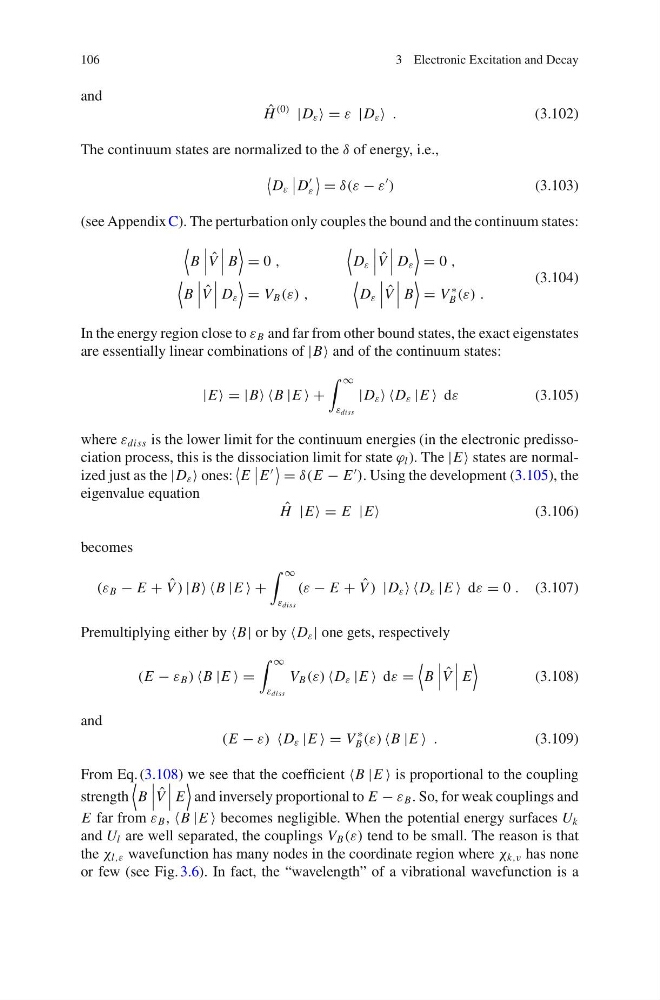
The continuum states are normalized to the δ of energy, i.e.,
D ε
D
ε
= δ(ε − ε
)
(3.103)
(see Appendix C). The perturbation only couples the bound and the continuum states:
B
ˆ
V
B
= 0 ,
D ε
ˆ
V
D ε
= 0 ,
B
ˆ
V
D ε
= V B (ε) ,
D ε
ˆ
V
B
= V
∗
B (ε) .
(3.104)
In the energy region close to ε B and far from other bound states, the exact eigenstates
are essentially linear combinations of |B and of the continuum states:
|E = |B B |E +
∞
ε diss
|D ε D ε |E dε
(3.105)
where ε diss is the lower limit for the continuum energies (in the electronic predissociation process, this is the dissociation limit for state ϕ l ). The |E states are normalized just as the |D ε ones:
E
E
= δ(E − E
). Using the development (3.105), the
eigenvalue equation
ˆ
H |E = E |E
(3.106)
becomes
(ε B − E + ˆ
V ) |B B |E +
∞
ε diss
(ε − E + ˆ
V ) |D ε D ε |E dε = 0 . (3.107)
Premultiplying either by B| or by D ε | one gets, respectively
(E − ε B ) B |E =
∞
ε diss
V B (ε) D ε |E dε =
B
ˆ
V
E
(3.108)
and
(E − ε) D ε |E = V
∗
B (ε) B |E .
(3.109)
From Eq. (3.108) we see that the coefficient B |E is proportional to the coupling
strength
B
ˆ
V
E
and inversely proportional to E − ε B . So, for weak couplings and
E far from ε B , B |E becomes negligible. When the potential energy surfaces U k
and U l are well separated, the couplings V B (ε) tend to be small. The reason is that
the χ l,ε wavefunction has many nodes in the coordinate region where χ k,v has none
or few (see Fig. 3.6). In fact, the “wavelength” of a vibrational wavefunction is a
3 Electronic Excitation and Decay
and
ˆ
H
(0)
|D ε = ε |D ε .
(3.102)
The continuum states are normalized to the δ of energy, i.e.,
D ε
D
ε
= δ(ε − ε
)
(3.103)
(see Appendix C). The perturbation only couples the bound and the continuum states:
B
ˆ
V
B
= 0 ,
D ε
ˆ
V
D ε
= 0 ,
B
ˆ
V
D ε
= V B (ε) ,
D ε
ˆ
V
B
= V
∗
B (ε) .
(3.104)
In the energy region close to ε B and far from other bound states, the exact eigenstates
are essentially linear combinations of |B and of the continuum states:
|E = |B B |E +
∞
ε diss
|D ε D ε |E dε
(3.105)
where ε diss is the lower limit for the continuum energies (in the electronic predissociation process, this is the dissociation limit for state ϕ l ). The |E states are normalized just as the |D ε ones:
E
E
= δ(E − E
). Using the development (3.105), the
eigenvalue equation
ˆ
H |E = E |E
(3.106)
becomes
(ε B − E + ˆ
V ) |B B |E +
∞
ε diss
(ε − E + ˆ
V ) |D ε D ε |E dε = 0 . (3.107)
Premultiplying either by B| or by D ε | one gets, respectively
(E − ε B ) B |E =
∞
ε diss
V B (ε) D ε |E dε =
B
ˆ
V
E
(3.108)
and
(E − ε) D ε |E = V
∗
B (ε) B |E .
(3.109)
From Eq. (3.108) we see that the coefficient B |E is proportional to the coupling
strength
B
ˆ
V
E
and inversely proportional to E − ε B . So, for weak couplings and
E far from ε B , B |E becomes negligible. When the potential energy surfaces U k
and U l are well separated, the couplings V B (ε) tend to be small. The reason is that
the χ l,ε wavefunction has many nodes in the coordinate region where χ k,v has none
or few (see Fig. 3.6). In fact, the “wavelength” of a vibrational wavefunction is a