

104
3 Electronic Excitation and Decay
||Ψ exc (t) |Ψ exc (0) |
2
= 1 −
4 |V |
2
(ε D − ε B ) 2 + 4 |V |
2
sin
2
Ω R t
2
(3.98)
where
Ω R =
−1
(ε D − ε B ) 2 + 4 |V |
2
.
(3.99)
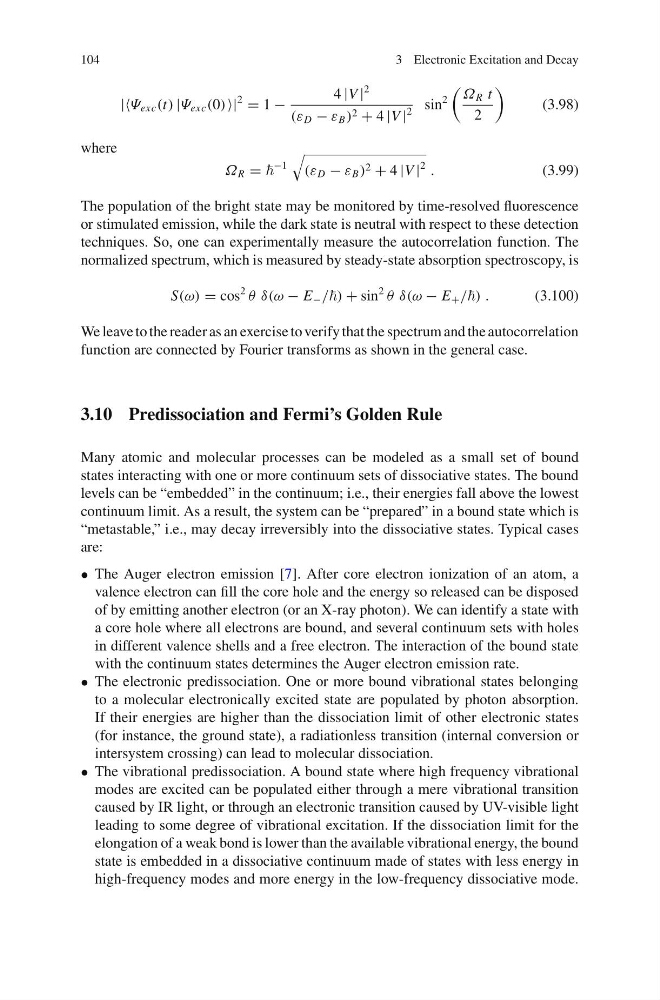
The population of the bright state may be monitored by time-resolved fluorescence
or stimulated emission, while the dark state is neutral with respect to these detection
techniques. So, one can experimentally measure the autocorrelation function. The
normalized spectrum, which is measured by steady-state absorption spectroscopy, is
S(ω) = cos
2
θ δ(ω − E − /) + sin
2
θ δ(ω − E + /) .
(3.100)
We leave to the reader as an exercise to verify that the spectrum and the autocorrelation
function are connected by Fourier transforms as shown in the general case.
3.10 Predissociation and Fermi’s Golden Rule
Many atomic and molecular processes can be modeled as a small set of bound
states interacting with one or more continuum sets of dissociative states. The bound
levels can be “embedded” in the continuum; i.e., their energies fall above the lowest
continuum limit. As a result, the system can be “prepared” in a bound state which is
“metastable,” i.e., may decay irreversibly into the dissociative states. Typical cases
are:
• The Auger electron emission [7]. After core electron ionization of an atom, a
valence electron can fill the core hole and the energy so released can be disposed
of by emitting another electron (or an X-ray photon). We can identify a state with
a core hole where all electrons are bound, and several continuum sets with holes
in different valence shells and a free electron. The interaction of the bound state
with the continuum states determines the Auger electron emission rate.
• The electronic predissociation. One or more bound vibrational states belonging
to a molecular electronically excited state are populated by photon absorption.
If their energies are higher than the dissociation limit of other electronic states
(for instance, the ground state), a radiationless transition (internal conversion or
intersystem crossing) can lead to molecular dissociation.
• The vibrational predissociation. A bound state where high frequency vibrational
modes are excited can be populated either through a mere vibrational transition
caused by IR light, or through an electronic transition caused by UV-visible light
leading to some degree of vibrational excitation. If the dissociation limit for the
elongation of a weak bond is lower than the available vibrational energy, the bound
state is embedded in a dissociative continuum made of states with less energy in
high-frequency modes and more energy in the low-frequency dissociative mode.
3 Electronic Excitation and Decay
||Ψ exc (t) |Ψ exc (0) |
2
= 1 −
4 |V |
2
(ε D − ε B ) 2 + 4 |V |
2
sin
2
Ω R t
2
(3.98)
where
Ω R =
−1
(ε D − ε B ) 2 + 4 |V |
2
.
(3.99)
The population of the bright state may be monitored by time-resolved fluorescence
or stimulated emission, while the dark state is neutral with respect to these detection
techniques. So, one can experimentally measure the autocorrelation function. The
normalized spectrum, which is measured by steady-state absorption spectroscopy, is
S(ω) = cos
2
θ δ(ω − E − /) + sin
2
θ δ(ω − E + /) .
(3.100)
We leave to the reader as an exercise to verify that the spectrum and the autocorrelation
function are connected by Fourier transforms as shown in the general case.
3.10 Predissociation and Fermi’s Golden Rule
Many atomic and molecular processes can be modeled as a small set of bound
states interacting with one or more continuum sets of dissociative states. The bound
levels can be “embedded” in the continuum; i.e., their energies fall above the lowest
continuum limit. As a result, the system can be “prepared” in a bound state which is
“metastable,” i.e., may decay irreversibly into the dissociative states. Typical cases
are:
• The Auger electron emission [7]. After core electron ionization of an atom, a
valence electron can fill the core hole and the energy so released can be disposed
of by emitting another electron (or an X-ray photon). We can identify a state with
a core hole where all electrons are bound, and several continuum sets with holes
in different valence shells and a free electron. The interaction of the bound state
with the continuum states determines the Auger electron emission rate.
• The electronic predissociation. One or more bound vibrational states belonging
to a molecular electronically excited state are populated by photon absorption.
If their energies are higher than the dissociation limit of other electronic states
(for instance, the ground state), a radiationless transition (internal conversion or
intersystem crossing) can lead to molecular dissociation.
• The vibrational predissociation. A bound state where high frequency vibrational
modes are excited can be populated either through a mere vibrational transition
caused by IR light, or through an electronic transition caused by UV-visible light
leading to some degree of vibrational excitation. If the dissociation limit for the
elongation of a weak bond is lower than the available vibrational energy, the bound
state is embedded in a dissociative continuum made of states with less energy in
high-frequency modes and more energy in the low-frequency dissociative mode.