

3.5 Excitation by a Continuous Wave
91
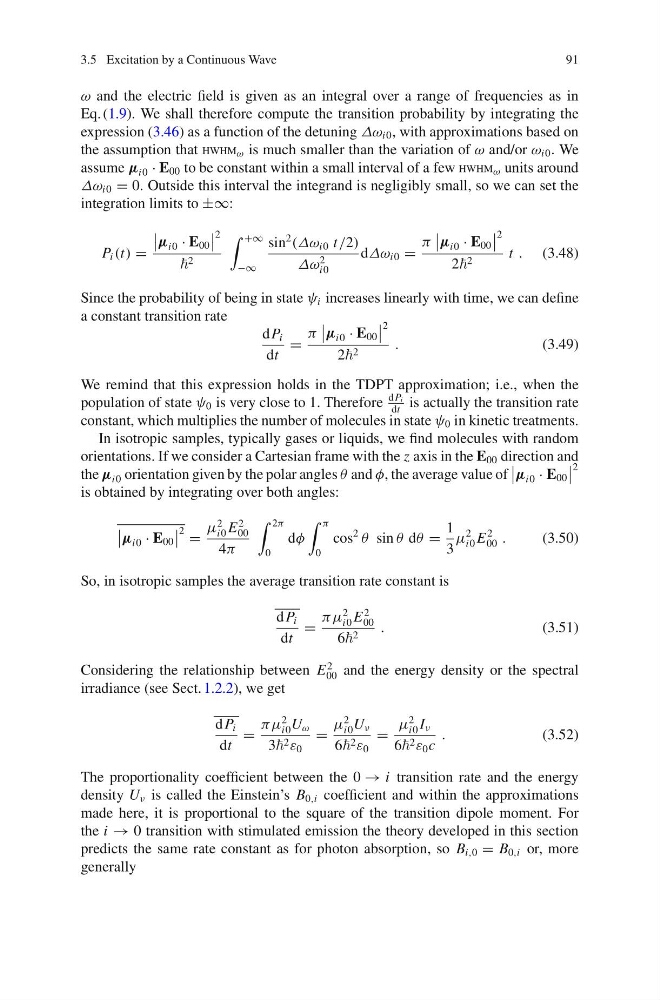
ω and the electric field is given as an integral over a range of frequencies as in
Eq. (1.9). We shall therefore compute the transition probability by integrating the
expression (3.46) as a function of the detuning Δω i0 , with approximations based on
the assumption that HWHM ω is much smaller than the variation of ω and/or ω i0 . We
assume µ i0 · E 00 to be constant within a small interval of a few HWHM ω units around
Δω i0 = 0. Outside this interval the integrand is negligibly small, so we can set the
integration limits to ±∞:
P i (t) =
µ i0 · E 00
2
2
+∞
−∞
sin
2
(Δω i0 t/2)
Δω
2
i0
dΔω i0 =
π
µ i0 · E 00
2
2 2
t . (3.48)
Since the probability of being in state ψ i increases linearly with time, we can define
a constant transition rate
d P i
dt
=
π
µ i0 · E 00
2
2 2
.
(3.49)
We remind that this expression holds in the TDPT approximation; i.e., when the
population of state ψ 0 is very close to 1. Therefore
d P i
dt
is actually the transition rate
constant, which multiplies the number of molecules in state ψ 0 in kinetic treatments.
In isotropic samples, typically gases or liquids, we find molecules with random
orientations. If we consider a Cartesian frame with the z axis in the E 00 direction and
the µ i0 orientation given by the polar angles θ and φ, the average value of
µ i0 · E 00
2
is obtained by integrating over both angles:
µ i0 · E 00
2 =
μ
2
i0 E
2
00
4π
2π
0
dφ
π
0
cos
2
θ sin θ dθ =
1
3
μ
2
i0 E
2
00 .
(3.50)
So, in isotropic samples the average transition rate constant is
d P i
dt
=
πμ
2
i0 E
2
00
6 2 .
(3.51)
Considering the relationship between E
2
00 and the energy density or the spectral
irradiance (see Sect. 1.2.2), we get
d P i
dt
=
πμ
2
i0 U ω
3 2 ε 0
=
μ
2
i0 U ν
6 2 ε 0
=
μ
2
i0 I ν
6 2 ε 0 c
.
(3.52)
The proportionality coefficient between the 0 → i transition rate and the energy
density U ν is called the Einstein’s B 0,i coefficient and within the approximations
made here, it is proportional to the square of the transition dipole moment. For
the i → 0 transition with stimulated emission the theory developed in this section
predicts the same rate constant as for photon absorption, so B i,0 = B 0,i or, more
generally
91
ω and the electric field is given as an integral over a range of frequencies as in
Eq. (1.9). We shall therefore compute the transition probability by integrating the
expression (3.46) as a function of the detuning Δω i0 , with approximations based on
the assumption that HWHM ω is much smaller than the variation of ω and/or ω i0 . We
assume µ i0 · E 00 to be constant within a small interval of a few HWHM ω units around
Δω i0 = 0. Outside this interval the integrand is negligibly small, so we can set the
integration limits to ±∞:
P i (t) =
µ i0 · E 00
2
2
+∞
−∞
sin
2
(Δω i0 t/2)
Δω
2
i0
dΔω i0 =
π
µ i0 · E 00
2
2 2
t . (3.48)
Since the probability of being in state ψ i increases linearly with time, we can define
a constant transition rate
d P i
dt
=
π
µ i0 · E 00
2
2 2
.
(3.49)
We remind that this expression holds in the TDPT approximation; i.e., when the
population of state ψ 0 is very close to 1. Therefore
d P i
dt
is actually the transition rate
constant, which multiplies the number of molecules in state ψ 0 in kinetic treatments.
In isotropic samples, typically gases or liquids, we find molecules with random
orientations. If we consider a Cartesian frame with the z axis in the E 00 direction and
the µ i0 orientation given by the polar angles θ and φ, the average value of
µ i0 · E 00
2
is obtained by integrating over both angles:
µ i0 · E 00
2 =
μ
2
i0 E
2
00
4π
2π
0
dφ
π
0
cos
2
θ sin θ dθ =
1
3
μ
2
i0 E
2
00 .
(3.50)
So, in isotropic samples the average transition rate constant is
d P i
dt
=
πμ
2
i0 E
2
00
6 2 .
(3.51)
Considering the relationship between E
2
00 and the energy density or the spectral
irradiance (see Sect. 1.2.2), we get
d P i
dt
=
πμ
2
i0 U ω
3 2 ε 0
=
μ
2
i0 U ν
6 2 ε 0
=
μ
2
i0 I ν
6 2 ε 0 c
.
(3.52)
The proportionality coefficient between the 0 → i transition rate and the energy
density U ν is called the Einstein’s B 0,i coefficient and within the approximations
made here, it is proportional to the square of the transition dipole moment. For
the i → 0 transition with stimulated emission the theory developed in this section
predicts the same rate constant as for photon absorption, so B i,0 = B 0,i or, more
generally