

92
3 Electronic Excitation and Decay
B i, j = B j,i =
μ
2
i j
6 2 ε 0
.
(3.53)
In atomic units:
B i, j = B j,i =
2πμ
2
i j
3
.
(3.54)
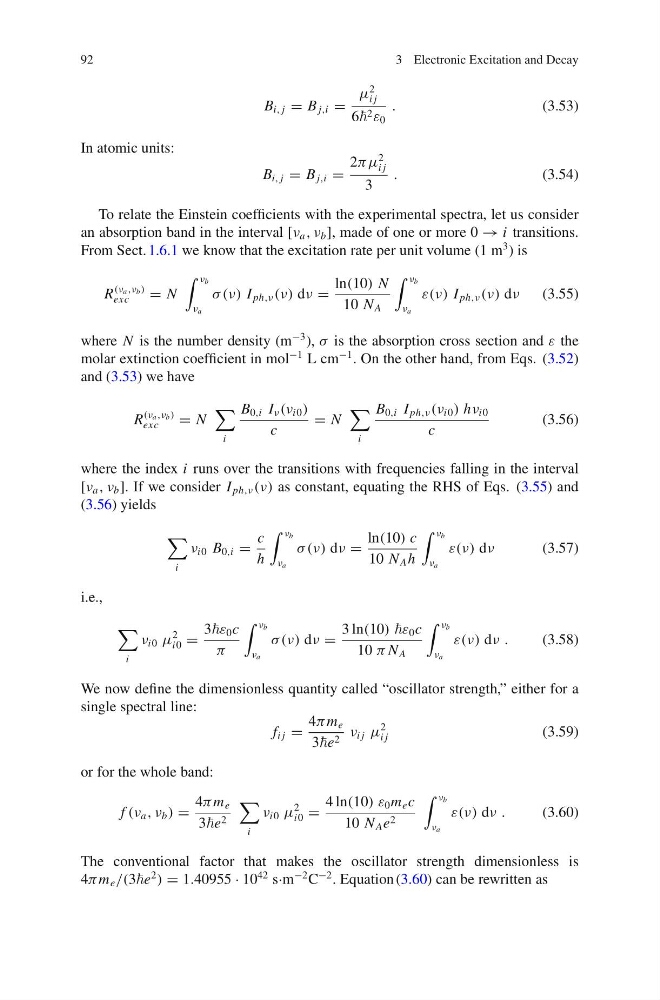
To relate the Einstein coefficients with the experimental spectra, let us consider
an absorption band in the interval [ν a , ν b ], made of one or more 0 → i transitions.
From Sect. 1.6.1 we know that the excitation rate per unit volume (1 m
3 ) is
R
(ν a ,ν b )
exc
= N
ν b
ν a
σ (ν) I ph,ν (ν) dν =
ln(10) N
10 N A
ν b
ν a
ε(ν) I ph,ν (ν) dν
(3.55)
where N is the number density (m
−3 ), σ is the absorption cross section and ε the
molar extinction coefficient in mol
−1 L cm
−1 . On the other hand, from Eqs. (3.52)
and (3.53) we have
R
(ν a ,ν b )
exc
= N
i
B 0,i I ν (ν i0 )
c
= N
i
B 0,i I ph,ν (ν i0 ) hν i0
c
(3.56)
where the index i runs over the transitions with frequencies falling in the interval
[ν a , ν b ]. If we consider I ph,ν (ν) as constant, equating the RHS of Eqs. (3.55) and
(3.56) yields
i
ν i0 B 0,i =
c
h
ν b
ν a
σ (ν) dν =
ln(10) c
10 N A h
ν b
ν a
ε(ν) dν
(3.57)
i.e.,
i
ν i0 μ
2
i0 =
3ε 0 c
π
ν b
ν a
σ (ν) dν =
3 ln(10) ε 0 c
10 π N A
ν b
ν a
ε(ν) dν .
(3.58)
We now define the dimensionless quantity called “oscillator strength,” either for a
single spectral line:
f i j =
4π m e
3e 2 ν i j μ
2
i j
(3.59)
or for the whole band:
f (ν a , ν b ) =
4π m e
3e 2
i
ν i0 μ
2
i0 =
4 ln(10) ε 0 m e c
10 N A e 2
ν b
ν a
ε(ν) dν .
(3.60)
The conventional factor that makes the oscillator strength dimensionless is
4π m e /(3e
2
) = 1.40955 · 10
42 s·m
−2 C
−2 . Equation (3.60) can be rewritten as
3 Electronic Excitation and Decay
B i, j = B j,i =
μ
2
i j
6 2 ε 0
.
(3.53)
In atomic units:
B i, j = B j,i =
2πμ
2
i j
3
.
(3.54)
To relate the Einstein coefficients with the experimental spectra, let us consider
an absorption band in the interval [ν a , ν b ], made of one or more 0 → i transitions.
From Sect. 1.6.1 we know that the excitation rate per unit volume (1 m
3 ) is
R
(ν a ,ν b )
exc
= N
ν b
ν a
σ (ν) I ph,ν (ν) dν =
ln(10) N
10 N A
ν b
ν a
ε(ν) I ph,ν (ν) dν
(3.55)
where N is the number density (m
−3 ), σ is the absorption cross section and ε the
molar extinction coefficient in mol
−1 L cm
−1 . On the other hand, from Eqs. (3.52)
and (3.53) we have
R
(ν a ,ν b )
exc
= N
i
B 0,i I ν (ν i0 )
c
= N
i
B 0,i I ph,ν (ν i0 ) hν i0
c
(3.56)
where the index i runs over the transitions with frequencies falling in the interval
[ν a , ν b ]. If we consider I ph,ν (ν) as constant, equating the RHS of Eqs. (3.55) and
(3.56) yields
i
ν i0 B 0,i =
c
h
ν b
ν a
σ (ν) dν =
ln(10) c
10 N A h
ν b
ν a
ε(ν) dν
(3.57)
i.e.,
i
ν i0 μ
2
i0 =
3ε 0 c
π
ν b
ν a
σ (ν) dν =
3 ln(10) ε 0 c
10 π N A
ν b
ν a
ε(ν) dν .
(3.58)
We now define the dimensionless quantity called “oscillator strength,” either for a
single spectral line:
f i j =
4π m e
3e 2 ν i j μ
2
i j
(3.59)
or for the whole band:
f (ν a , ν b ) =
4π m e
3e 2
i
ν i0 μ
2
i0 =
4 ln(10) ε 0 m e c
10 N A e 2
ν b
ν a
ε(ν) dν .
(3.60)
The conventional factor that makes the oscillator strength dimensionless is
4π m e /(3e
2
) = 1.40955 · 10
42 s·m
−2 C
−2 . Equation (3.60) can be rewritten as