

90
3 Electronic Excitation and Decay
t = 2 ps
t = 1ps
1/ , cm −1
f
( ,t)
-40 -30 -20 -10 0
10 20 30 40
1
0.8
0.6
0.4
0.2
0
1/ = 5cm −1
1/ = 2cm −1
time,ps
f
( ,t)
0
5
10
15
20
25
30
9
8
7
6
5
4
3
2
1
0
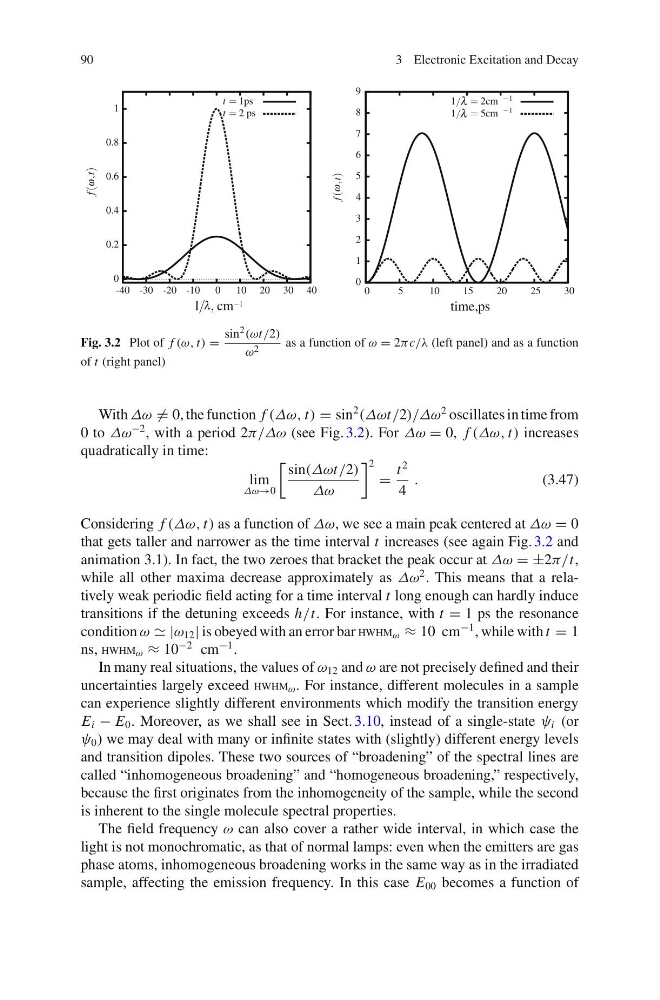
Fig. 3.2 Plot of f (ω, t) =
sin 2 (ωt/2)
ω 2
as a function of ω = 2π c/λ (left panel) and as a function
of t (right panel)
With Δω = 0, the function f (Δω, t) = sin
2
(Δωt/2)/Δω
2 oscillates in time from
0 to Δω
−2 , with a period 2π/Δω (see Fig. 3.2). For Δω = 0, f (Δω, t) increases
quadratically in time:
lim
Δω→0
sin(Δωt/2)
Δω
2
=
t
2
4
.
(3.47)
Considering f (Δω, t) as a function of Δω, we see a main peak centered at Δω = 0
that gets taller and narrower as the time interval t increases (see again Fig. 3.2 and
animation 3.1). In fact, the two zeroes that bracket the peak occur at Δω = ±2π/t,
while all other maxima decrease approximately as Δω
2 . This means that a relatively weak periodic field acting for a time interval t long enough can hardly induce
transitions if the detuning exceeds h/t. For instance, with t = 1 ps the resonance
condition ω |ω 12 | is obeyed with an error bar HWHM ω ≈ 10 cm
−1 , while with t = 1
ns, HWHM ω ≈ 10
−2 cm
−1 .
In many real situations, the values of ω 12 and ω are not precisely defined and their
uncertainties largely exceed HWHM ω . For instance, different molecules in a sample
can experience slightly different environments which modify the transition energy
E i − E 0 . Moreover, as we shall see in Sect. 3.10, instead of a single-state ψ i (or
ψ 0 ) we may deal with many or infinite states with (slightly) different energy levels
and transition dipoles. These two sources of “broadening” of the spectral lines are
called “inhomogeneous broadening” and “homogeneous broadening,” respectively,
because the first originates from the inhomogeneity of the sample, while the second
is inherent to the single molecule spectral properties.
The field frequency ω can also cover a rather wide interval, in which case the
light is not monochromatic, as that of normal lamps: even when the emitters are gas
phase atoms, inhomogeneous broadening works in the same way as in the irradiated
sample, affecting the emission frequency. In this case E 00 becomes a function of
3 Electronic Excitation and Decay
t = 2 ps
t = 1ps
1/ , cm −1
f
( ,t)
-40 -30 -20 -10 0
10 20 30 40
1
0.8
0.6
0.4
0.2
0
1/ = 5cm −1
1/ = 2cm −1
time,ps
f
( ,t)
0
5
10
15
20
25
30
9
8
7
6
5
4
3
2
1
0
Fig. 3.2 Plot of f (ω, t) =
sin 2 (ωt/2)
ω 2
as a function of ω = 2π c/λ (left panel) and as a function
of t (right panel)
With Δω = 0, the function f (Δω, t) = sin
2
(Δωt/2)/Δω
2 oscillates in time from
0 to Δω
−2 , with a period 2π/Δω (see Fig. 3.2). For Δω = 0, f (Δω, t) increases
quadratically in time:
lim
Δω→0
sin(Δωt/2)
Δω
2
=
t
2
4
.
(3.47)
Considering f (Δω, t) as a function of Δω, we see a main peak centered at Δω = 0
that gets taller and narrower as the time interval t increases (see again Fig. 3.2 and
animation 3.1). In fact, the two zeroes that bracket the peak occur at Δω = ±2π/t,
while all other maxima decrease approximately as Δω
2 . This means that a relatively weak periodic field acting for a time interval t long enough can hardly induce
transitions if the detuning exceeds h/t. For instance, with t = 1 ps the resonance
condition ω |ω 12 | is obeyed with an error bar HWHM ω ≈ 10 cm
−1 , while with t = 1
ns, HWHM ω ≈ 10
−2 cm
−1 .
In many real situations, the values of ω 12 and ω are not precisely defined and their
uncertainties largely exceed HWHM ω . For instance, different molecules in a sample
can experience slightly different environments which modify the transition energy
E i − E 0 . Moreover, as we shall see in Sect. 3.10, instead of a single-state ψ i (or
ψ 0 ) we may deal with many or infinite states with (slightly) different energy levels
and transition dipoles. These two sources of “broadening” of the spectral lines are
called “inhomogeneous broadening” and “homogeneous broadening,” respectively,
because the first originates from the inhomogeneity of the sample, while the second
is inherent to the single molecule spectral properties.
The field frequency ω can also cover a rather wide interval, in which case the
light is not monochromatic, as that of normal lamps: even when the emitters are gas
phase atoms, inhomogeneous broadening works in the same way as in the irradiated
sample, affecting the emission frequency. In this case E 00 becomes a function of