

66
2 The Quantum Approach to the Two-Body Problem
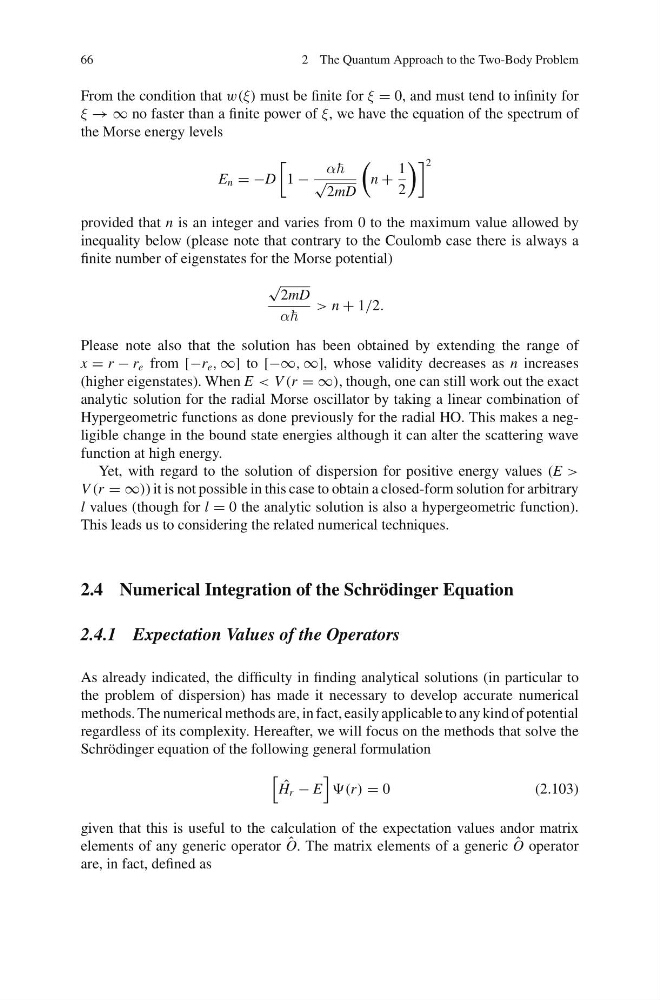
From the condition that w(ξ) must be finite for ξ = 0, and must tend to infinity for
ξ → ∞ no faster than a finite power of ξ, we have the equation of the spectrum of
the Morse energy levels
E n = −D
1 −
α
√
2mD
n +
1
2
2
provided that n is an integer and varies from 0 to the maximum value allowed by
inequality below (please note that contrary to the Coulomb case there is always a
finite number of eigenstates for the Morse potential)
√
2mD
α
> n + 1/2.
Please note also that the solution has been obtained by extending the range of
x = r − r e from [−r e , ∞] to [−∞, ∞], whose validity decreases as n increases
(higher eigenstates). When E < V (r = ∞), though, one can still work out the exact
analytic solution for the radial Morse oscillator by taking a linear combination of
Hypergeometric functions as done previously for the radial HO. This makes a negligible change in the bound state energies although it can alter the scattering wave
function at high energy.
Yet, with regard to the solution of dispersion for positive energy values (E >
V (r = ∞)) it is not possible in this case to obtain a closed-form solution for arbitrary
l values (though for l = 0 the analytic solution is also a hypergeometric function).
This leads us to considering the related numerical techniques.
2.4 Numerical Integration of the Schrödinger Equation
2.4.1 Expectation Values of the Operators
As already indicated, the difficulty in finding analytical solutions (in particular to
the problem of dispersion) has made it necessary to develop accurate numerical
methods. The numerical methods are, in fact, easily applicable to any kind of potential
regardless of its complexity. Hereafter, we will focus on the methods that solve the
Schrödinger equation of the following general formulation
ˆ
H r − E
(r) = 0
(2.103)
given that this is useful to the calculation of the expectation values andor matrix
elements of any generic operator ˆ
O. The matrix elements of a generic ˆ
O operator
are, in fact, defined as
2 The Quantum Approach to the Two-Body Problem
From the condition that w(ξ) must be finite for ξ = 0, and must tend to infinity for
ξ → ∞ no faster than a finite power of ξ, we have the equation of the spectrum of
the Morse energy levels
E n = −D
1 −
α
√
2mD
n +
1
2
2
provided that n is an integer and varies from 0 to the maximum value allowed by
inequality below (please note that contrary to the Coulomb case there is always a
finite number of eigenstates for the Morse potential)
√
2mD
α
> n + 1/2.
Please note also that the solution has been obtained by extending the range of
x = r − r e from [−r e , ∞] to [−∞, ∞], whose validity decreases as n increases
(higher eigenstates). When E < V (r = ∞), though, one can still work out the exact
analytic solution for the radial Morse oscillator by taking a linear combination of
Hypergeometric functions as done previously for the radial HO. This makes a negligible change in the bound state energies although it can alter the scattering wave
function at high energy.
Yet, with regard to the solution of dispersion for positive energy values (E >
V (r = ∞)) it is not possible in this case to obtain a closed-form solution for arbitrary
l values (though for l = 0 the analytic solution is also a hypergeometric function).
This leads us to considering the related numerical techniques.
2.4 Numerical Integration of the Schrödinger Equation
2.4.1 Expectation Values of the Operators
As already indicated, the difficulty in finding analytical solutions (in particular to
the problem of dispersion) has made it necessary to develop accurate numerical
methods. The numerical methods are, in fact, easily applicable to any kind of potential
regardless of its complexity. Hereafter, we will focus on the methods that solve the
Schrödinger equation of the following general formulation
ˆ
H r − E
(r) = 0
(2.103)
given that this is useful to the calculation of the expectation values andor matrix
elements of any generic operator ˆ
O. The matrix elements of a generic ˆ
O operator
are, in fact, defined as