

2.2 Quantum Elastic Scattering
59
0.00
0.50
1.00
1.50
2.00
2.50
0.0
5.0
10.0
15.0
20.0
25.0
30.0
V(r)
r
Ψ1
Ψ2
a1
a2
U1
U2
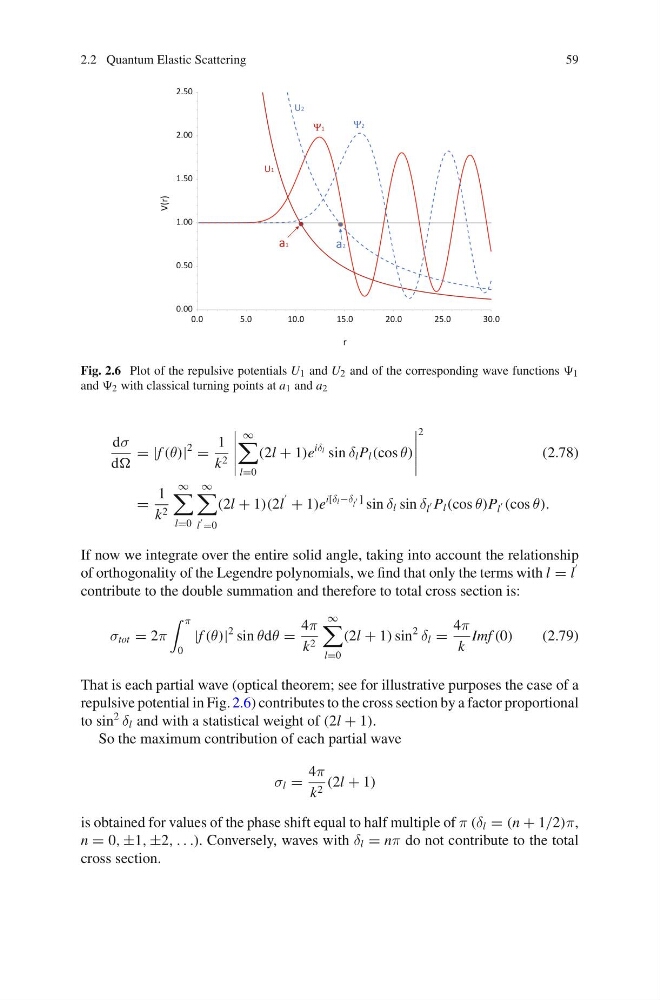
Fig. 2.6 Plot of the repulsive potentials U 1 and U 2 and of the corresponding wave functions 1
and 2 with classical turning points at a 1 and a 2
dσ
d
= |f (θ)|
2
=
1
k 2
∞
l=0
(2l + 1)e
iδ l sin δ l P l (cos θ)
2
(2.78)
=
1
k 2
∞
l=0
∞
l
=0
(2l + 1)(2l
+ 1)e
i[δ l −δ l
] sin δ l sin δ l
P l (cos θ)P l
(cos θ).
If now we integrate over the entire solid angle, taking into account the relationship
of orthogonality of the Legendre polynomials, we find that only the terms with l = l
contribute to the double summation and therefore to total cross section is:
σ tot = 2π
π
0
|f (θ)|
2 sin θdθ =
4π
k 2
∞
l=0
(2l + 1) sin
2
δ l =
4π
k
Imf (0)
(2.79)
That is each partial wave (optical theorem; see for illustrative purposes the case of a
repulsive potential in Fig. 2.6) contributes to the cross section by a factor proportional
to sin
2
δ l and with a statistical weight of (2l + 1).
So the maximum contribution of each partial wave
σ l =
4π
k 2 (2l + 1)
is obtained for values of the phase shift equal to half multiple of π (δ l = (n + 1/2)π,
n = 0, ±1, ±2, . . .). Conversely, waves with δ l = nπ do not contribute to the total
cross section.
59
0.00
0.50
1.00
1.50
2.00
2.50
0.0
5.0
10.0
15.0
20.0
25.0
30.0
V(r)
r
Ψ1
Ψ2
a1
a2
U1
U2
Fig. 2.6 Plot of the repulsive potentials U 1 and U 2 and of the corresponding wave functions 1
and 2 with classical turning points at a 1 and a 2
dσ
d
= |f (θ)|
2
=
1
k 2
∞
l=0
(2l + 1)e
iδ l sin δ l P l (cos θ)
2
(2.78)
=
1
k 2
∞
l=0
∞
l
=0
(2l + 1)(2l
+ 1)e
i[δ l −δ l
] sin δ l sin δ l
P l (cos θ)P l
(cos θ).
If now we integrate over the entire solid angle, taking into account the relationship
of orthogonality of the Legendre polynomials, we find that only the terms with l = l
contribute to the double summation and therefore to total cross section is:
σ tot = 2π
π
0
|f (θ)|
2 sin θdθ =
4π
k 2
∞
l=0
(2l + 1) sin
2
δ l =
4π
k
Imf (0)
(2.79)
That is each partial wave (optical theorem; see for illustrative purposes the case of a
repulsive potential in Fig. 2.6) contributes to the cross section by a factor proportional
to sin
2
δ l and with a statistical weight of (2l + 1).
So the maximum contribution of each partial wave
σ l =
4π
k 2 (2l + 1)
is obtained for values of the phase shift equal to half multiple of π (δ l = (n + 1/2)π,
n = 0, ±1, ±2, . . .). Conversely, waves with δ l = nπ do not contribute to the total
cross section.