

58
2 The Quantum Approach to the Two-Body Problem
∞
l=0
(2l + 1)P l (cos θ) = 0 to θ = 0
(2.72)
then we can rewrite the scattering amplitude as (remembering that P l (1) = (−1)
l )
f (θ) =
⎧
⎨
⎩
1
2ik
∞
l=0 (2l + 1)S l P l (cos θ) for θ = 0
1
k
∞
l=0 (2l + 1) sin δ l e
iδ l
for θ = 0
(2.73)
2.2.3 The Quantum Elastic Scattering Cross Section
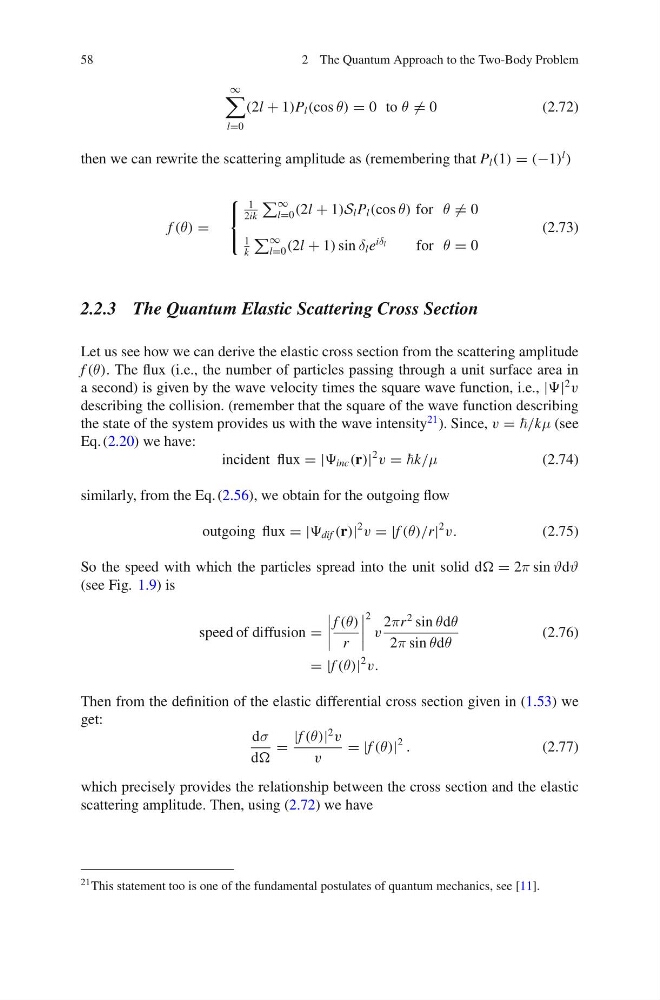
Let us see how we can derive the elastic cross section from the scattering amplitude
f (θ). The flux (i.e., the number of particles passing through a unit surface area in
a second) is given by the wave velocity times the square wave function, i.e., ||
2
v
describing the collision. (remember that the square of the wave function describing
the state of the system provides us with the wave intensity
21 ). Since, v = /kμ (see
Eq. (2.20) we have:
incident flux = | inc (r)|
2
v = k/μ
(2.74)
similarly, from the Eq. (2.56), we obtain for the outgoing flow
outgoing flux = | dif (r)|
2
v = |f (θ)/r|
2
v.
(2.75)
So the speed with which the particles spread into the unit solid d = 2π sin ϑdϑ
(see Fig. 1.9) is
speed of diffusion =
f (θ)
r
2
v
2πr
2 sin θdθ
2π sin θdθ
(2.76)
= |f (θ)|
2
v.
Then from the definition of the elastic differential cross section given in (1.53) we
get:
dσ
d
=
|f (θ)|
2
v
v
= |f (θ)|
2
.
(2.77)
which precisely provides the relationship between the cross section and the elastic
scattering amplitude. Then, using (2.72) we have
21 This statement too is one of the fundamental postulates of quantum mechanics, see [11].
2 The Quantum Approach to the Two-Body Problem
∞
l=0
(2l + 1)P l (cos θ) = 0 to θ = 0
(2.72)
then we can rewrite the scattering amplitude as (remembering that P l (1) = (−1)
l )
f (θ) =
⎧
⎨
⎩
1
2ik
∞
l=0 (2l + 1)S l P l (cos θ) for θ = 0
1
k
∞
l=0 (2l + 1) sin δ l e
iδ l
for θ = 0
(2.73)
2.2.3 The Quantum Elastic Scattering Cross Section
Let us see how we can derive the elastic cross section from the scattering amplitude
f (θ). The flux (i.e., the number of particles passing through a unit surface area in
a second) is given by the wave velocity times the square wave function, i.e., ||
2
v
describing the collision. (remember that the square of the wave function describing
the state of the system provides us with the wave intensity
21 ). Since, v = /kμ (see
Eq. (2.20) we have:
incident flux = | inc (r)|
2
v = k/μ
(2.74)
similarly, from the Eq. (2.56), we obtain for the outgoing flow
outgoing flux = | dif (r)|
2
v = |f (θ)/r|
2
v.
(2.75)
So the speed with which the particles spread into the unit solid d = 2π sin ϑdϑ
(see Fig. 1.9) is
speed of diffusion =
f (θ)
r
2
v
2πr
2 sin θdθ
2π sin θdθ
(2.76)
= |f (θ)|
2
v.
Then from the definition of the elastic differential cross section given in (1.53) we
get:
dσ
d
=
|f (θ)|
2
v
v
= |f (θ)|
2
.
(2.77)
which precisely provides the relationship between the cross section and the elastic
scattering amplitude. Then, using (2.72) we have
21 This statement too is one of the fundamental postulates of quantum mechanics, see [11].