

2.2 Quantum Elastic Scattering
53
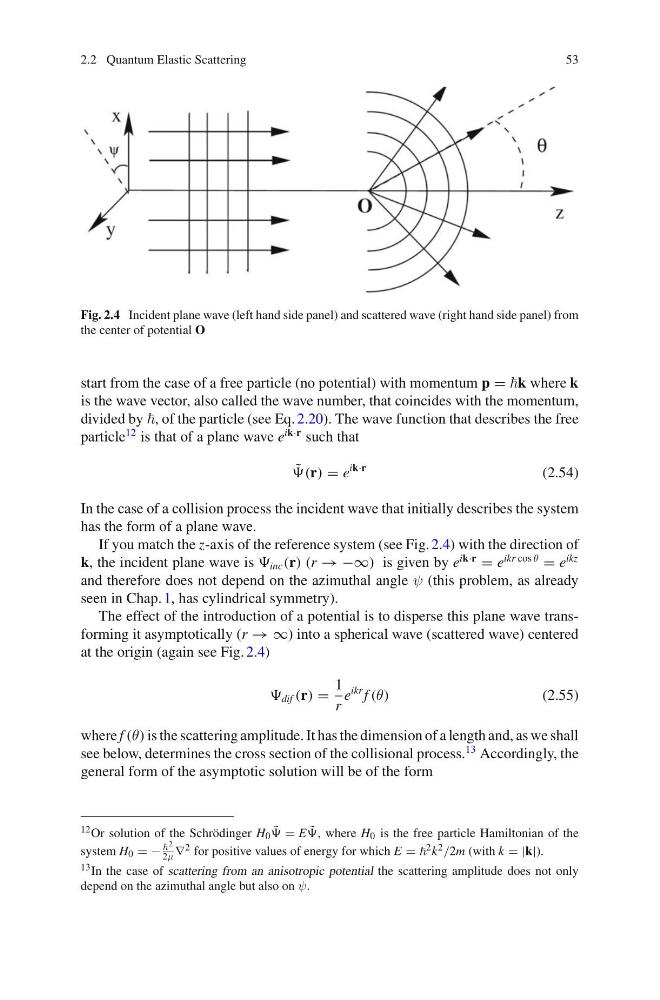
Fig. 2.4 Incident plane wave (left hand side panel) and scattered wave (right hand side panel) from
the center of potential O
start from the case of a free particle (no potential) with momentum p = k where k
is the wave vector, also called the wave number, that coincides with the momentum,
divided by , of the particle (see Eq. 2.20). The wave function that describes the free
particle
12 is that of a plane wave e
ik·r such that
˜
(r) = e
ik·r
(2.54)
In the case of a collision process the incident wave that initially describes the system
has the form of a plane wave.
If you match the z-axis of the reference system (see Fig. 2.4) with the direction of
k, the incident plane wave is inc (r) (r → −∞) is given by e
ik·r
= e
ikr cos θ
= e
ikz
and therefore does not depend on the azimuthal angle ψ (this problem, as already
seen in Chap. 1, has cylindrical symmetry).
The effect of the introduction of a potential is to disperse this plane wave transforming it asymptotically (r → ∞) into a spherical wave (scattered wave) centered
at the origin (again see Fig. 2.4)
dif (r) =
1
r
e
ikr f (θ)
(2.55)
where f (θ) is the scattering amplitude. It has the dimension of a length and, as we shall
see below, determines the cross section of the collisional process.
13 Accordingly, the
general form of the asymptotic solution will be of the form
12 Or solution of the Schrödinger H 0 ˜
= E ˜
, where H 0 is the free particle Hamiltonian of the
system H 0 = −
2
2μ ∇ 2 for positive values of energy for which E = 2 k 2 /2m (with k = |k|).
13 In the case of scattering from an anisotropic potential the scattering amplitude does not only
depend on the azimuthal angle but also on ψ.
53
Fig. 2.4 Incident plane wave (left hand side panel) and scattered wave (right hand side panel) from
the center of potential O
start from the case of a free particle (no potential) with momentum p = k where k
is the wave vector, also called the wave number, that coincides with the momentum,
divided by , of the particle (see Eq. 2.20). The wave function that describes the free
particle
12 is that of a plane wave e
ik·r such that
˜
(r) = e
ik·r
(2.54)
In the case of a collision process the incident wave that initially describes the system
has the form of a plane wave.
If you match the z-axis of the reference system (see Fig. 2.4) with the direction of
k, the incident plane wave is inc (r) (r → −∞) is given by e
ik·r
= e
ikr cos θ
= e
ikz
and therefore does not depend on the azimuthal angle ψ (this problem, as already
seen in Chap. 1, has cylindrical symmetry).
The effect of the introduction of a potential is to disperse this plane wave transforming it asymptotically (r → ∞) into a spherical wave (scattered wave) centered
at the origin (again see Fig. 2.4)
dif (r) =
1
r
e
ikr f (θ)
(2.55)
where f (θ) is the scattering amplitude. It has the dimension of a length and, as we shall
see below, determines the cross section of the collisional process.
13 Accordingly, the
general form of the asymptotic solution will be of the form
12 Or solution of the Schrödinger H 0 ˜
= E ˜
, where H 0 is the free particle Hamiltonian of the
system H 0 = −
2
2μ ∇ 2 for positive values of energy for which E = 2 k 2 /2m (with k = |k|).
13 In the case of scattering from an anisotropic potential the scattering amplitude does not only
depend on the azimuthal angle but also on ψ.