

2.2 Quantum Elastic Scattering
51
l=2
n=3
m=1
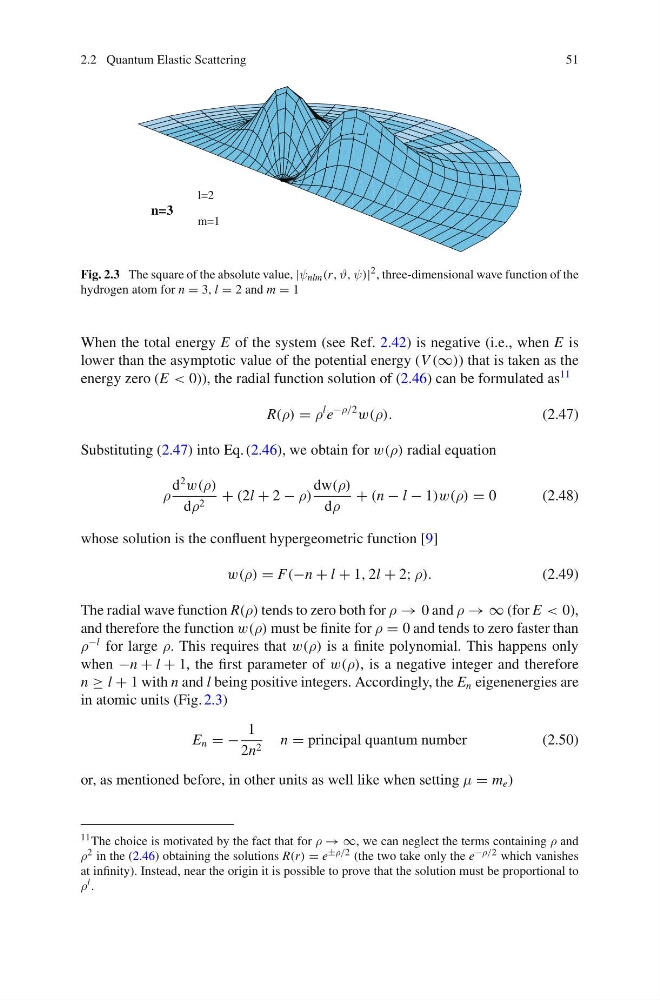
Fig. 2.3 The square of the absolute value, |ψ nlm (r, ϑ, ψ)|
2 , three-dimensional wave function of the
hydrogen atom for n = 3, l = 2 and m = 1
When the total energy E of the system (see Ref. 2.42) is negative (i.e., when E is
lower than the asymptotic value of the potential energy (V (∞)) that is taken as the
energy zero (E < 0)), the radial function solution of (2.46) can be formulated as
11
R(ρ) = ρ
l e
−ρ/2
w(ρ).
(2.47)
Substituting (2.47) into Eq. (2.46), we obtain for w(ρ) radial equation
ρ
d
2
w(ρ)
dρ 2 + (2l + 2 − ρ)
dw(ρ)
dρ
+ (n − l − 1)w(ρ) = 0
(2.48)
whose solution is the confluent hypergeometric function [9]
w(ρ) = F(−n + l + 1, 2l + 2; ρ).
(2.49)
The radial wave function R(ρ) tends to zero both for ρ → 0 and ρ → ∞ (for E < 0),
and therefore the function w(ρ) must be finite for ρ = 0 and tends to zero faster than
ρ
−l for large ρ. This requires that w(ρ) is a finite polynomial. This happens only
when −n + l + 1, the first parameter of w(ρ), is a negative integer and therefore
n ≥ l + 1 with n and l being positive integers. Accordingly, the E n eigenenergies are
in atomic units (Fig. 2.3)
E n = −
1
2n 2 n = principal quantum number
(2.50)
or, as mentioned before, in other units as well like when setting μ = m e )
11 The choice is motivated by the fact that for ρ → ∞, we can neglect the terms containing ρ and
ρ 2 in the (2.46) obtaining the solutions R(r) = e ±ρ/2 (the two take only the e −ρ/2 which vanishes
at infinity). Instead, near the origin it is possible to prove that the solution must be proportional to
ρ l .
51
l=2
n=3
m=1
Fig. 2.3 The square of the absolute value, |ψ nlm (r, ϑ, ψ)|
2 , three-dimensional wave function of the
hydrogen atom for n = 3, l = 2 and m = 1
When the total energy E of the system (see Ref. 2.42) is negative (i.e., when E is
lower than the asymptotic value of the potential energy (V (∞)) that is taken as the
energy zero (E < 0)), the radial function solution of (2.46) can be formulated as
11
R(ρ) = ρ
l e
−ρ/2
w(ρ).
(2.47)
Substituting (2.47) into Eq. (2.46), we obtain for w(ρ) radial equation
ρ
d
2
w(ρ)
dρ 2 + (2l + 2 − ρ)
dw(ρ)
dρ
+ (n − l − 1)w(ρ) = 0
(2.48)
whose solution is the confluent hypergeometric function [9]
w(ρ) = F(−n + l + 1, 2l + 2; ρ).
(2.49)
The radial wave function R(ρ) tends to zero both for ρ → 0 and ρ → ∞ (for E < 0),
and therefore the function w(ρ) must be finite for ρ = 0 and tends to zero faster than
ρ
−l for large ρ. This requires that w(ρ) is a finite polynomial. This happens only
when −n + l + 1, the first parameter of w(ρ), is a negative integer and therefore
n ≥ l + 1 with n and l being positive integers. Accordingly, the E n eigenenergies are
in atomic units (Fig. 2.3)
E n = −
1
2n 2 n = principal quantum number
(2.50)
or, as mentioned before, in other units as well like when setting μ = m e )
11 The choice is motivated by the fact that for ρ → ∞, we can neglect the terms containing ρ and
ρ 2 in the (2.46) obtaining the solutions R(r) = e ±ρ/2 (the two take only the e −ρ/2 which vanishes
at infinity). Instead, near the origin it is possible to prove that the solution must be proportional to
ρ l .