

50
2 The Quantum Approach to the Two-Body Problem
closed form. For both the hydrogen atom (one proton) and for a high lying Rydberg
state of a many-electron atom, Z = 1 and the interaction is attractive
8
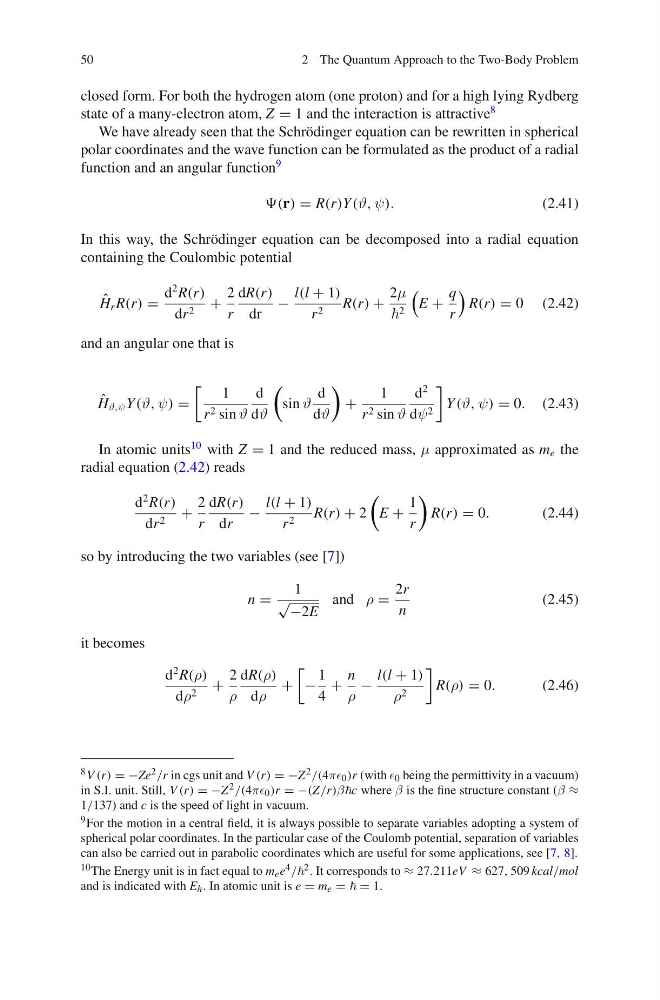
We have already seen that the Schrödinger equation can be rewritten in spherical
polar coordinates and the wave function can be formulated as the product of a radial
function and an angular function
9
(r) = R(r)Y (ϑ, ψ).
(2.41)
In this way, the Schrödinger equation can be decomposed into a radial equation
containing the Coulombic potential
ˆ
H r R(r) =
d
2 R(r)
dr 2 +
2
r
dR(r)
dr
−
l(l + 1)
r 2 R(r) +
2μ
2
E +
q
r
R(r) = 0 (2.42)
and an angular one that is
ˆ
H ϑ,ψ Y (ϑ, ψ) =
1
r 2 sin ϑ
d
dϑ
sin ϑ
d
dϑ
+
1
r 2 sin ϑ
d
2
dψ 2
Y (ϑ, ψ) = 0. (2.43)
In atomic units
10 with Z = 1 and the reduced mass, μ approximated as m e the
radial equation (2.42) reads
d
2 R(r)
dr 2 +
2
r
dR(r)
dr
−
l(l + 1)
r 2 R(r) + 2
E +
1
r
R(r) = 0.
(2.44)
so by introducing the two variables (see [7])
n =
1
√
−2E
and ρ =
2r
n
(2.45)
it becomes
d
2 R(ρ)
dρ 2 +
2
ρ
dR(ρ)
dρ
+
−
1
4
+
n
ρ
−
l(l + 1)
ρ 2
R(ρ) = 0.
(2.46)
8 V (r) = −Ze 2 /r in cgs unit and V (r) = −Z 2 /(4ππ 0 )r (with 0 being the permittivity in a vacuum)
in S.I. unit. Still, V (r) = −Z 2 /(4ππ 0 )r = −(Z/r)βc where β is the fine structure constant (β ≈
1/137) and c is the speed of light in vacuum.
9 For the motion in a central field, it is always possible to separate variables adopting a system of
spherical polar coordinates. In the particular case of the Coulomb potential, separation of variables
can also be carried out in parabolic coordinates which are useful for some applications, see [7, 8].
10 The Energy unit is in fact equal to m e e 4 / 2 . It corresponds to ≈ 27.211eV ≈ 627, 509 kcal/mol
and is indicated with E h . In atomic unit is e = m e = = 1.
2 The Quantum Approach to the Two-Body Problem
closed form. For both the hydrogen atom (one proton) and for a high lying Rydberg
state of a many-electron atom, Z = 1 and the interaction is attractive
8
We have already seen that the Schrödinger equation can be rewritten in spherical
polar coordinates and the wave function can be formulated as the product of a radial
function and an angular function
9
(r) = R(r)Y (ϑ, ψ).
(2.41)
In this way, the Schrödinger equation can be decomposed into a radial equation
containing the Coulombic potential
ˆ
H r R(r) =
d
2 R(r)
dr 2 +
2
r
dR(r)
dr
−
l(l + 1)
r 2 R(r) +
2μ
2
E +
q
r
R(r) = 0 (2.42)
and an angular one that is
ˆ
H ϑ,ψ Y (ϑ, ψ) =
1
r 2 sin ϑ
d
dϑ
sin ϑ
d
dϑ
+
1
r 2 sin ϑ
d
2
dψ 2
Y (ϑ, ψ) = 0. (2.43)
In atomic units
10 with Z = 1 and the reduced mass, μ approximated as m e the
radial equation (2.42) reads
d
2 R(r)
dr 2 +
2
r
dR(r)
dr
−
l(l + 1)
r 2 R(r) + 2
E +
1
r
R(r) = 0.
(2.44)
so by introducing the two variables (see [7])
n =
1
√
−2E
and ρ =
2r
n
(2.45)
it becomes
d
2 R(ρ)
dρ 2 +
2
ρ
dR(ρ)
dρ
+
−
1
4
+
n
ρ
−
l(l + 1)
ρ 2
R(ρ) = 0.
(2.46)
8 V (r) = −Ze 2 /r in cgs unit and V (r) = −Z 2 /(4ππ 0 )r (with 0 being the permittivity in a vacuum)
in S.I. unit. Still, V (r) = −Z 2 /(4ππ 0 )r = −(Z/r)βc where β is the fine structure constant (β ≈
1/137) and c is the speed of light in vacuum.
9 For the motion in a central field, it is always possible to separate variables adopting a system of
spherical polar coordinates. In the particular case of the Coulomb potential, separation of variables
can also be carried out in parabolic coordinates which are useful for some applications, see [7, 8].
10 The Energy unit is in fact equal to m e e 4 / 2 . It corresponds to ≈ 27.211eV ≈ 627, 509 kcal/mol
and is indicated with E h . In atomic unit is e = m e = = 1.