

44
2 The Quantum Approach to the Two-Body Problem
U (r) =
2μV (r)
2
and k is the modulus of the wave vector of the incident particle
k =
2μ
2 E
1/2
=
2πμv
h
.
(2.20)
There are different techniques to solve the stationary Schrödinger equation.
2 The
Schrödinger equation (2.19) is a second-order partial differential equation (PDE) of
elliptic type. Its integration is carried out, usually, either using numerical techniques
or separating variables. In this regard, the Laplacian operator ∇
2
r is expressed in
spherical polar coordinates
3 (r, ϑ, ψ) as illustrated in the LHS scheme of Fig. 1.5
∇
2
r =
1
r 2
∂
∂r
r
2 ∂
∂r
+
1
r 2 sin ϑ
∂
∂ϑ
sin ϑ
∂
∂ϑ
+
1
r 2 sin ϑ
∂
2
∂ψ 2
(2.21)
whose component in r can also be written (see Appendix A2) as
∂
2
∂r 2 +
2
r
∂
∂r
=
1
r
d
2
dr 2 r
(2.22)
Equation 2.22 is particularly useful in different situations as we will see later in this
text.
The function (r) is, in turn, expressed as a product of a radial term R(r) and an
angular term Y (ϑ, ψ)
(r) = R(r)Y (ϑ, ψ).
(2.23)
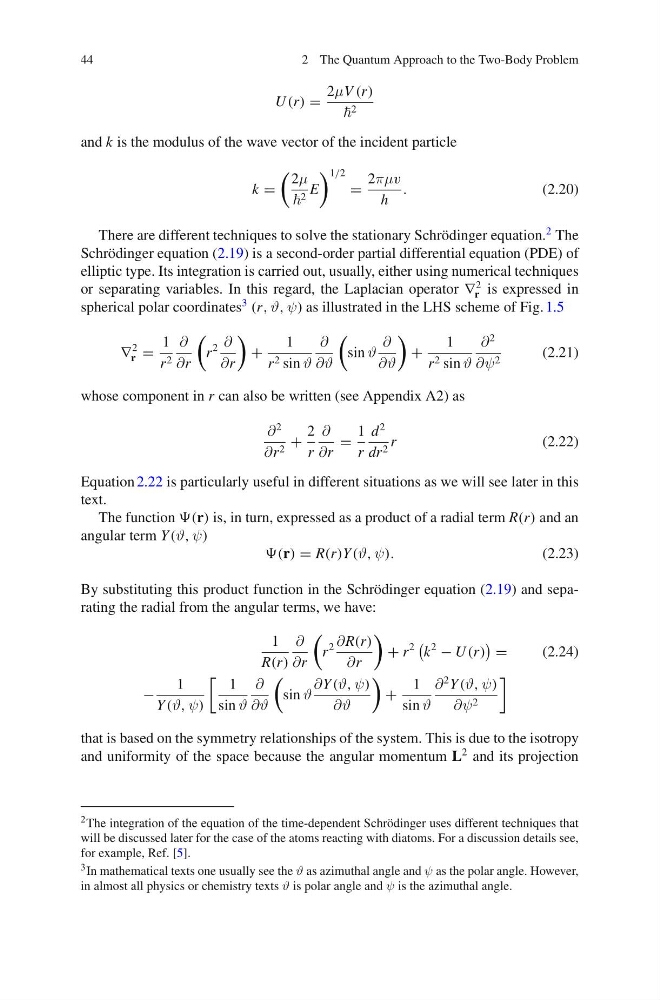
By substituting this product function in the Schrödinger equation (2.19) and separating the radial from the angular terms, we have:
1
R(r)
∂
∂r
r
2 ∂R(r)
∂r
+ r
2
k
2
− U (r)
=
(2.24)
−
1
Y (ϑ, ψ)
1
sin ϑ
∂
∂ϑ
sin ϑ
∂Y (ϑ, ψ)
∂ϑ
+
1
sin ϑ
∂
2 Y (ϑ, ψ)
∂ψ 2
that is based on the symmetry relationships of the system. This is due to the isotropy
and uniformity of the space because the angular momentum L
2 and its projection
2 The integration of the equation of the time-dependent Schrödinger uses different techniques that
will be discussed later for the case of the atoms reacting with diatoms. For a discussion details see,
for example, Ref. [5].
3 In mathematical texts one usually see the ϑ as azimuthal angle and ψ as the polar angle. However,
in almost all physics or chemistry texts ϑ is polar angle and ψ is the azimuthal angle.
2 The Quantum Approach to the Two-Body Problem
U (r) =
2μV (r)
2
and k is the modulus of the wave vector of the incident particle
k =
2μ
2 E
1/2
=
2πμv
h
.
(2.20)
There are different techniques to solve the stationary Schrödinger equation.
2 The
Schrödinger equation (2.19) is a second-order partial differential equation (PDE) of
elliptic type. Its integration is carried out, usually, either using numerical techniques
or separating variables. In this regard, the Laplacian operator ∇
2
r is expressed in
spherical polar coordinates
3 (r, ϑ, ψ) as illustrated in the LHS scheme of Fig. 1.5
∇
2
r =
1
r 2
∂
∂r
r
2 ∂
∂r
+
1
r 2 sin ϑ
∂
∂ϑ
sin ϑ
∂
∂ϑ
+
1
r 2 sin ϑ
∂
2
∂ψ 2
(2.21)
whose component in r can also be written (see Appendix A2) as
∂
2
∂r 2 +
2
r
∂
∂r
=
1
r
d
2
dr 2 r
(2.22)
Equation 2.22 is particularly useful in different situations as we will see later in this
text.
The function (r) is, in turn, expressed as a product of a radial term R(r) and an
angular term Y (ϑ, ψ)
(r) = R(r)Y (ϑ, ψ).
(2.23)
By substituting this product function in the Schrödinger equation (2.19) and separating the radial from the angular terms, we have:
1
R(r)
∂
∂r
r
2 ∂R(r)
∂r
+ r
2
k
2
− U (r)
=
(2.24)
−
1
Y (ϑ, ψ)
1
sin ϑ
∂
∂ϑ
sin ϑ
∂Y (ϑ, ψ)
∂ϑ
+
1
sin ϑ
∂
2 Y (ϑ, ψ)
∂ψ 2
that is based on the symmetry relationships of the system. This is due to the isotropy
and uniformity of the space because the angular momentum L
2 and its projection
2 The integration of the equation of the time-dependent Schrödinger uses different techniques that
will be discussed later for the case of the atoms reacting with diatoms. For a discussion details see,
for example, Ref. [5].
3 In mathematical texts one usually see the ϑ as azimuthal angle and ψ as the polar angle. However,
in almost all physics or chemistry texts ϑ is polar angle and ψ is the azimuthal angle.