

2.1 Quantum Mechanics and Bound States
43
the Heisenberg uncertainty principle) to give a description of the system which is
distributed in space with a probability of finding the system in the corresponding configuration proportional to the square modulus of the wave function . The properties
of are determined by applying the appropriate operators (corresponding quantum
operators of classical variables). In the Cartesian coordinate system, these operators
take simple forms (ˆ p x , the momentum operator along x, becomes −i(∂/∂x) for
which the corresponding kinetic term of the Hamiltonian becomes −
2
/2μ(∂
2
/∂x
2 )
and in the case of a system of two particles that, as already shown, is isomorphic to
the problem of a particle of mass μ subject to the central potential V (r) is described
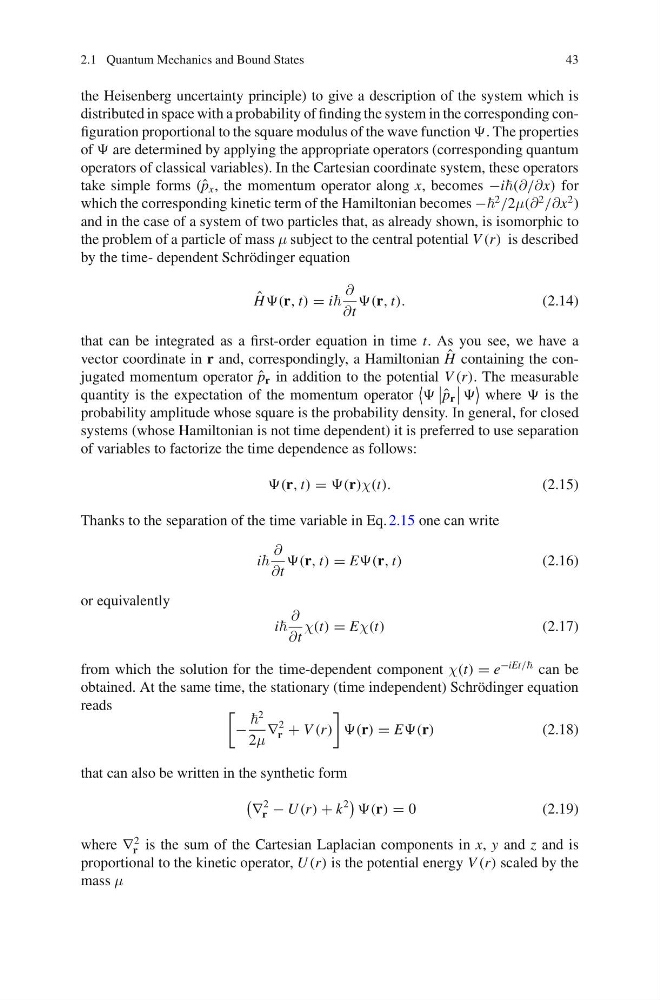
by the time- dependent Schrödinger equation
ˆ
H(r, t) = i
∂
∂t
(r, t).
(2.14)
that can be integrated as a first-order equation in time t. As you see, we have a
vector coordinate in r and, correspondingly, a Hamiltonian ˆ
H containing the conjugated momentum operator ˆ
p r in addition to the potential V (r). The measurable
quantity is the expectation of the momentum operator
ˆ
p r
where is the
probability amplitude whose square is the probability density. In general, for closed
systems (whose Hamiltonian is not time dependent) it is preferred to use separation
of variables to factorize the time dependence as follows:
(r, t) = (r)χ(t).
(2.15)
Thanks to the separation of the time variable in Eq. 2.15 one can write
i
∂
∂t
(r, t) = E(r, t)
(2.16)
or equivalently
i
∂
∂t
χ(t) = Eχ(t)
(2.17)
from which the solution for the time-dependent component χ(t) = e
−iEt/ can be
obtained. At the same time, the stationary (time independent) Schrödinger equation
reads
−
2
2μ
∇
2
r + V (r)
(r) = E(r)
(2.18)
that can also be written in the synthetic form
∇
2
r − U (r) + k
2
(r) = 0
(2.19)
where ∇
2
r is the sum of the Cartesian Laplacian components in x, y and z and is
proportional to the kinetic operator, U (r) is the potential energy V (r) scaled by the
mass μ
43
the Heisenberg uncertainty principle) to give a description of the system which is
distributed in space with a probability of finding the system in the corresponding configuration proportional to the square modulus of the wave function . The properties
of are determined by applying the appropriate operators (corresponding quantum
operators of classical variables). In the Cartesian coordinate system, these operators
take simple forms (ˆ p x , the momentum operator along x, becomes −i(∂/∂x) for
which the corresponding kinetic term of the Hamiltonian becomes −
2
/2μ(∂
2
/∂x
2 )
and in the case of a system of two particles that, as already shown, is isomorphic to
the problem of a particle of mass μ subject to the central potential V (r) is described
by the time- dependent Schrödinger equation
ˆ
H(r, t) = i
∂
∂t
(r, t).
(2.14)
that can be integrated as a first-order equation in time t. As you see, we have a
vector coordinate in r and, correspondingly, a Hamiltonian ˆ
H containing the conjugated momentum operator ˆ
p r in addition to the potential V (r). The measurable
quantity is the expectation of the momentum operator
ˆ
p r
where is the
probability amplitude whose square is the probability density. In general, for closed
systems (whose Hamiltonian is not time dependent) it is preferred to use separation
of variables to factorize the time dependence as follows:
(r, t) = (r)χ(t).
(2.15)
Thanks to the separation of the time variable in Eq. 2.15 one can write
i
∂
∂t
(r, t) = E(r, t)
(2.16)
or equivalently
i
∂
∂t
χ(t) = Eχ(t)
(2.17)
from which the solution for the time-dependent component χ(t) = e
−iEt/ can be
obtained. At the same time, the stationary (time independent) Schrödinger equation
reads
−
2
2μ
∇
2
r + V (r)
(r) = E(r)
(2.18)
that can also be written in the synthetic form
∇
2
r − U (r) + k
2
(r) = 0
(2.19)
where ∇
2
r is the sum of the Cartesian Laplacian components in x, y and z and is
proportional to the kinetic operator, U (r) is the potential energy V (r) scaled by the
mass μ