

42
2 The Quantum Approach to the Two-Body Problem
differential cross section
scattering angle
Exact quantum
sin classical component
rainbow component
d /db=0 singularity
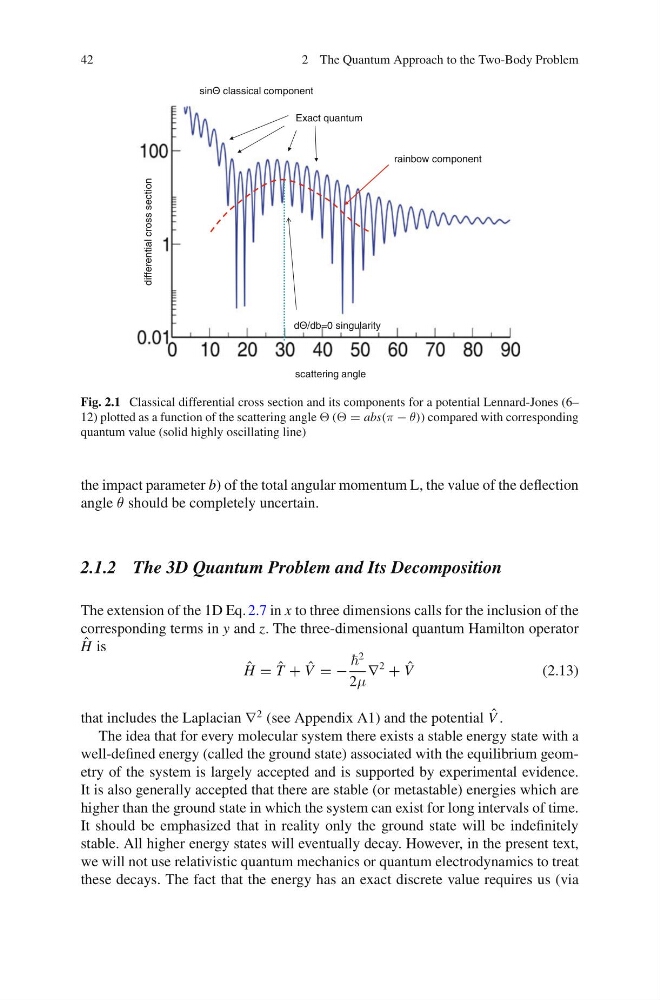
Fig. 2.1 Classical differential cross section and its components for a potential Lennard-Jones (6–
12) plotted as a function of the scattering angle ( = abs(π − θ)) compared with corresponding
quantum value (solid highly oscillating line)
the impact parameter b) of the total angular momentum L, the value of the deflection
angle θ should be completely uncertain.
2.1.2 The 3D Quantum Problem and Its Decomposition
The extension of the 1D Eq. 2.7 in x to three dimensions calls for the inclusion of the
corresponding terms in y and z. The three-dimensional quantum Hamilton operator
ˆ
H is
ˆ
H = ˆ
T + ˆ
V = −
2
2μ
∇
2
+ ˆ
V
(2.13)
that includes the Laplacian ∇
2 (see Appendix A1) and the potential ˆ
V .
The idea that for every molecular system there exists a stable energy state with a
well-defined energy (called the ground state) associated with the equilibrium geometry of the system is largely accepted and is supported by experimental evidence.
It is also generally accepted that there are stable (or metastable) energies which are
higher than the ground state in which the system can exist for long intervals of time.
It should be emphasized that in reality only the ground state will be indefinitely
stable. All higher energy states will eventually decay. However, in the present text,
we will not use relativistic quantum mechanics or quantum electrodynamics to treat
these decays. The fact that the energy has an exact discrete value requires us (via
2 The Quantum Approach to the Two-Body Problem
differential cross section
scattering angle
Exact quantum
sin classical component
rainbow component
d /db=0 singularity
Fig. 2.1 Classical differential cross section and its components for a potential Lennard-Jones (6–
12) plotted as a function of the scattering angle ( = abs(π − θ)) compared with corresponding
quantum value (solid highly oscillating line)
the impact parameter b) of the total angular momentum L, the value of the deflection
angle θ should be completely uncertain.
2.1.2 The 3D Quantum Problem and Its Decomposition
The extension of the 1D Eq. 2.7 in x to three dimensions calls for the inclusion of the
corresponding terms in y and z. The three-dimensional quantum Hamilton operator
ˆ
H is
ˆ
H = ˆ
T + ˆ
V = −
2
2μ
∇
2
+ ˆ
V
(2.13)
that includes the Laplacian ∇
2 (see Appendix A1) and the potential ˆ
V .
The idea that for every molecular system there exists a stable energy state with a
well-defined energy (called the ground state) associated with the equilibrium geometry of the system is largely accepted and is supported by experimental evidence.
It is also generally accepted that there are stable (or metastable) energies which are
higher than the ground state in which the system can exist for long intervals of time.
It should be emphasized that in reality only the ground state will be indefinitely
stable. All higher energy states will eventually decay. However, in the present text,
we will not use relativistic quantum mechanics or quantum electrodynamics to treat
these decays. The fact that the energy has an exact discrete value requires us (via