

2.1 Quantum Mechanics and Bound States
45
L z on a space-fixed coordinate system are conserved
4 with value [l(l + 1)] and m l
Accordingly, the separation constant of the LHS and RHS terms of Eq. 2.24 is set
equal to the discrete variable [l(l + 1)]. For the LHS, we will have, therefore,
1
r 2
d
dr
r
2 d R(r)
d r
+
k
2
− U (r) −
l(l + 1)
r 2
R(r) = 0
(2.25)
as we noted before in Eq. 2.22, this equation can be written as
1
r
d
2
dr 2 [rR(r)] +
k
2
− U (r) −
l(l + 1)
r 2
R(r) = 0.
(2.26)
This latter expression suggests that we introduce the function R(r) = η l (r)/r (we
have indicated explicitly with the subscript l the fact that we have a radial function
for every l). In this way, we obtain
d
2
dr 2 + k
2
− U
l
(r)
η l (r) = 0
(2.27)
with an effective potential
U
l
(r) = U (r) +
l(l + 1)
r 2
while for the RHS terms
1
sin ϑ
∂
∂ϑ
sin ϑ
∂
∂ϑ
+
1
sin ϑ
d
2
dψ 2
Y (ϑ, ψ) + l(l + 1)Y (ϑ, ψ) = 0.
(2.28)
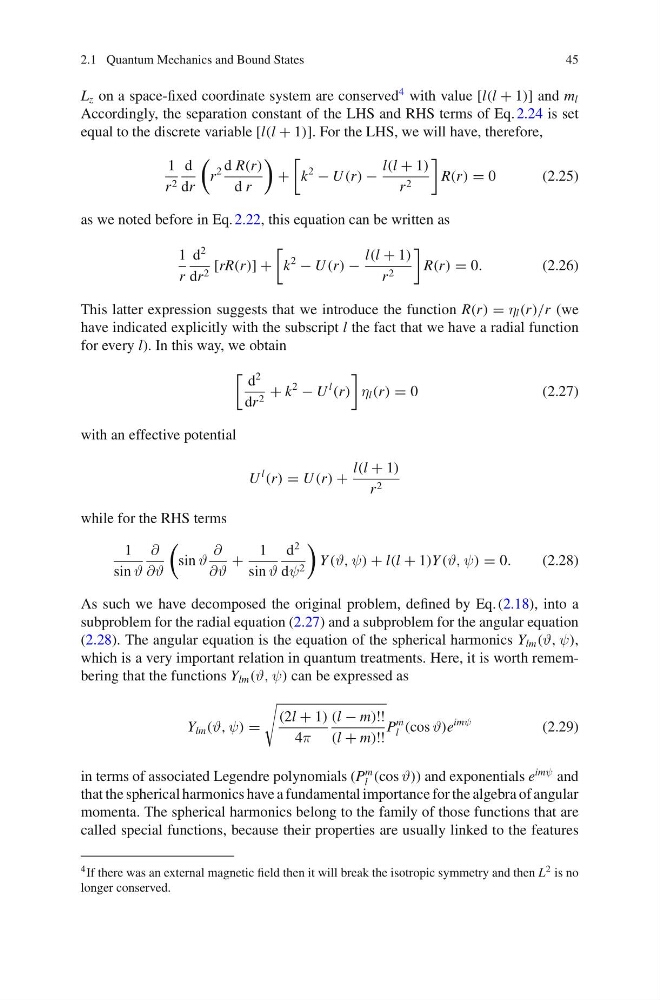
As such we have decomposed the original problem, defined by Eq. (2.18), into a
subproblem for the radial equation (2.27) and a subproblem for the angular equation
(2.28). The angular equation is the equation of the spherical harmonics Y lm (ϑ, ψ),
which is a very important relation in quantum treatments. Here, it is worth remembering that the functions Y lm (ϑ, ψ) can be expressed as
Y lm (ϑ, ψ) =
(2l + 1)
4π
(l − m)!!
(l + m)!!
P
m
l (cos ϑ)e
imψ
(2.29)
in terms of associated Legendre polynomials (P
m
l (cos ϑ)) and exponentials e
imψ and
that the spherical harmonics have a fundamental importance for the algebra of angular
momenta. The spherical harmonics belong to the family of those functions that are
called special functions, because their properties are usually linked to the features
4 If there was an external magnetic field then it will break the isotropic symmetry and then L 2 is no
longer conserved.
45
L z on a space-fixed coordinate system are conserved
4 with value [l(l + 1)] and m l
Accordingly, the separation constant of the LHS and RHS terms of Eq. 2.24 is set
equal to the discrete variable [l(l + 1)]. For the LHS, we will have, therefore,
1
r 2
d
dr
r
2 d R(r)
d r
+
k
2
− U (r) −
l(l + 1)
r 2
R(r) = 0
(2.25)
as we noted before in Eq. 2.22, this equation can be written as
1
r
d
2
dr 2 [rR(r)] +
k
2
− U (r) −
l(l + 1)
r 2
R(r) = 0.
(2.26)
This latter expression suggests that we introduce the function R(r) = η l (r)/r (we
have indicated explicitly with the subscript l the fact that we have a radial function
for every l). In this way, we obtain
d
2
dr 2 + k
2
− U
l
(r)
η l (r) = 0
(2.27)
with an effective potential
U
l
(r) = U (r) +
l(l + 1)
r 2
while for the RHS terms
1
sin ϑ
∂
∂ϑ
sin ϑ
∂
∂ϑ
+
1
sin ϑ
d
2
dψ 2
Y (ϑ, ψ) + l(l + 1)Y (ϑ, ψ) = 0.
(2.28)
As such we have decomposed the original problem, defined by Eq. (2.18), into a
subproblem for the radial equation (2.27) and a subproblem for the angular equation
(2.28). The angular equation is the equation of the spherical harmonics Y lm (ϑ, ψ),
which is a very important relation in quantum treatments. Here, it is worth remembering that the functions Y lm (ϑ, ψ) can be expressed as
Y lm (ϑ, ψ) =
(2l + 1)
4π
(l − m)!!
(l + m)!!
P
m
l (cos ϑ)e
imψ
(2.29)
in terms of associated Legendre polynomials (P
m
l (cos ϑ)) and exponentials e
imψ and
that the spherical harmonics have a fundamental importance for the algebra of angular
momenta. The spherical harmonics belong to the family of those functions that are
called special functions, because their properties are usually linked to the features
4 If there was an external magnetic field then it will break the isotropic symmetry and then L 2 is no
longer conserved.