

34
1 From the Phenomenology of Chemical Reactions …
as the internuclear distance r goes to infinity, while the second gets increasingly
repulsive as the internuclear distance tends to zero). Furthermore, as we shall see in
more detail later, it leads straightforwardly either to analytical or to easy to compute
formulations of other diatomic properties, it is easy to generalize to higher powers of
n and more bodies and it allows as well the formulation of simple continuity variables
connecting different processes.[4]
1.4.4 The Scattering Lennard–Jones (6–12) potential
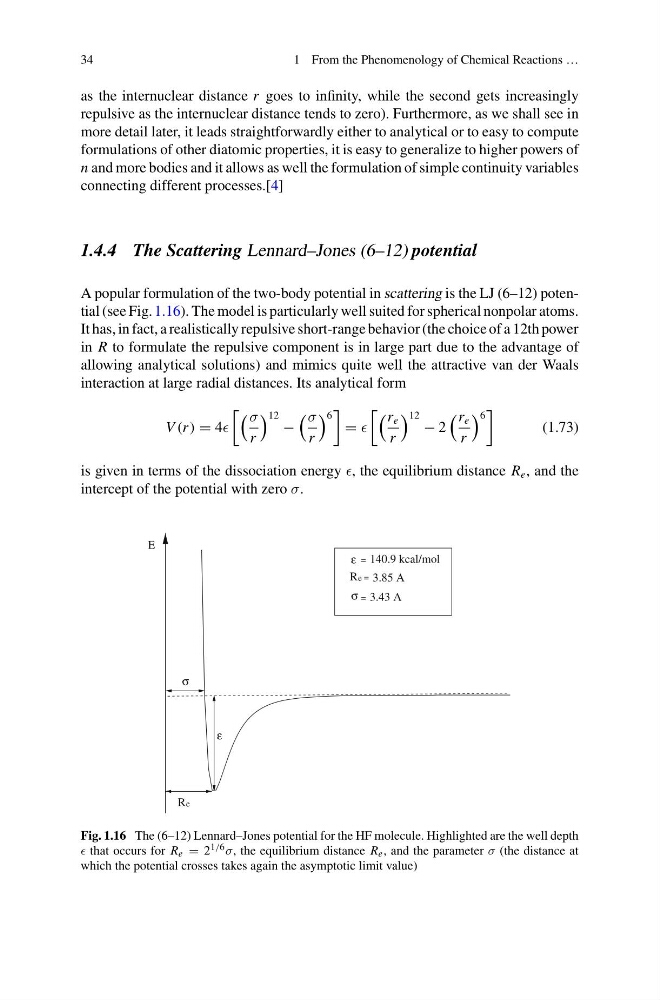
A popular formulation of the two-body potential in scattering is the LJ (6–12) potential (see Fig. 1.16). The model is particularly well suited for spherical nonpolar atoms.
It has, in fact, a realistically repulsive short-range behavior (the choice of a 12th power
in R to formulate the repulsive component is in large part due to the advantage of
allowing analytical solutions) and mimics quite well the attractive van der Waals
interaction at large radial distances. Its analytical form
V (r ) = 4
σ
r
12 −
σ
r
6
=
r e
r
12 − 2
r e
r
6
(1.73)
is given in terms of the dissociation energy , the equilibrium distance R e , and the
intercept of the potential with zero σ.
e
Re =
=
=
ε
σ 3.43 A
140.9 kcal/mol
3.85 A
E
ε
R
σ
Fig. 1.16 The (6–12) Lennard–Jones potential for the HF molecule. Highlighted are the well depth
that occurs for R e = 2 1/6 σ, the equilibrium distance R e , and the parameter σ (the distance at
which the potential crosses takes again the asymptotic limit value)
1 From the Phenomenology of Chemical Reactions …
as the internuclear distance r goes to infinity, while the second gets increasingly
repulsive as the internuclear distance tends to zero). Furthermore, as we shall see in
more detail later, it leads straightforwardly either to analytical or to easy to compute
formulations of other diatomic properties, it is easy to generalize to higher powers of
n and more bodies and it allows as well the formulation of simple continuity variables
connecting different processes.[4]
1.4.4 The Scattering Lennard–Jones (6–12) potential
A popular formulation of the two-body potential in scattering is the LJ (6–12) potential (see Fig. 1.16). The model is particularly well suited for spherical nonpolar atoms.
It has, in fact, a realistically repulsive short-range behavior (the choice of a 12th power
in R to formulate the repulsive component is in large part due to the advantage of
allowing analytical solutions) and mimics quite well the attractive van der Waals
interaction at large radial distances. Its analytical form
V (r ) = 4
σ
r
12 −
σ
r
6
=
r e
r
12 − 2
r e
r
6
(1.73)
is given in terms of the dissociation energy , the equilibrium distance R e , and the
intercept of the potential with zero σ.
e
Re =
=
=
ε
σ 3.43 A
140.9 kcal/mol
3.85 A
E
ε
R
σ
Fig. 1.16 The (6–12) Lennard–Jones potential for the HF molecule. Highlighted are the well depth
that occurs for R e = 2 1/6 σ, the equilibrium distance R e , and the parameter σ (the distance at
which the potential crosses takes again the asymptotic limit value)