

32
1 From the Phenomenology of Chemical Reactions …
r
V(r)
E>0
E<0
a
0
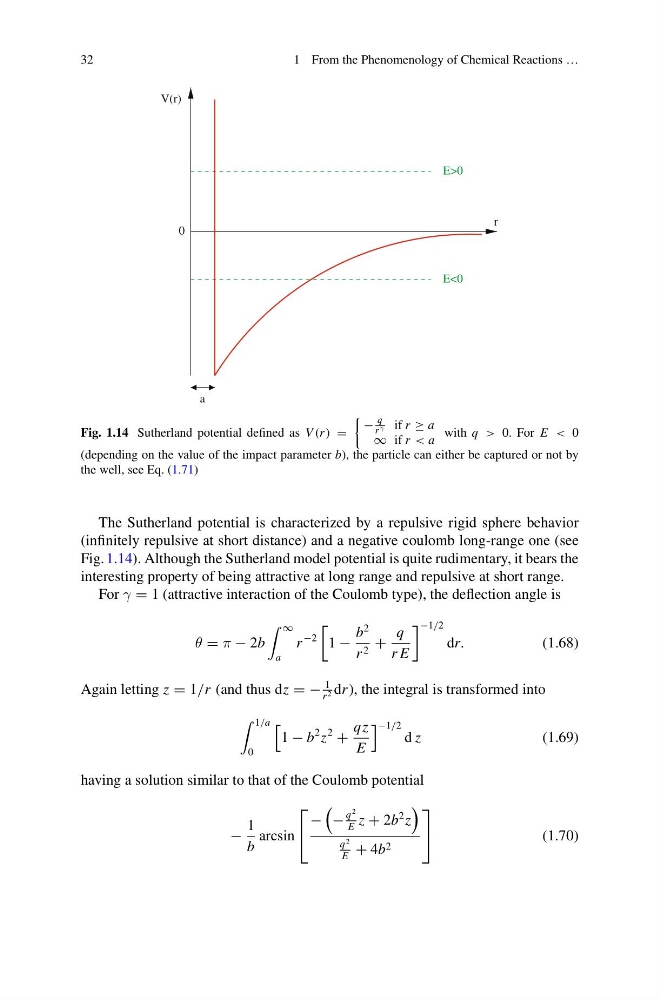
Fig. 1.14 Sutherland potential defined as V (r ) =
−
q
r γ if r ≥ a
∞ if r < a
with q > 0. For E < 0
(depending on the value of the impact parameter b), the particle can either be captured or not by
the well, see Eq. (1.71)
The Sutherland potential is characterized by a repulsive rigid sphere behavior
(infinitely repulsive at short distance) and a negative coulomb long-range one (see
Fig. 1.14). Although the Sutherland model potential is quite rudimentary, it bears the
interesting property of being attractive at long range and repulsive at short range.
For γ = 1 (attractive interaction of the Coulomb type), the deflection angle is
θ = π − 2b
∞
a
r
−2
1 −
b
2
r 2 +
q
r E
−1/2
dr.
(1.68)
Again letting z = 1/r (and thus dz = −
1
r 2 dr ), the integral is transformed into
1/a
0
1 − b
2 z
2
+
qz
E
−1/2
d z
(1.69)
having a solution similar to that of the Coulomb potential
−
1
b
arcsin
⎡
⎣
−
−
q
2
E
z + 2b
2 z
q 2
E
+ 4b 2
⎤
⎦
(1.70)
1 From the Phenomenology of Chemical Reactions …
r
V(r)
E>0
E<0
a
0
Fig. 1.14 Sutherland potential defined as V (r ) =
−
q
r γ if r ≥ a
∞ if r < a
with q > 0. For E < 0
(depending on the value of the impact parameter b), the particle can either be captured or not by
the well, see Eq. (1.71)
The Sutherland potential is characterized by a repulsive rigid sphere behavior
(infinitely repulsive at short distance) and a negative coulomb long-range one (see
Fig. 1.14). Although the Sutherland model potential is quite rudimentary, it bears the
interesting property of being attractive at long range and repulsive at short range.
For γ = 1 (attractive interaction of the Coulomb type), the deflection angle is
θ = π − 2b
∞
a
r
−2
1 −
b
2
r 2 +
q
r E
−1/2
dr.
(1.68)
Again letting z = 1/r (and thus dz = −
1
r 2 dr ), the integral is transformed into
1/a
0
1 − b
2 z
2
+
qz
E
−1/2
d z
(1.69)
having a solution similar to that of the Coulomb potential
−
1
b
arcsin
⎡
⎣
−
−
q
2
E
z + 2b
2 z
q 2
E
+ 4b 2
⎤
⎦
(1.70)