

1.4 Popular Scattering Model Potentials
27
1.4 Popular Scattering Model Potentials
1.4.1 The Rigid Sphere Model
There is an extensive list of chemical models for the potential energy used to interpret
and predict physical phenomena in the gas, liquid, and solid phases. The models that
are commonly used in these cases attempt to represent the potentials in a simple
yet realistic manner using a minimum number of parameters with a strong physical
significance. In our case, the two particles may represent nuclei, atoms, electrons,
fragments of the molecule, whole molecules, or still even more complex bodies.
Therefore, even if there are theoretical means for improving the quality of these model
potentials (see Chaps. 3 and 4), they are of widespread use in modeling chemistry.
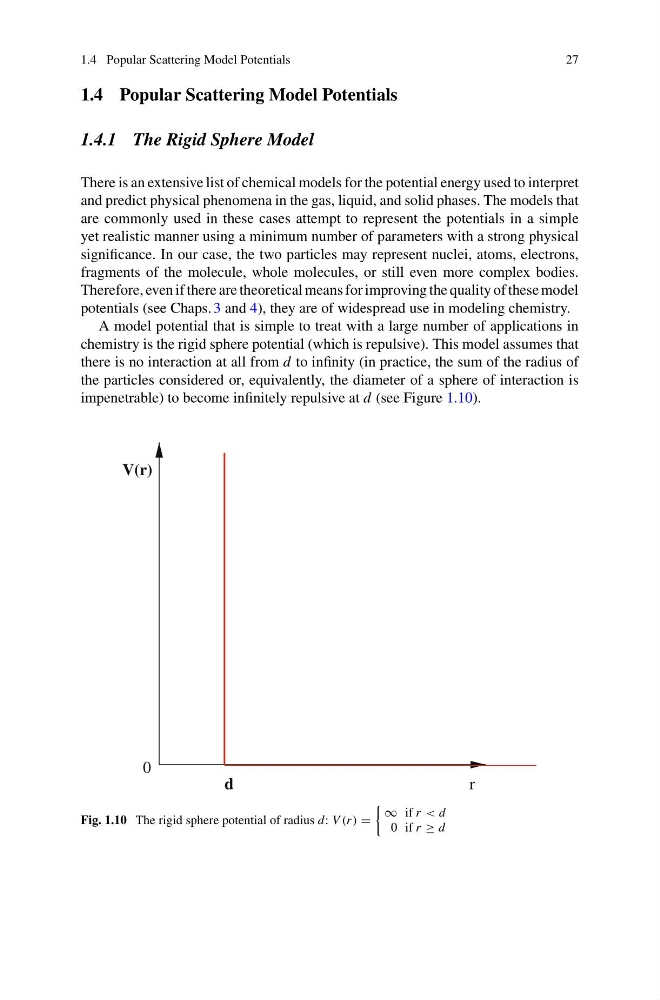
A model potential that is simple to treat with a large number of applications in
chemistry is the rigid sphere potential (which is repulsive). This model assumes that
there is no interaction at all from d to infinity (in practice, the sum of the radius of
the particles considered or, equivalently, the diameter of a sphere of interaction is
impenetrable) to become infinitely repulsive at d (see Figure 1.10).
r
0
d
V(r)
Fig. 1.10 The rigid sphere potential of radius d: V (r ) =
∞ if r < d
0 if r ≥ d
27
1.4 Popular Scattering Model Potentials
1.4.1 The Rigid Sphere Model
There is an extensive list of chemical models for the potential energy used to interpret
and predict physical phenomena in the gas, liquid, and solid phases. The models that
are commonly used in these cases attempt to represent the potentials in a simple
yet realistic manner using a minimum number of parameters with a strong physical
significance. In our case, the two particles may represent nuclei, atoms, electrons,
fragments of the molecule, whole molecules, or still even more complex bodies.
Therefore, even if there are theoretical means for improving the quality of these model
potentials (see Chaps. 3 and 4), they are of widespread use in modeling chemistry.
A model potential that is simple to treat with a large number of applications in
chemistry is the rigid sphere potential (which is repulsive). This model assumes that
there is no interaction at all from d to infinity (in practice, the sum of the radius of
the particles considered or, equivalently, the diameter of a sphere of interaction is
impenetrable) to become infinitely repulsive at d (see Figure 1.10).
r
0
d
V(r)
Fig. 1.10 The rigid sphere potential of radius d: V (r ) =
∞ if r < d
0 if r ≥ d