

26
1 From the Phenomenology of Chemical Reactions …
Sinc
Sdif
x
y
z
sin d
Ω=2π θ θ
d
θ
θ
d
b
b
d
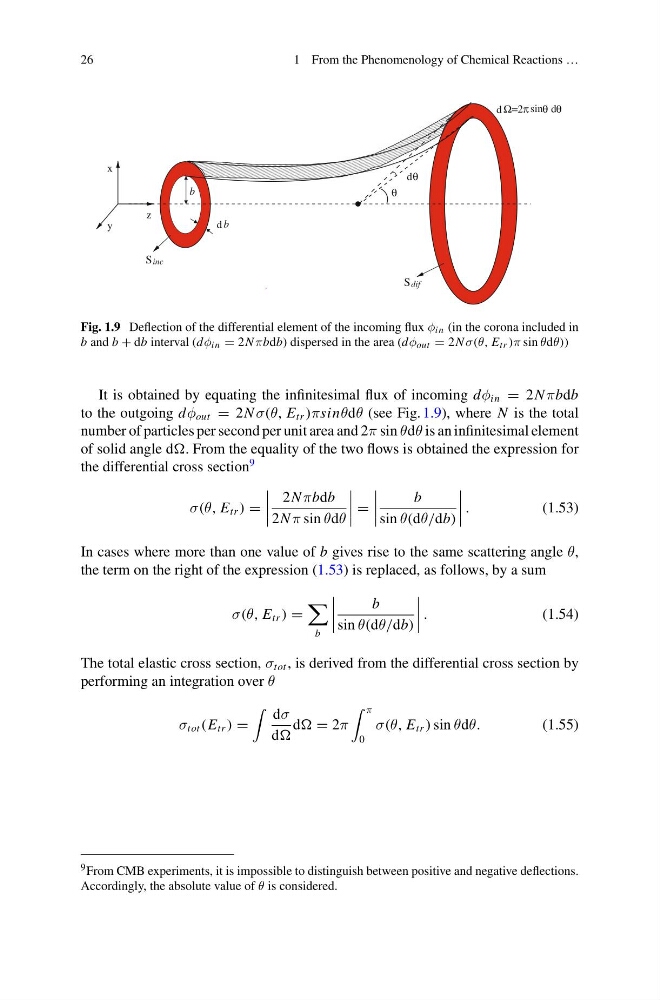
Fig. 1.9 Deflection of the differential element of the incoming flux φ in (in the corona included in
b and b + db interval (dφ in = 2N πbdb) dispersed in the area (dφ out = 2N σ(θ, E tr )π sin θdθ))
It is obtained by equating the infinitesimal flux of incoming dφ in = 2N πbdb
to the outgoing dφ out = 2N σ(θ, E tr )πsinθdθ (see Fig. 1.9), where N is the total
number of particles per second per unit area and 2π sin θdθ is an infinitesimal element
of solid angle d. From the equality of the two flows is obtained the expression for
the differential cross section
9
σ(θ, E tr ) =
2N πbdb
2N π sin θdθ
=
b
sin θ(dθ/db)
.
(1.53)
In cases where more than one value of b gives rise to the same scattering angle θ,
the term on the right of the expression (1.53) is replaced, as follows, by a sum
σ(θ, E tr ) =
b
b
sin θ(dθ/db)
.
(1.54)
The total elastic cross section, σ tot , is derived from the differential cross section by
performing an integration over θ
σ tot (E tr ) =
dσ
d
d = 2π
π
0
σ(θ, E tr ) sin θdθ.
(1.55)
9 From CMB experiments, it is impossible to distinguish between positive and negative deflections.
Accordingly, the absolute value of θ is considered.
1 From the Phenomenology of Chemical Reactions …
Sinc
Sdif
x
y
z
sin d
Ω=2π θ θ
d
θ
θ
d
b
b
d
Fig. 1.9 Deflection of the differential element of the incoming flux φ in (in the corona included in
b and b + db interval (dφ in = 2N πbdb) dispersed in the area (dφ out = 2N σ(θ, E tr )π sin θdθ))
It is obtained by equating the infinitesimal flux of incoming dφ in = 2N πbdb
to the outgoing dφ out = 2N σ(θ, E tr )πsinθdθ (see Fig. 1.9), where N is the total
number of particles per second per unit area and 2π sin θdθ is an infinitesimal element
of solid angle d. From the equality of the two flows is obtained the expression for
the differential cross section
9
σ(θ, E tr ) =
2N πbdb
2N π sin θdθ
=
b
sin θ(dθ/db)
.
(1.53)
In cases where more than one value of b gives rise to the same scattering angle θ,
the term on the right of the expression (1.53) is replaced, as follows, by a sum
σ(θ, E tr ) =
b
b
sin θ(dθ/db)
.
(1.54)
The total elastic cross section, σ tot , is derived from the differential cross section by
performing an integration over θ
σ tot (E tr ) =
dσ
d
d = 2π
π
0
σ(θ, E tr ) sin θdθ.
(1.55)
9 From CMB experiments, it is impossible to distinguish between positive and negative deflections.
Accordingly, the absolute value of θ is considered.