

1.3 The Computation of Scattering Properties
25
where p
0
(r ) and p(r ) are the radial momenta of the system, respectively, in the
absence and in the presence of the potential. (E, L) fulfills a vital role in the
classical description of the trajectories (periodic orbits, swings, etc.), and by requiring
the discretization of the classical action, you can find a classical analogue of the
quantum numbers (see Ref. [3]). Also, the classical action and its conjugated variable
(the angle θ) are a pair of variables (called action-angle variables) that can either
be or are actually used to describe the processes of scattering involving periodic
motions and allows one to include semiclassical effects of resonance and interference.
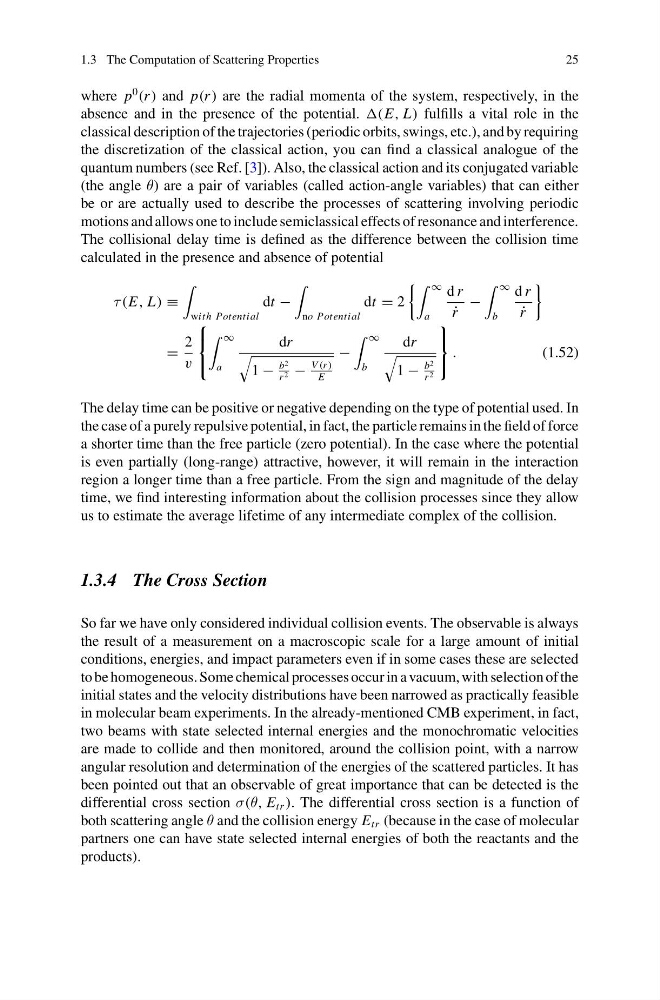
The collisional delay time is defined as the difference between the collision time
calculated in the presence and absence of potential
τ (E, L) ≡
with Potential
dt −
no Potential
dt = 2
∞
a
d r
˙
r
−
∞
b
d r
˙
r
=
2
v
⎧
⎨
⎩
∞
a
dr
1 −
b 2
r 2 −
V (r )
E
−
∞
b
dr
1 −
b 2
r 2
⎫
⎬
⎭
.
(1.52)
The delay time can be positive or negative depending on the type of potential used. In
the case of a purely repulsive potential, in fact, the particle remains in the field of force
a shorter time than the free particle (zero potential). In the case where the potential
is even partially (long-range) attractive, however, it will remain in the interaction
region a longer time than a free particle. From the sign and magnitude of the delay
time, we find interesting information about the collision processes since they allow
us to estimate the average lifetime of any intermediate complex of the collision.
1.3.4 The Cross Section
So far we have only considered individual collision events. The observable is always
the result of a measurement on a macroscopic scale for a large amount of initial
conditions, energies, and impact parameters even if in some cases these are selected
to be homogeneous. Some chemical processes occur in a vacuum, with selection of the
initial states and the velocity distributions have been narrowed as practically feasible
in molecular beam experiments. In the already-mentioned CMB experiment, in fact,
two beams with state selected internal energies and the monochromatic velocities
are made to collide and then monitored, around the collision point, with a narrow
angular resolution and determination of the energies of the scattered particles. It has
been pointed out that an observable of great importance that can be detected is the
differential cross section σ(θ, E tr ). The differential cross section is a function of
both scattering angle θ and the collision energy E tr (because in the case of molecular
partners one can have state selected internal energies of both the reactants and the
products).
25
where p
0
(r ) and p(r ) are the radial momenta of the system, respectively, in the
absence and in the presence of the potential. (E, L) fulfills a vital role in the
classical description of the trajectories (periodic orbits, swings, etc.), and by requiring
the discretization of the classical action, you can find a classical analogue of the
quantum numbers (see Ref. [3]). Also, the classical action and its conjugated variable
(the angle θ) are a pair of variables (called action-angle variables) that can either
be or are actually used to describe the processes of scattering involving periodic
motions and allows one to include semiclassical effects of resonance and interference.
The collisional delay time is defined as the difference between the collision time
calculated in the presence and absence of potential
τ (E, L) ≡
with Potential
dt −
no Potential
dt = 2
∞
a
d r
˙
r
−
∞
b
d r
˙
r
=
2
v
⎧
⎨
⎩
∞
a
dr
1 −
b 2
r 2 −
V (r )
E
−
∞
b
dr
1 −
b 2
r 2
⎫
⎬
⎭
.
(1.52)
The delay time can be positive or negative depending on the type of potential used. In
the case of a purely repulsive potential, in fact, the particle remains in the field of force
a shorter time than the free particle (zero potential). In the case where the potential
is even partially (long-range) attractive, however, it will remain in the interaction
region a longer time than a free particle. From the sign and magnitude of the delay
time, we find interesting information about the collision processes since they allow
us to estimate the average lifetime of any intermediate complex of the collision.
1.3.4 The Cross Section
So far we have only considered individual collision events. The observable is always
the result of a measurement on a macroscopic scale for a large amount of initial
conditions, energies, and impact parameters even if in some cases these are selected
to be homogeneous. Some chemical processes occur in a vacuum, with selection of the
initial states and the velocity distributions have been narrowed as practically feasible
in molecular beam experiments. In the already-mentioned CMB experiment, in fact,
two beams with state selected internal energies and the monochromatic velocities
are made to collide and then monitored, around the collision point, with a narrow
angular resolution and determination of the energies of the scattered particles. It has
been pointed out that an observable of great importance that can be detected is the
differential cross section σ(θ, E tr ). The differential cross section is a function of
both scattering angle θ and the collision energy E tr (because in the case of molecular
partners one can have state selected internal energies of both the reactants and the
products).