

24
1 From the Phenomenology of Chemical Reactions …
The second type of convergence, external, is then needed in order to gradually
extend the range by adding to the upper bound additional intervals. The associated
iteration is closed when the values calculated in two successive iterations differ with
minimal error. You will have, therefore, the following:
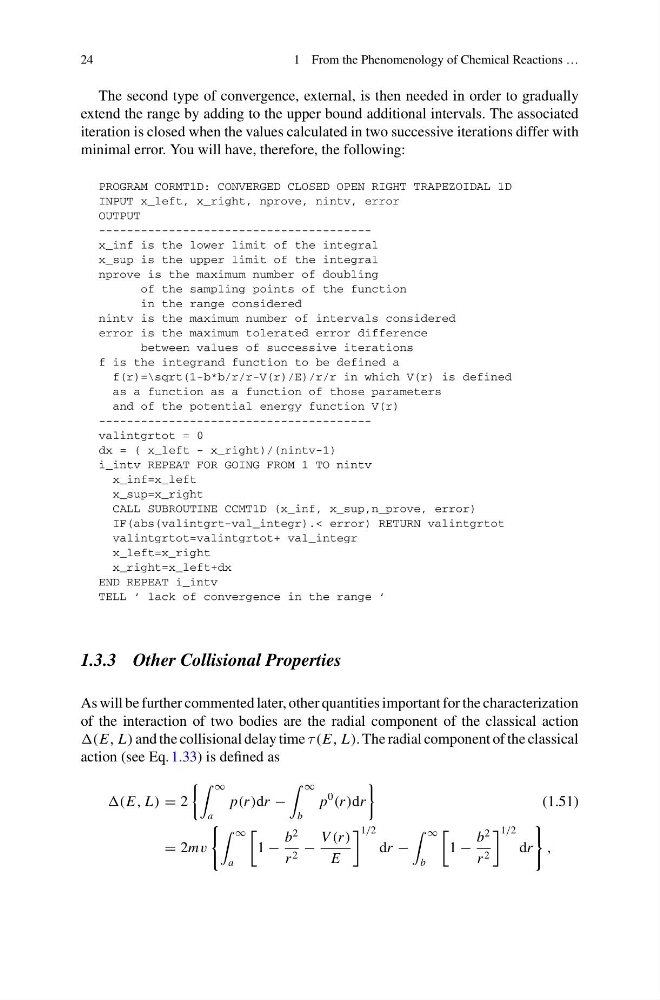
PROGRAM CORMT1D: CONVERGED CLOSED OPEN RIGHT TRAPEZOIDAL 1D
INPUT x_left, x_right, nprove, nintv, error
OUTPUT
--------------------------------------x_inf is the lower limit of the integral
x_sup is the upper limit of the integral
nprove is the maximum number of doubling
of the sampling points of the function
in the range considered
nintv is the maximum number of intervals considered
error is the maximum tolerated error difference
between values of successive iterations
f is the integrand function to be defined a
f(r)=\sqrt(1-b*b/r/r-V(r)/E)/r/r in which V(r) is defined
as a function as a function of those parameters
and of the potential energy function V(r)
--------------------------------------valintgrtot = 0
dx = ( x_left - x_right)/(nintv-1)
i_intv REPEAT FOR GOING FROM 1 TO nintv
x_inf=x_left
x_sup=x_right
CALL SUBROUTINE CCMT1D (x_inf, x_sup,n_prove, error)
IF(abs(valintgrt-val_integr).< error) RETURN valintgrtot
valintgrtot=valintgrtot+ val_integr
x_left=x_right
x_right=x_left+dx
END REPEAT i_intv
TELL ’ lack of convergence in the range ’
1.3.3 Other Collisional Properties
As will be further commented later, other quantities important for the characterization
of the interaction of two bodies are the radial component of the classical action
(E, L) and the collisional delay time τ (E, L). The radial component of the classical
action (see Eq. 1.33) is defined as
(E, L) = 2
∞
a
p(r )dr −
∞
b
p
0
(r )dr
(1.51)
= 2mv
∞
a
1 −
b
2
r 2 −
V (r )
E
1/2
dr −
∞
b
1 −
b
2
r 2
1/2
dr
,
1 From the Phenomenology of Chemical Reactions …
The second type of convergence, external, is then needed in order to gradually
extend the range by adding to the upper bound additional intervals. The associated
iteration is closed when the values calculated in two successive iterations differ with
minimal error. You will have, therefore, the following:
PROGRAM CORMT1D: CONVERGED CLOSED OPEN RIGHT TRAPEZOIDAL 1D
INPUT x_left, x_right, nprove, nintv, error
OUTPUT
--------------------------------------x_inf is the lower limit of the integral
x_sup is the upper limit of the integral
nprove is the maximum number of doubling
of the sampling points of the function
in the range considered
nintv is the maximum number of intervals considered
error is the maximum tolerated error difference
between values of successive iterations
f is the integrand function to be defined a
f(r)=\sqrt(1-b*b/r/r-V(r)/E)/r/r in which V(r) is defined
as a function as a function of those parameters
and of the potential energy function V(r)
--------------------------------------valintgrtot = 0
dx = ( x_left - x_right)/(nintv-1)
i_intv REPEAT FOR GOING FROM 1 TO nintv
x_inf=x_left
x_sup=x_right
CALL SUBROUTINE CCMT1D (x_inf, x_sup,n_prove, error)
IF(abs(valintgrt-val_integr).< error) RETURN valintgrtot
valintgrtot=valintgrtot+ val_integr
x_left=x_right
x_right=x_left+dx
END REPEAT i_intv
TELL ’ lack of convergence in the range ’
1.3.3 Other Collisional Properties
As will be further commented later, other quantities important for the characterization
of the interaction of two bodies are the radial component of the classical action
(E, L) and the collisional delay time τ (E, L). The radial component of the classical
action (see Eq. 1.33) is defined as
(E, L) = 2
∞
a
p(r )dr −
∞
b
p
0
(r )dr
(1.51)
= 2mv
∞
a
1 −
b
2
r 2 −
V (r )
E
1/2
dr −
∞
b
1 −
b
2
r 2
1/2
dr
,