

28
1 From the Phenomenology of Chemical Reactions …
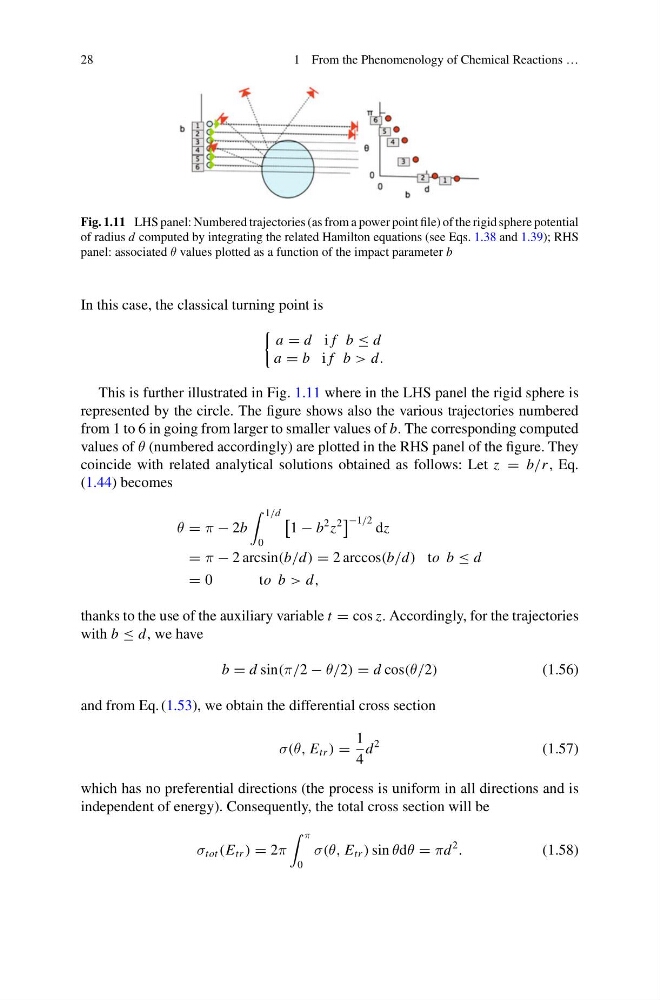
Fig. 1.11 LHS panel: Numbered trajectories (as from a power point file) of the rigid sphere potential
of radius d computed by integrating the related Hamilton equations (see Eqs. 1.38 and 1.39); RHS
panel: associated θ values plotted as a function of the impact parameter b
In this case, the classical turning point is
a = d i f b ≤ d
a = b i f b > d.
This is further illustrated in Fig. 1.11 where in the LHS panel the rigid sphere is
represented by the circle. The figure shows also the various trajectories numbered
from 1 to 6 in going from larger to smaller values of b. The corresponding computed
values of θ (numbered accordingly) are plotted in the RHS panel of the figure. They
coincide with related analytical solutions obtained as follows: Let z = b/r , Eq.
(1.44) becomes
θ = π − 2b
1/d
0
1 − b
2 z
2
−1/2 dz
= π − 2 arcsin(b/d) = 2 arccos(b/d) to b ≤ d
= 0
to b > d,
thanks to the use of the auxiliary variable t = cos z. Accordingly, for the trajectories
with b ≤ d, we have
b = d sin(π/2 − θ/2) = d cos(θ/2)
(1.56)
and from Eq. (1.53), we obtain the differential cross section
σ(θ, E tr ) =
1
4
d
2
(1.57)
which has no preferential directions (the process is uniform in all directions and is
independent of energy). Consequently, the total cross section will be
σ tot (E tr ) = 2π
π
0
σ(θ, E tr ) sin θdθ = πd
2
.
(1.58)
1 From the Phenomenology of Chemical Reactions …
Fig. 1.11 LHS panel: Numbered trajectories (as from a power point file) of the rigid sphere potential
of radius d computed by integrating the related Hamilton equations (see Eqs. 1.38 and 1.39); RHS
panel: associated θ values plotted as a function of the impact parameter b
In this case, the classical turning point is
a = d i f b ≤ d
a = b i f b > d.
This is further illustrated in Fig. 1.11 where in the LHS panel the rigid sphere is
represented by the circle. The figure shows also the various trajectories numbered
from 1 to 6 in going from larger to smaller values of b. The corresponding computed
values of θ (numbered accordingly) are plotted in the RHS panel of the figure. They
coincide with related analytical solutions obtained as follows: Let z = b/r , Eq.
(1.44) becomes
θ = π − 2b
1/d
0
1 − b
2 z
2
−1/2 dz
= π − 2 arcsin(b/d) = 2 arccos(b/d) to b ≤ d
= 0
to b > d,
thanks to the use of the auxiliary variable t = cos z. Accordingly, for the trajectories
with b ≤ d, we have
b = d sin(π/2 − θ/2) = d cos(θ/2)
(1.56)
and from Eq. (1.53), we obtain the differential cross section
σ(θ, E tr ) =
1
4
d
2
(1.57)
which has no preferential directions (the process is uniform in all directions and is
independent of energy). Consequently, the total cross section will be
σ tot (E tr ) = 2π
π
0
σ(θ, E tr ) sin θdθ = πd
2
.
(1.58)