

20
1 From the Phenomenology of Chemical Reactions …
where x
2
= E/k B T and k B is the Boltzmann constant (k B ≈ 1.38066 × 10
−23 J/K).
In a dilute gas, in fact, the dominant component is the two-body interaction. Threeand more-body interactions are not important until the gas is very dense or condenses
to form a liquid or solid where many-body interaction become very important.
1.3 The Computation of Scattering Properties
1.3.1 Trajectories integration (Hamilton equations)
If you want to know the detailed temporal evolution of the system, the equations of
motion (1.38) and (1.39) must be integrated numerically. A very simple numerical
method for integrating first-order differential equations is based on the Euler method
which uses an approximation of the first derivative by the quotient of the function
f (x) at neighboring points and the distance between those points
d
dx
f (x)
δ f (x)
δx
=
f (x i+1 ) − f (x i )
h
(1.48)
for the generic point i with stepsize h = δx = x i+1 − x i . From Eq. (1.48), we obtain
the formula
f (x i+1 ) = f (x i ) + h
d
dx
f (x)
x=x i
+ O(h
2
).
(1.49)
Thus, by knowing f (x i ) and its first derivative
d
dx
f (x)| x=x i , one can calculate the
value of f at the next point x i+1 .
The price paid in exchange for the simplicity of this formula is to accumulate at
each step an error of first order (which is conventionally referred to as O(h
2
), where
h is the integration step) that is too large to allow further integration for sufficiently
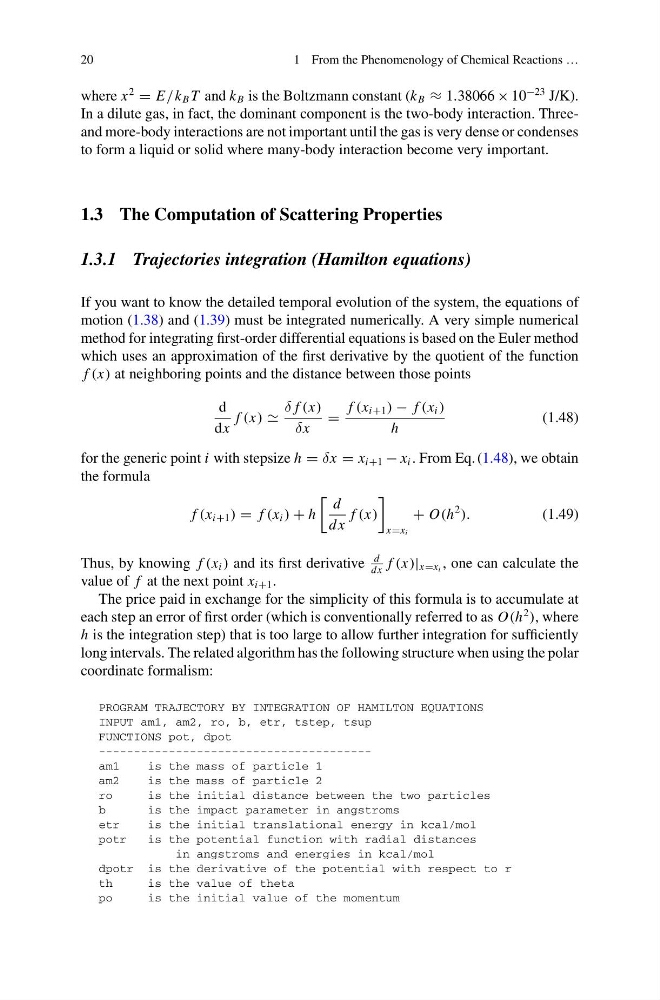
long intervals. The related algorithm has the following structure when using the polar
coordinate formalism:
PROGRAM TRAJECTORY BY INTEGRATION OF HAMILTON EQUATIONS
INPUT am1, am2, ro, b, etr, tstep, tsup
FUNCTIONS pot, dpot
--------------------------------------am1
is the mass of particle 1
am2
is the mass of particle 2
ro
is the initial distance between the two particles
b
is the impact parameter in angstroms
etr
is the initial translational energy in kcal/mol
potr
is the potential function with radial distances
in angstroms and energies in kcal/mol
dpotr is the derivative of the potential with respect to r
th
is the value of theta
po
is the initial value of the momentum
1 From the Phenomenology of Chemical Reactions …
where x
2
= E/k B T and k B is the Boltzmann constant (k B ≈ 1.38066 × 10
−23 J/K).
In a dilute gas, in fact, the dominant component is the two-body interaction. Threeand more-body interactions are not important until the gas is very dense or condenses
to form a liquid or solid where many-body interaction become very important.
1.3 The Computation of Scattering Properties
1.3.1 Trajectories integration (Hamilton equations)
If you want to know the detailed temporal evolution of the system, the equations of
motion (1.38) and (1.39) must be integrated numerically. A very simple numerical
method for integrating first-order differential equations is based on the Euler method
which uses an approximation of the first derivative by the quotient of the function
f (x) at neighboring points and the distance between those points
d
dx
f (x)
δ f (x)
δx
=
f (x i+1 ) − f (x i )
h
(1.48)
for the generic point i with stepsize h = δx = x i+1 − x i . From Eq. (1.48), we obtain
the formula
f (x i+1 ) = f (x i ) + h
d
dx
f (x)
x=x i
+ O(h
2
).
(1.49)
Thus, by knowing f (x i ) and its first derivative
d
dx
f (x)| x=x i , one can calculate the
value of f at the next point x i+1 .
The price paid in exchange for the simplicity of this formula is to accumulate at
each step an error of first order (which is conventionally referred to as O(h
2
), where
h is the integration step) that is too large to allow further integration for sufficiently
long intervals. The related algorithm has the following structure when using the polar
coordinate formalism:
PROGRAM TRAJECTORY BY INTEGRATION OF HAMILTON EQUATIONS
INPUT am1, am2, ro, b, etr, tstep, tsup
FUNCTIONS pot, dpot
--------------------------------------am1
is the mass of particle 1
am2
is the mass of particle 2
ro
is the initial distance between the two particles
b
is the impact parameter in angstroms
etr
is the initial translational energy in kcal/mol
potr
is the potential function with radial distances
in angstroms and energies in kcal/mol
dpotr is the derivative of the potential with respect to r
th
is the value of theta
po
is the initial value of the momentum