

1.2 Classical Mechanics of Two-Particle Collisions
19
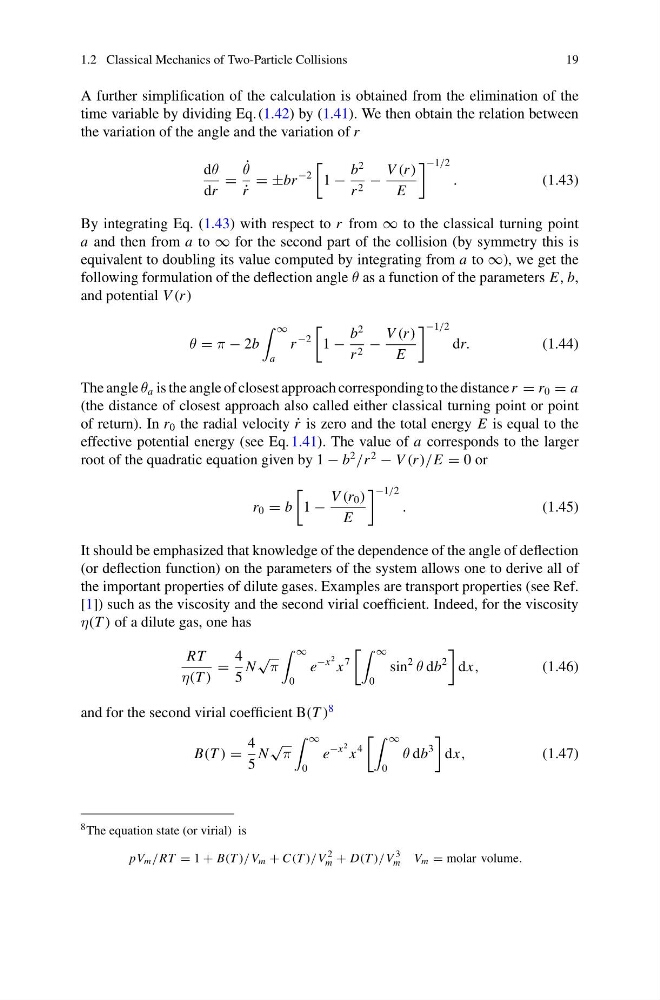
A further simplification of the calculation is obtained from the elimination of the
time variable by dividing Eq. (1.42) by (1.41). We then obtain the relation between
the variation of the angle and the variation of r
dθ
dr
=
˙
θ
˙
r
= ±br
−2
1 −
b
2
r 2 −
V (r )
E
−1/2
.
(1.43)
By integrating Eq. (1.43) with respect to r from ∞ to the classical turning point
a and then from a to ∞ for the second part of the collision (by symmetry this is
equivalent to doubling its value computed by integrating from a to ∞), we get the
following formulation of the deflection angle θ as a function of the parameters E, b,
and potential V (r )
θ = π − 2b
∞
a
r
−2
1 −
b
2
r 2 −
V (r )
E
−1/2
dr.
(1.44)
The angle θ a is the angle of closest approach corresponding to the distance r = r 0 = a
(the distance of closest approach also called either classical turning point or point
of return). In r 0 the radial velocity ˙
r is zero and the total energy E is equal to the
effective potential energy (see Eq. 1.41). The value of a corresponds to the larger
root of the quadratic equation given by 1 − b
2
/r
2
− V (r )/E = 0 or
r 0 = b
1 −
V (r 0 )
E
−1/2
.
(1.45)
It should be emphasized that knowledge of the dependence of the angle of deflection
(or deflection function) on the parameters of the system allows one to derive all of
the important properties of dilute gases. Examples are transport properties (see Ref.
[1]) such as the viscosity and the second virial coefficient. Indeed, for the viscosity
η(T ) of a dilute gas, one has
RT
η(T )
=
4
5
N
√
π
∞
0
e
−x
2 x
7
∞
0
sin
2
θ db
2
dx,
(1.46)
and for the second virial coefficient B(T )
8
B(T ) =
4
5
N
√
π
∞
0
e
−x
2 x
4
∞
0
θ db
3
dx,
(1.47)
8 The equation state (or virial) is
pV m /RT = 1 + B(T )/V m + C(T )/V
2
m + D(T )/V
3
m V m = molar volume.
19
A further simplification of the calculation is obtained from the elimination of the
time variable by dividing Eq. (1.42) by (1.41). We then obtain the relation between
the variation of the angle and the variation of r
dθ
dr
=
˙
θ
˙
r
= ±br
−2
1 −
b
2
r 2 −
V (r )
E
−1/2
.
(1.43)
By integrating Eq. (1.43) with respect to r from ∞ to the classical turning point
a and then from a to ∞ for the second part of the collision (by symmetry this is
equivalent to doubling its value computed by integrating from a to ∞), we get the
following formulation of the deflection angle θ as a function of the parameters E, b,
and potential V (r )
θ = π − 2b
∞
a
r
−2
1 −
b
2
r 2 −
V (r )
E
−1/2
dr.
(1.44)
The angle θ a is the angle of closest approach corresponding to the distance r = r 0 = a
(the distance of closest approach also called either classical turning point or point
of return). In r 0 the radial velocity ˙
r is zero and the total energy E is equal to the
effective potential energy (see Eq. 1.41). The value of a corresponds to the larger
root of the quadratic equation given by 1 − b
2
/r
2
− V (r )/E = 0 or
r 0 = b
1 −
V (r 0 )
E
−1/2
.
(1.45)
It should be emphasized that knowledge of the dependence of the angle of deflection
(or deflection function) on the parameters of the system allows one to derive all of
the important properties of dilute gases. Examples are transport properties (see Ref.
[1]) such as the viscosity and the second virial coefficient. Indeed, for the viscosity
η(T ) of a dilute gas, one has
RT
η(T )
=
4
5
N
√
π
∞
0
e
−x
2 x
7
∞
0
sin
2
θ db
2
dx,
(1.46)
and for the second virial coefficient B(T )
8
B(T ) =
4
5
N
√
π
∞
0
e
−x
2 x
4
∞
0
θ db
3
dx,
(1.47)
8 The equation state (or virial) is
pV m /RT = 1 + B(T )/V m + C(T )/V
2
m + D(T )/V
3
m V m = molar volume.