

8
1 From the Phenomenology of Chemical Reactions …
definition of its location and/or energetics (e.g., variational, including centrifugal
barriers, etc.) on the MEP or even by including statistical considerations derived by
model or reduced dimensionality dynamical calculations.
1.1.4 Toward Detailed Single-Collision Studies
It has to be stressed here that the TST approach has no predictive power. Accordingly,
its most popular use is as a phenomenological (empirical) equation whose coefficients
are treated as best-fit parameters. As a matter of fact, the TST formulation of the rate
coefficient is extensively employed as a practical way of implementing the integration of kinetic equations of the chemical subsystem of multiscale (atmospheric,
combustion, etc.) simulations, the management of knowledge contents, and in artificial intelligence procedures.
Fortunately, in the last half century, both experimental and computational technologies have progressed enormously. For this purpose, it is worth recalling here
that, before applying any model or accurate treatment to reactive processes, it should
be taken into account that, for a thermalized system occurring on a single PES, the
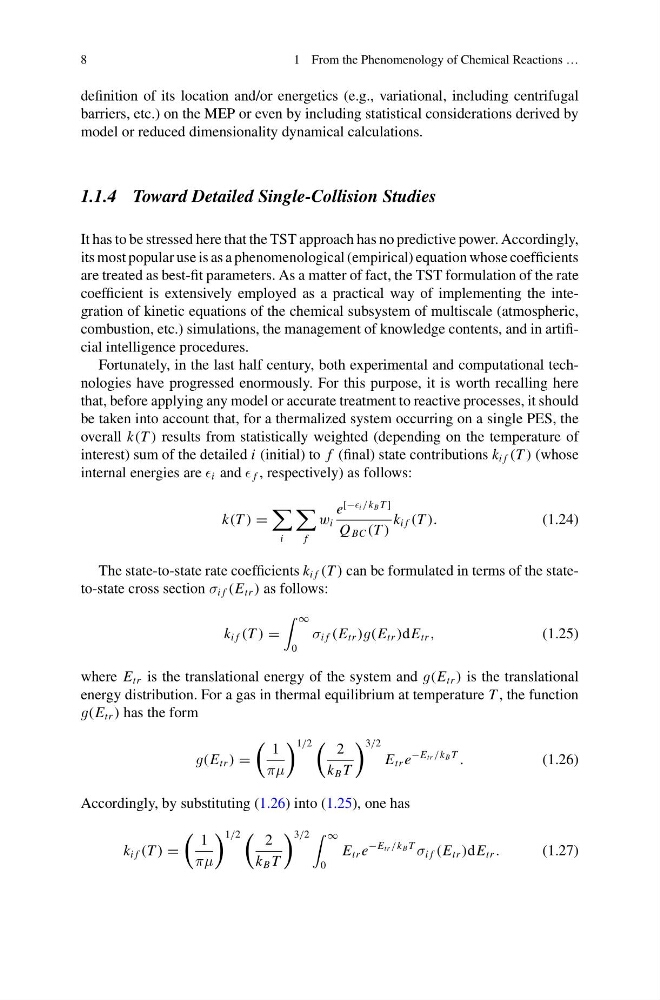
overall k(T ) results from statistically weighted (depending on the temperature of
interest) sum of the detailed i (initial) to f (final) state contributions k i f (T ) (whose
internal energies are i and f , respectively) as follows:
k(T ) =
i
f
w i
e
[− i /k B T ]
Q BC (T )
k i f (T ).
(1.24)
The state-to-state rate coefficients k i f (T ) can be formulated in terms of the stateto-state cross section σ i f (E tr ) as follows:
k i f (T ) =
∞
0
σ i f (E tr )g(E tr )dE tr ,
(1.25)
where E tr is the translational energy of the system and g(E tr ) is the translational
energy distribution. For a gas in thermal equilibrium at temperature T , the function
g(E tr ) has the form
g(E tr ) =
1
πμ
1/2
2
k B T
3/2
E tr e
−E tr /k B T
.
(1.26)
Accordingly, by substituting (1.26) into (1.25), one has
k i f (T ) =
1
πμ
1/2
2
k B T
3/2 ∞
0
E tr e
−E tr /k B T
σ i f (E tr )dE tr .
(1.27)
1 From the Phenomenology of Chemical Reactions …
definition of its location and/or energetics (e.g., variational, including centrifugal
barriers, etc.) on the MEP or even by including statistical considerations derived by
model or reduced dimensionality dynamical calculations.
1.1.4 Toward Detailed Single-Collision Studies
It has to be stressed here that the TST approach has no predictive power. Accordingly,
its most popular use is as a phenomenological (empirical) equation whose coefficients
are treated as best-fit parameters. As a matter of fact, the TST formulation of the rate
coefficient is extensively employed as a practical way of implementing the integration of kinetic equations of the chemical subsystem of multiscale (atmospheric,
combustion, etc.) simulations, the management of knowledge contents, and in artificial intelligence procedures.
Fortunately, in the last half century, both experimental and computational technologies have progressed enormously. For this purpose, it is worth recalling here
that, before applying any model or accurate treatment to reactive processes, it should
be taken into account that, for a thermalized system occurring on a single PES, the
overall k(T ) results from statistically weighted (depending on the temperature of
interest) sum of the detailed i (initial) to f (final) state contributions k i f (T ) (whose
internal energies are i and f , respectively) as follows:
k(T ) =
i
f
w i
e
[− i /k B T ]
Q BC (T )
k i f (T ).
(1.24)
The state-to-state rate coefficients k i f (T ) can be formulated in terms of the stateto-state cross section σ i f (E tr ) as follows:
k i f (T ) =
∞
0
σ i f (E tr )g(E tr )dE tr ,
(1.25)
where E tr is the translational energy of the system and g(E tr ) is the translational
energy distribution. For a gas in thermal equilibrium at temperature T , the function
g(E tr ) has the form
g(E tr ) =
1
πμ
1/2
2
k B T
3/2
E tr e
−E tr /k B T
.
(1.26)
Accordingly, by substituting (1.26) into (1.25), one has
k i f (T ) =
1
πμ
1/2
2
k B T
3/2 ∞
0
E tr e
−E tr /k B T
σ i f (E tr )dE tr .
(1.27)