

170
5 Complex Reactive Applications: A Forward Look to Open Science
paths making the definition of the functional representation of the overall PES almost
impossible.
Accordingly, thanks to the present easier accessibility to fast computers, increasing use is made of “on the fly” techniques (also called direct) in which the potential
energy of a given molecular geometry is computed using a suitable package right
when (and if) it is actually needed rather than adopting a general functional formulation of the whole PES. This approach avoids heavy ab initio calculations of the
potential energy (and related derivatives) for the system geometries which are not
reached during the integration of the dynamical equations. The price to pay, however, is the impossibility of carrying out a preliminary analysis of the PES to discard
nonconverged values and the practical impossibility of using top-level theoretical
treatments for ab initio calculations and LS fitting.
For complex systems, the most frequently adopted solution is the molecular
mechanics (MM) one. Typically, in MM applications an ex ante overall assemblage
and calibration of the PES is performed by making use of several simple empirical
local formulations of the interaction to shape the energy channels associated with
the different degrees of freedom. In this approach, based on the separate treatment of
independent simple components (force fields), each bond length, each planar or dihedral or out-of-plane angle, each ionic or dispersion interaction is treated individually
despite the fact that this is likely to introduce an uncontrolled fine structure in the
interaction representation. The theoretical ground for this approach is the adoption
of a generalized MBE of the interaction (as already discussed in Chap. 3) followed
by the dropping of terms of higher order. This means, for example, that the retained
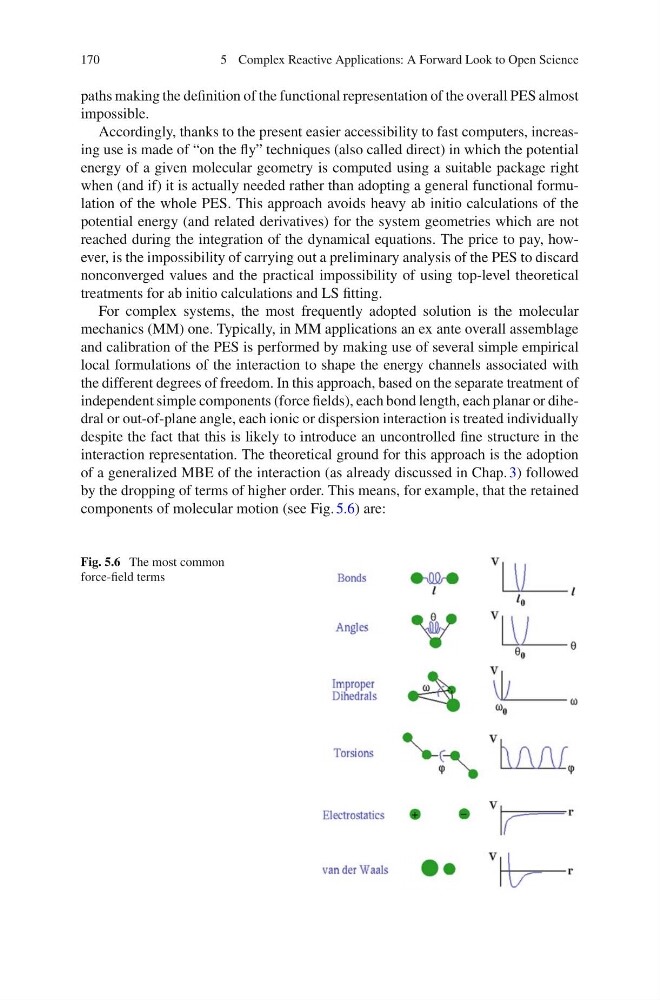
components of molecular motion (see Fig. 5.6) are:
Fig. 5.6 The most common
force-field terms
5 Complex Reactive Applications: A Forward Look to Open Science
paths making the definition of the functional representation of the overall PES almost
impossible.
Accordingly, thanks to the present easier accessibility to fast computers, increasing use is made of “on the fly” techniques (also called direct) in which the potential
energy of a given molecular geometry is computed using a suitable package right
when (and if) it is actually needed rather than adopting a general functional formulation of the whole PES. This approach avoids heavy ab initio calculations of the
potential energy (and related derivatives) for the system geometries which are not
reached during the integration of the dynamical equations. The price to pay, however, is the impossibility of carrying out a preliminary analysis of the PES to discard
nonconverged values and the practical impossibility of using top-level theoretical
treatments for ab initio calculations and LS fitting.
For complex systems, the most frequently adopted solution is the molecular
mechanics (MM) one. Typically, in MM applications an ex ante overall assemblage
and calibration of the PES is performed by making use of several simple empirical
local formulations of the interaction to shape the energy channels associated with
the different degrees of freedom. In this approach, based on the separate treatment of
independent simple components (force fields), each bond length, each planar or dihedral or out-of-plane angle, each ionic or dispersion interaction is treated individually
despite the fact that this is likely to introduce an uncontrolled fine structure in the
interaction representation. The theoretical ground for this approach is the adoption
of a generalized MBE of the interaction (as already discussed in Chap. 3) followed
by the dropping of terms of higher order. This means, for example, that the retained
components of molecular motion (see Fig. 5.6) are:
Fig. 5.6 The most common
force-field terms