

5.2 Large Systems Studies Using Classical Dynamics
169
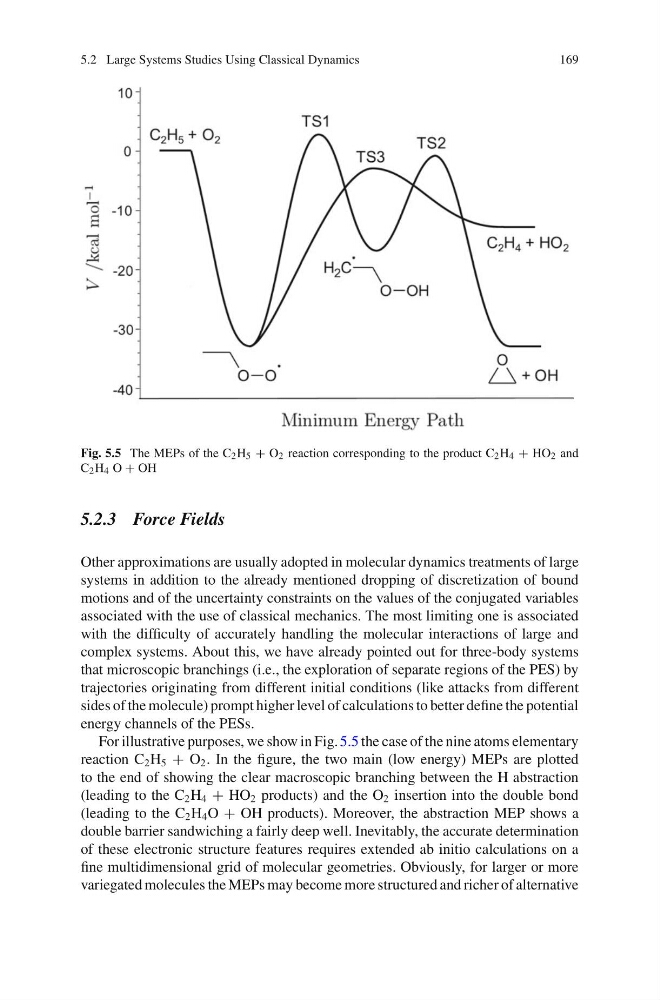
Fig. 5.5 The MEPs of the C 2 H 5 + O 2 reaction corresponding to the product C 2 H 4 + HO 2 and
C 2 H 4 O + OH
5.2.3 Force Fields
Other approximations are usually adopted in molecular dynamics treatments of large
systems in addition to the already mentioned dropping of discretization of bound
motions and of the uncertainty constraints on the values of the conjugated variables
associated with the use of classical mechanics. The most limiting one is associated
with the difficulty of accurately handling the molecular interactions of large and
complex systems. About this, we have already pointed out for three-body systems
that microscopic branchings (i.e., the exploration of separate regions of the PES) by
trajectories originating from different initial conditions (like attacks from different
sides of the molecule) prompt higher level of calculations to better define the potential
energy channels of the PESs.
For illustrative purposes, we show in Fig. 5.5 the case of the nine atoms elementary
reaction C 2 H 5 + O 2 . In the figure, the two main (low energy) MEPs are plotted
to the end of showing the clear macroscopic branching between the H abstraction
(leading to the C 2 H 4 + HO 2 products) and the O 2 insertion into the double bond
(leading to the C 2 H 4 O + OH products). Moreover, the abstraction MEP shows a
double barrier sandwiching a fairly deep well. Inevitably, the accurate determination
of these electronic structure features requires extended ab initio calculations on a
fine multidimensional grid of molecular geometries. Obviously, for larger or more
variegated molecules the MEPs may become more structured and richer of alternative
169
Fig. 5.5 The MEPs of the C 2 H 5 + O 2 reaction corresponding to the product C 2 H 4 + HO 2 and
C 2 H 4 O + OH
5.2.3 Force Fields
Other approximations are usually adopted in molecular dynamics treatments of large
systems in addition to the already mentioned dropping of discretization of bound
motions and of the uncertainty constraints on the values of the conjugated variables
associated with the use of classical mechanics. The most limiting one is associated
with the difficulty of accurately handling the molecular interactions of large and
complex systems. About this, we have already pointed out for three-body systems
that microscopic branchings (i.e., the exploration of separate regions of the PES) by
trajectories originating from different initial conditions (like attacks from different
sides of the molecule) prompt higher level of calculations to better define the potential
energy channels of the PESs.
For illustrative purposes, we show in Fig. 5.5 the case of the nine atoms elementary
reaction C 2 H 5 + O 2 . In the figure, the two main (low energy) MEPs are plotted
to the end of showing the clear macroscopic branching between the H abstraction
(leading to the C 2 H 4 + HO 2 products) and the O 2 insertion into the double bond
(leading to the C 2 H 4 O + OH products). Moreover, the abstraction MEP shows a
double barrier sandwiching a fairly deep well. Inevitably, the accurate determination
of these electronic structure features requires extended ab initio calculations on a
fine multidimensional grid of molecular geometries. Obviously, for larger or more
variegated molecules the MEPs may become more structured and richer of alternative