

5.2 Large Systems Studies Using Classical Dynamics
171
• the two-body stretching of atom–atom bonds,
• the bending of an in-plane angle formed by two bonds,
• the variation of either a proper or improper dihedral angle,
• the torsion around a given axis
• the Coulombic repulsion/attraction,
• the short-range repulsion and long-range attraction of two dressed nuclei.
which are formulated, respectively, using simple analytical functions like:
• either a Harmonic or a Morse oscillator,
• a Harmonic oscillator,
• an out-of-plane Harmonic oscillator,
• a Fourier series,
• a positive/negative inverse r power, and
• an inverted 12th power of r (or a Buckingham Ae
−Br ) at short range and a multipolar expansion of the van der Waals type at long range
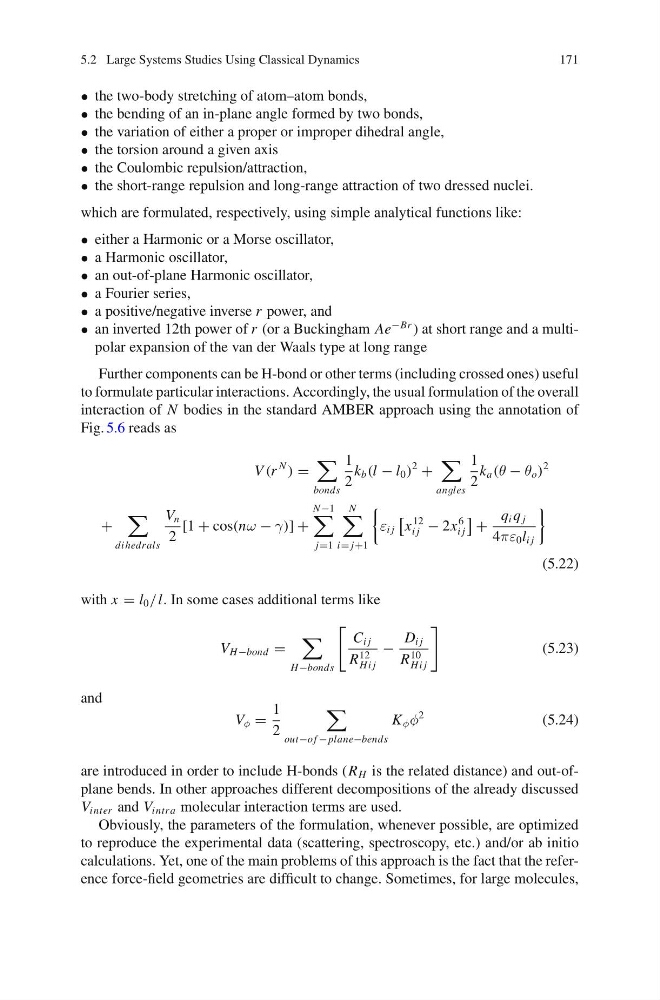
Further components can be H-bond or other terms (including crossed ones) useful
to formulate particular interactions. Accordingly, the usual formulation of the overall
interaction of N bodies in the standard AMBER approach using the annotation of
Fig. 5.6 reads as
V (r
N
) =
bonds
1
2
k b (l − l 0 )
2
+
angles
1
2
k a (θ − θ o )
2
+
dihedrals
V n
2
[1 + cos(nω − γ)] +
N −1
j=1
N
i= j+1
ε i j
x
12
i j − 2x
6
i j
+
q i q j
4πε 0 l i j
(5.22)
with x = l 0 /l. In some cases additional terms like
V H −bond =
H −bonds
C i j
R
12
Hi j
−
D i j
R
10
Hi j
(5.23)
and
V φ =
1
2
out−of − plane−bends
K φ φ
2
(5.24)
are introduced in order to include H-bonds (R H is the related distance) and out-ofplane bends. In other approaches different decompositions of the already discussed
V inter and V intra molecular interaction terms are used.
Obviously, the parameters of the formulation, whenever possible, are optimized
to reproduce the experimental data (scattering, spectroscopy, etc.) and/or ab initio
calculations. Yet, one of the main problems of this approach is the fact that the reference force-field geometries are difficult to change. Sometimes, for large molecules,
171
• the two-body stretching of atom–atom bonds,
• the bending of an in-plane angle formed by two bonds,
• the variation of either a proper or improper dihedral angle,
• the torsion around a given axis
• the Coulombic repulsion/attraction,
• the short-range repulsion and long-range attraction of two dressed nuclei.
which are formulated, respectively, using simple analytical functions like:
• either a Harmonic or a Morse oscillator,
• a Harmonic oscillator,
• an out-of-plane Harmonic oscillator,
• a Fourier series,
• a positive/negative inverse r power, and
• an inverted 12th power of r (or a Buckingham Ae
−Br ) at short range and a multipolar expansion of the van der Waals type at long range
Further components can be H-bond or other terms (including crossed ones) useful
to formulate particular interactions. Accordingly, the usual formulation of the overall
interaction of N bodies in the standard AMBER approach using the annotation of
Fig. 5.6 reads as
V (r
N
) =
bonds
1
2
k b (l − l 0 )
2
+
angles
1
2
k a (θ − θ o )
2
+
dihedrals
V n
2
[1 + cos(nω − γ)] +
N −1
j=1
N
i= j+1
ε i j
x
12
i j − 2x
6
i j
+
q i q j
4πε 0 l i j
(5.22)
with x = l 0 /l. In some cases additional terms like
V H −bond =
H −bonds
C i j
R
12
Hi j
−
D i j
R
10
Hi j
(5.23)
and
V φ =
1
2
out−of − plane−bends
K φ φ
2
(5.24)
are introduced in order to include H-bonds (R H is the related distance) and out-ofplane bends. In other approaches different decompositions of the already discussed
V inter and V intra molecular interaction terms are used.
Obviously, the parameters of the formulation, whenever possible, are optimized
to reproduce the experimental data (scattering, spectroscopy, etc.) and/or ab initio
calculations. Yet, one of the main problems of this approach is the fact that the reference force-field geometries are difficult to change. Sometimes, for large molecules,