

4
1 From the Phenomenology of Chemical Reactions …
η against ln τ (see the example sketched in the lower row of Fig. 1.1 again for m =
0, 1, and 2).
Under the assumptions mentioned above, one can, in principle, estimate the value
of the rate coefficient at a different given temperature T and initial concentration
[X] o values (such measurements are performed using either chemical or physical
properties of the reactive system) by measuring the current concentration [X] of the
involved species at different elapsed times.
1.1.2 Realistic Kinetic Models
However, even seemingly, simple gas-phase reactions are difficult to interpret in this
way due to the uncertainty of the experimental measurements and to the complexity
of the actual reaction mechanisms. In the real world, chemical processes generally
occur through a combination of several different simpler (elementary) steps that
produce and connect various intermediates of different stabilities and give rise to
complex reaction mechanisms combining initiation, propagation, chain propagation,
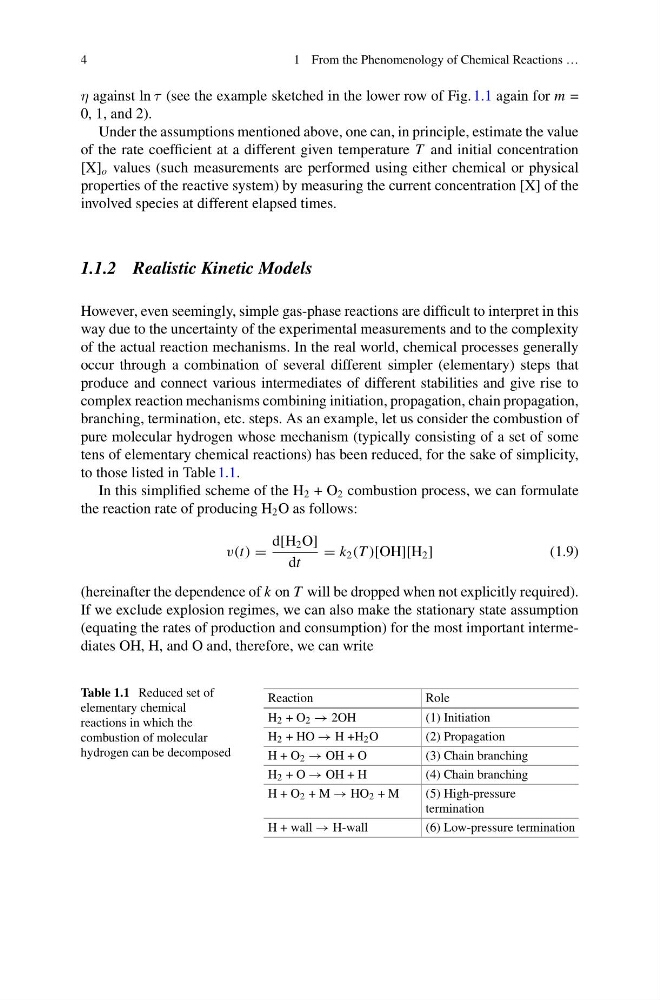
branching, termination, etc. steps. As an example, let us consider the combustion of
pure molecular hydrogen whose mechanism (typically consisting of a set of some
tens of elementary chemical reactions) has been reduced, for the sake of simplicity,
to those listed in Table 1.1.
In this simplified scheme of the H 2 + O 2 combustion process, we can formulate
the reaction rate of producing H 2 O as follows:
v(t) =
d[H 2 O]
dt
= k 2 (T )[OH][H 2 ]
(1.9)
(hereinafter the dependence of k on T will be dropped when not explicitly required).
If we exclude explosion regimes, we can also make the stationary state assumption
(equating the rates of production and consumption) for the most important intermediates OH, H, and O and, therefore, we can write
Table 1.1 Reduced set of
elementary chemical
reactions in which the
combustion of molecular
hydrogen can be decomposed
Reaction
Role
H 2 + O 2 → 2OH
(1) Initiation
H 2 + HO → H +H 2 O
(2) Propagation
H + O 2 → OH + O
(3) Chain branching
H 2 + O → OH + H
(4) Chain branching
H + O 2 + M → HO 2 + M
(5) High-pressure
termination
H + wall → H-wall
(6) Low-pressure termination
1 From the Phenomenology of Chemical Reactions …
η against ln τ (see the example sketched in the lower row of Fig. 1.1 again for m =
0, 1, and 2).
Under the assumptions mentioned above, one can, in principle, estimate the value
of the rate coefficient at a different given temperature T and initial concentration
[X] o values (such measurements are performed using either chemical or physical
properties of the reactive system) by measuring the current concentration [X] of the
involved species at different elapsed times.
1.1.2 Realistic Kinetic Models
However, even seemingly, simple gas-phase reactions are difficult to interpret in this
way due to the uncertainty of the experimental measurements and to the complexity
of the actual reaction mechanisms. In the real world, chemical processes generally
occur through a combination of several different simpler (elementary) steps that
produce and connect various intermediates of different stabilities and give rise to
complex reaction mechanisms combining initiation, propagation, chain propagation,
branching, termination, etc. steps. As an example, let us consider the combustion of
pure molecular hydrogen whose mechanism (typically consisting of a set of some
tens of elementary chemical reactions) has been reduced, for the sake of simplicity,
to those listed in Table 1.1.
In this simplified scheme of the H 2 + O 2 combustion process, we can formulate
the reaction rate of producing H 2 O as follows:
v(t) =
d[H 2 O]
dt
= k 2 (T )[OH][H 2 ]
(1.9)
(hereinafter the dependence of k on T will be dropped when not explicitly required).
If we exclude explosion regimes, we can also make the stationary state assumption
(equating the rates of production and consumption) for the most important intermediates OH, H, and O and, therefore, we can write
Table 1.1 Reduced set of
elementary chemical
reactions in which the
combustion of molecular
hydrogen can be decomposed
Reaction
Role
H 2 + O 2 → 2OH
(1) Initiation
H 2 + HO → H +H 2 O
(2) Propagation
H + O 2 → OH + O
(3) Chain branching
H 2 + O → OH + H
(4) Chain branching
H + O 2 + M → HO 2 + M
(5) High-pressure
termination
H + wall → H-wall
(6) Low-pressure termination