

1.1 From Kinetics to Bimolecular Collisions
5
d[OH]
dt
= 0 = 2k 1 [H 2 ][O 2 ] − k 2 [OH][H 2 ] + k 3 [H][O 2 ] + k 4 [O][H 2 ]
(1.10)
d[H]
dt
= 0 = k 2 [OH][H 2 ] − k 3 [H][O 2 ] + k 4 [O][H 2 ] − k 5 [H][O 2 ][M]
−k 6 [H]
(1.11)
d[O]
dt
= 0 = k 3 [H][O 2 ] − k 4 [O][H 2 ].
(1.12)
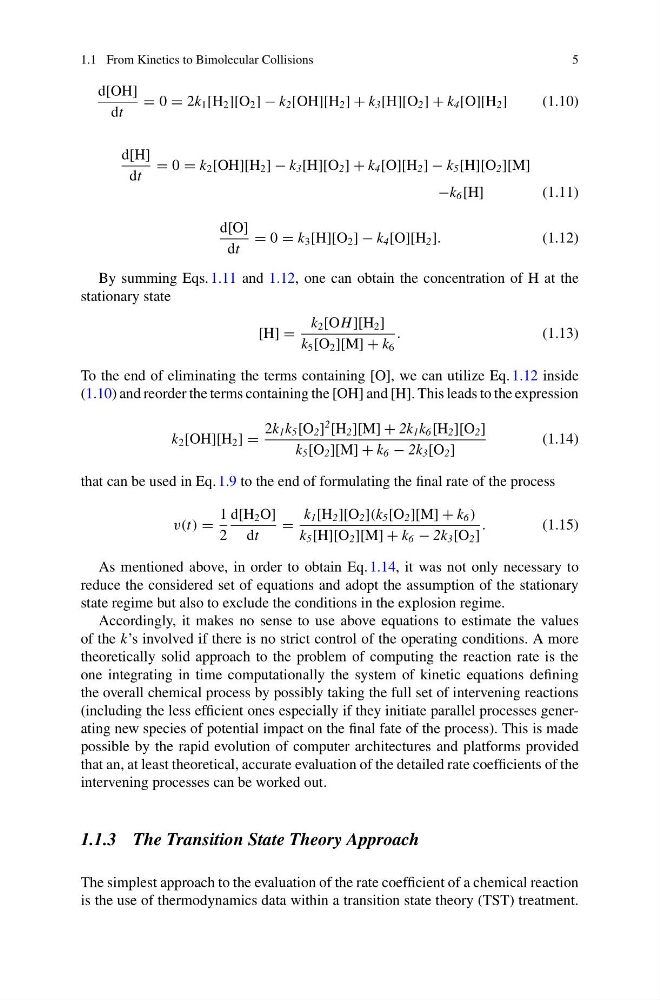
By summing Eqs. 1.11 and 1.12, one can obtain the concentration of H at the
stationary state
[H] =
k 2 [OH ][H 2 ]
k 5 [O 2 ][M] + k 6
.
(1.13)
To the end of eliminating the terms containing [O], we can utilize Eq. 1.12 inside
(1.10) and reorder the terms containing the [OH] and [H]. This leads to the expression
k 2 [OH][H 2 ] =
2k 1 k 5 [O 2 ]
2
[H 2 ][M] + 2k 1 k 6 [H 2 ][O 2 ]
k 5 [O 2 ][M] + k 6 − 2k 3 [O 2 ]
(1.14)
that can be used in Eq. 1.9 to the end of formulating the final rate of the process
v(t) =
1
2
d[H 2 O]
dt
=
k 1 [H 2 ][O 2 ](k 5 [O 2 ][M] + k 6 )
k 5 [H][O 2 ][M] + k 6 − 2k 3 [O 2 ]
.
(1.15)
As mentioned above, in order to obtain Eq. 1.14, it was not only necessary to
reduce the considered set of equations and adopt the assumption of the stationary
state regime but also to exclude the conditions in the explosion regime.
Accordingly, it makes no sense to use above equations to estimate the values
of the k’s involved if there is no strict control of the operating conditions. A more
theoretically solid approach to the problem of computing the reaction rate is the
one integrating in time computationally the system of kinetic equations defining
the overall chemical process by possibly taking the full set of intervening reactions
(including the less efficient ones especially if they initiate parallel processes generating new species of potential impact on the final fate of the process). This is made
possible by the rapid evolution of computer architectures and platforms provided
that an, at least theoretical, accurate evaluation of the detailed rate coefficients of the
intervening processes can be worked out.
1.1.3 The Transition State Theory Approach
The simplest approach to the evaluation of the rate coefficient of a chemical reaction
is the use of thermodynamics data within a transition state theory (TST) treatment.
5
d[OH]
dt
= 0 = 2k 1 [H 2 ][O 2 ] − k 2 [OH][H 2 ] + k 3 [H][O 2 ] + k 4 [O][H 2 ]
(1.10)
d[H]
dt
= 0 = k 2 [OH][H 2 ] − k 3 [H][O 2 ] + k 4 [O][H 2 ] − k 5 [H][O 2 ][M]
−k 6 [H]
(1.11)
d[O]
dt
= 0 = k 3 [H][O 2 ] − k 4 [O][H 2 ].
(1.12)
By summing Eqs. 1.11 and 1.12, one can obtain the concentration of H at the
stationary state
[H] =
k 2 [OH ][H 2 ]
k 5 [O 2 ][M] + k 6
.
(1.13)
To the end of eliminating the terms containing [O], we can utilize Eq. 1.12 inside
(1.10) and reorder the terms containing the [OH] and [H]. This leads to the expression
k 2 [OH][H 2 ] =
2k 1 k 5 [O 2 ]
2
[H 2 ][M] + 2k 1 k 6 [H 2 ][O 2 ]
k 5 [O 2 ][M] + k 6 − 2k 3 [O 2 ]
(1.14)
that can be used in Eq. 1.9 to the end of formulating the final rate of the process
v(t) =
1
2
d[H 2 O]
dt
=
k 1 [H 2 ][O 2 ](k 5 [O 2 ][M] + k 6 )
k 5 [H][O 2 ][M] + k 6 − 2k 3 [O 2 ]
.
(1.15)
As mentioned above, in order to obtain Eq. 1.14, it was not only necessary to
reduce the considered set of equations and adopt the assumption of the stationary
state regime but also to exclude the conditions in the explosion regime.
Accordingly, it makes no sense to use above equations to estimate the values
of the k’s involved if there is no strict control of the operating conditions. A more
theoretically solid approach to the problem of computing the reaction rate is the
one integrating in time computationally the system of kinetic equations defining
the overall chemical process by possibly taking the full set of intervening reactions
(including the less efficient ones especially if they initiate parallel processes generating new species of potential impact on the final fate of the process). This is made
possible by the rapid evolution of computer architectures and platforms provided
that an, at least theoretical, accurate evaluation of the detailed rate coefficients of the
intervening processes can be worked out.
1.1.3 The Transition State Theory Approach
The simplest approach to the evaluation of the rate coefficient of a chemical reaction
is the use of thermodynamics data within a transition state theory (TST) treatment.