

160
5 Complex Reactive Applications: A Forward Look to Open Science
v
i
(r i , t) =
0
v
i
(r i ) +
v
i =v
i
0
v
i
(r i )
H v
i v
i
E
0
v
i
− E
0
v
i
(5.13)
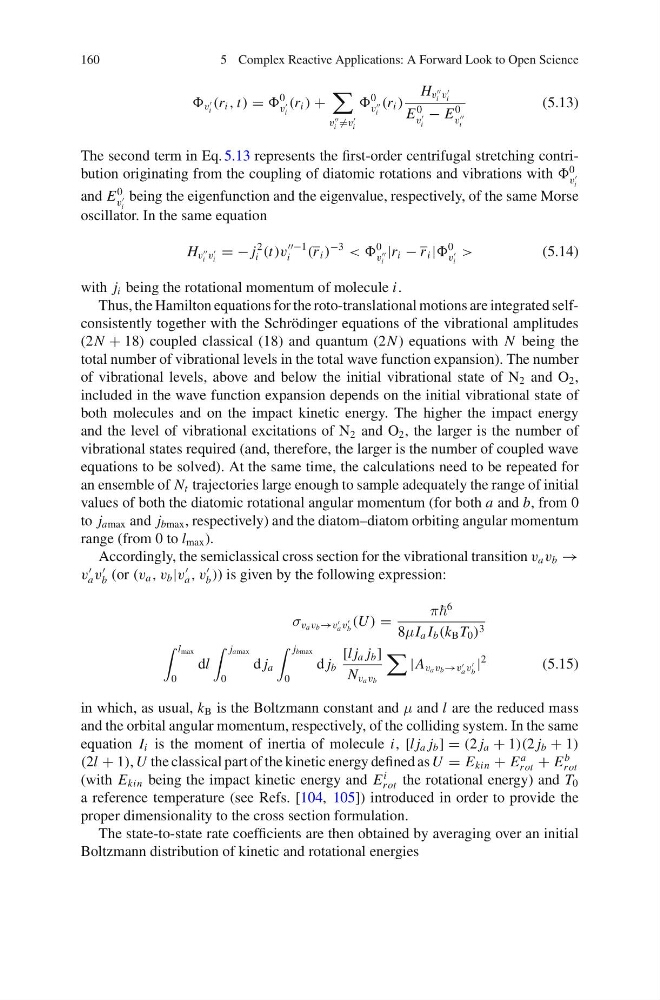
The second term in Eq. 5.13 represents the first-order centrifugal stretching contribution originating from the coupling of diatomic rotations and vibrations with
0
v
i
and E
0
v
i
being the eigenfunction and the eigenvalue, respectively, of the same Morse
oscillator. In the same equation
H v
i v
i
= − j
2
i (t)v
−1
i
(r i )
−3
< <
0
v
i
|r i − r i |
0
v
i
>
(5.14)
with j i being the rotational momentum of molecule i.
Thus, the Hamilton equations for the roto-translational motions are integrated selfconsistently together with the Schrödinger equations of the vibrational amplitudes
(2N + 18) coupled classical (18) and quantum (2N ) equations with N being the
total number of vibrational levels in the total wave function expansion). The number
of vibrational levels, above and below the initial vibrational state of N 2 and O 2 ,
included in the wave function expansion depends on the initial vibrational state of
both molecules and on the impact kinetic energy. The higher the impact energy
and the level of vibrational excitations of N 2 and O 2 , the larger is the number of
vibrational states required (and, therefore, the larger is the number of coupled wave
equations to be solved). At the same time, the calculations need to be repeated for
an ensemble of N t trajectories large enough to sample adequately the range of initial
values of both the diatomic rotational angular momentum (for both a and b, from 0
to j amax and j bmax , respectively) and the diatom–diatom orbiting angular momentum
range (from 0 to l max ).
Accordingly, the semiclassical cross section for the vibrational transition v a v b →
v
a v
b (or (v a , v b |v
a , v
b )) is given by the following expression:
σ v a v b →v
a v
b
(U ) =
π
6
8μI a I b (k B T 0 ) 3
l max
0
dl
j amax
0
d j a
j bmax
0
d j b
[l j a j b ]
N v a v b
|A v a v b →v
a v
b
|
2
(5.15)
in which, as usual, k B is the Boltzmann constant and μ and l are the reduced mass
and the orbital angular momentum, respectively, of the colliding system. In the same
equation I i is the moment of inertia of molecule i, [l j a j b ] = (2 j a + 1)(2 j b + 1)
(2l + 1), U the classical part of the kinetic energy defined as U = E kin + E
a
rot + E
b
rot
(with E kin being the impact kinetic energy and E
i
rot the rotational energy) and T 0
a reference temperature (see Refs. [104, 105]) introduced in order to provide the
proper dimensionality to the cross section formulation.
The state-to-state rate coefficients are then obtained by averaging over an initial
Boltzmann distribution of kinetic and rotational energies
5 Complex Reactive Applications: A Forward Look to Open Science
v
i
(r i , t) =
0
v
i
(r i ) +
v
i =v
i
0
v
i
(r i )
H v
i v
i
E
0
v
i
− E
0
v
i
(5.13)
The second term in Eq. 5.13 represents the first-order centrifugal stretching contribution originating from the coupling of diatomic rotations and vibrations with
0
v
i
and E
0
v
i
being the eigenfunction and the eigenvalue, respectively, of the same Morse
oscillator. In the same equation
H v
i v
i
= − j
2
i (t)v
−1
i
(r i )
−3
< <
0
v
i
|r i − r i |
0
v
i
>
(5.14)
with j i being the rotational momentum of molecule i.
Thus, the Hamilton equations for the roto-translational motions are integrated selfconsistently together with the Schrödinger equations of the vibrational amplitudes
(2N + 18) coupled classical (18) and quantum (2N ) equations with N being the
total number of vibrational levels in the total wave function expansion). The number
of vibrational levels, above and below the initial vibrational state of N 2 and O 2 ,
included in the wave function expansion depends on the initial vibrational state of
both molecules and on the impact kinetic energy. The higher the impact energy
and the level of vibrational excitations of N 2 and O 2 , the larger is the number of
vibrational states required (and, therefore, the larger is the number of coupled wave
equations to be solved). At the same time, the calculations need to be repeated for
an ensemble of N t trajectories large enough to sample adequately the range of initial
values of both the diatomic rotational angular momentum (for both a and b, from 0
to j amax and j bmax , respectively) and the diatom–diatom orbiting angular momentum
range (from 0 to l max ).
Accordingly, the semiclassical cross section for the vibrational transition v a v b →
v
a v
b (or (v a , v b |v
a , v
b )) is given by the following expression:
σ v a v b →v
a v
b
(U ) =
π
6
8μI a I b (k B T 0 ) 3
l max
0
dl
j amax
0
d j a
j bmax
0
d j b
[l j a j b ]
N v a v b
|A v a v b →v
a v
b
|
2
(5.15)
in which, as usual, k B is the Boltzmann constant and μ and l are the reduced mass
and the orbital angular momentum, respectively, of the colliding system. In the same
equation I i is the moment of inertia of molecule i, [l j a j b ] = (2 j a + 1)(2 j b + 1)
(2l + 1), U the classical part of the kinetic energy defined as U = E kin + E
a
rot + E
b
rot
(with E kin being the impact kinetic energy and E
i
rot the rotational energy) and T 0
a reference temperature (see Refs. [104, 105]) introduced in order to provide the
proper dimensionality to the cross section formulation.
The state-to-state rate coefficients are then obtained by averaging over an initial
Boltzmann distribution of kinetic and rotational energies