

5.1 Toward More Complex Systems
161
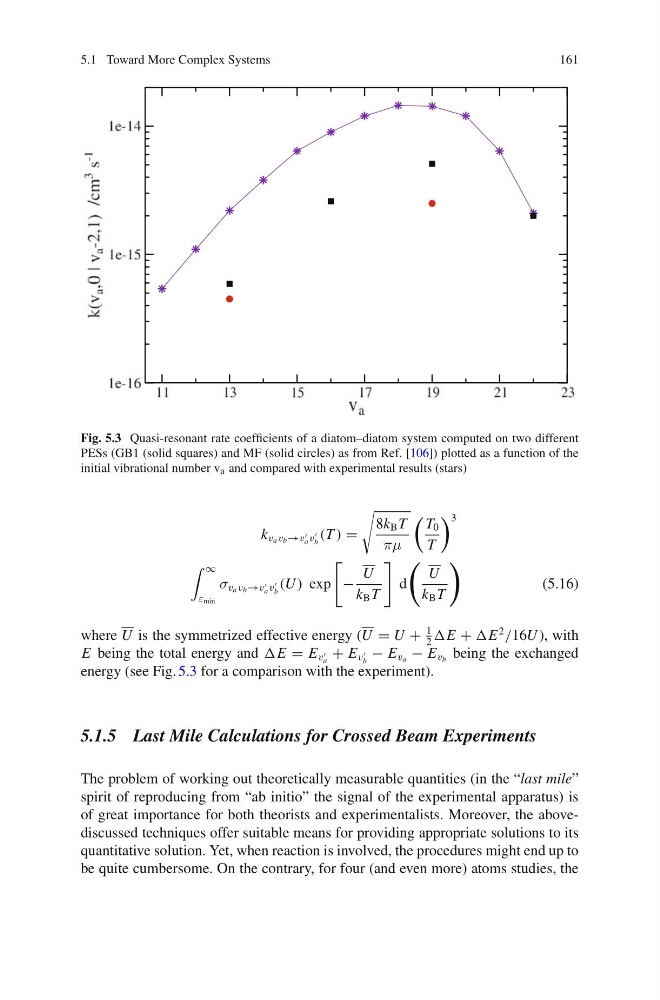
Fig. 5.3 Quasi-resonant rate coefficients of a diatom–diatom system computed on two different
PESs (GB1 (solid squares) and MF (solid circles) as from Ref. [106]) plotted as a function of the
initial vibrational number v a and compared with experimental results (stars)
k v a v b →v
a v
b
(T ) =
8k B T
πμ
T 0
T
3
∞
ε min
σ v a v b →v
a v
b
(U ) exp
−
U
k B T
d
U
k B T
(5.16)
where U is the symmetrized effective energy (U = U +
1
2
E + E
2
/16U ), with
E being the total energy and E = E v
a
+ E v
b
− E v a − E v b being the exchanged
energy (see Fig. 5.3 for a comparison with the experiment).
5.1.5 Last Mile Calculations for Crossed Beam Experiments
The problem of working out theoretically measurable quantities (in the “last mile”
spirit of reproducing from “ab initio” the signal of the experimental apparatus) is
of great importance for both theorists and experimentalists. Moreover, the abovediscussed techniques offer suitable means for providing appropriate solutions to its
quantitative solution. Yet, when reaction is involved, the procedures might end up to
be quite cumbersome. On the contrary, for four (and even more) atoms studies, the
161
Fig. 5.3 Quasi-resonant rate coefficients of a diatom–diatom system computed on two different
PESs (GB1 (solid squares) and MF (solid circles) as from Ref. [106]) plotted as a function of the
initial vibrational number v a and compared with experimental results (stars)
k v a v b →v
a v
b
(T ) =
8k B T
πμ
T 0
T
3
∞
ε min
σ v a v b →v
a v
b
(U ) exp
−
U
k B T
d
U
k B T
(5.16)
where U is the symmetrized effective energy (U = U +
1
2
E + E
2
/16U ), with
E being the total energy and E = E v
a
+ E v
b
− E v a − E v b being the exchanged
energy (see Fig. 5.3 for a comparison with the experiment).
5.1.5 Last Mile Calculations for Crossed Beam Experiments
The problem of working out theoretically measurable quantities (in the “last mile”
spirit of reproducing from “ab initio” the signal of the experimental apparatus) is
of great importance for both theorists and experimentalists. Moreover, the abovediscussed techniques offer suitable means for providing appropriate solutions to its
quantitative solution. Yet, when reaction is involved, the procedures might end up to
be quite cumbersome. On the contrary, for four (and even more) atoms studies, the