

4.2 Three-Atom Systems
125
T r = A(ρ, θ)J
2
x + B(ρ, θ)J
2
y + C(ρ, θ)J
2
z ,
(4.37)
=
A + B
2
J
2
+
A − B
2
(J
2
x − J
2
y ) +
C −
A + B
2
J
2
z
(4.38)
and
T c = −
i cos θ
μρ 2 sin
2
θ
J y
∂
∂χ
,
where inverses of A(ρ, θ), B(ρ, θ), and C(ρ, θ) are defined as A
−1
(ρ, θ) = μρ
2
(1 +
sin θ), B
−1
(ρ, θ) = 2μρ
2 sin
2
θ, C
−1
(ρ, θ) = μρ
2
(1 − sin θ).
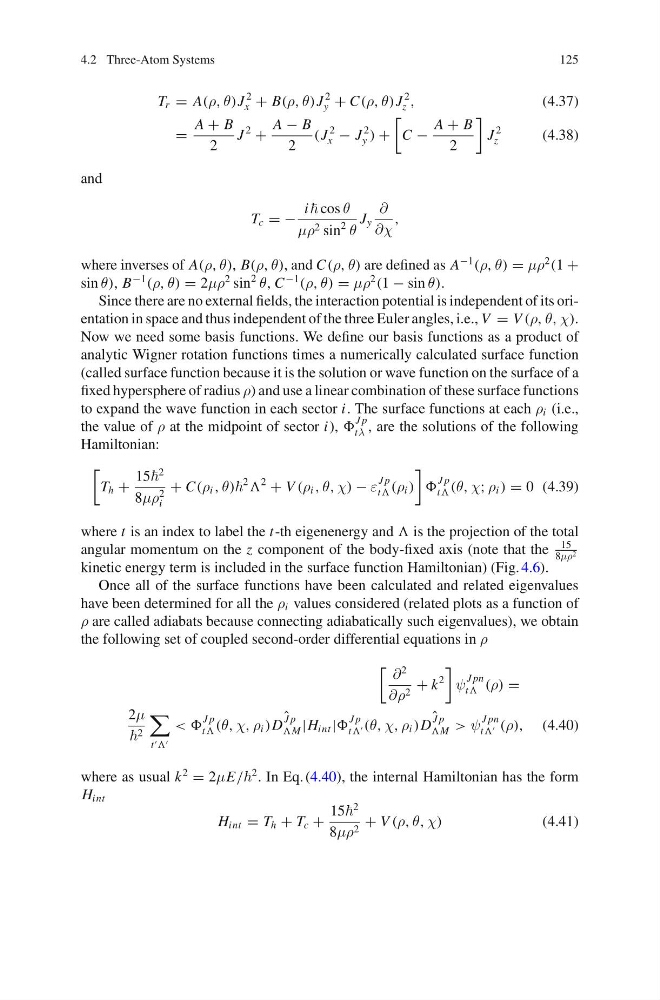
Since there are no external fields, the interaction potential is independent of its orientation in space and thus independent of the three Euler angles, i.e., V = V (ρ, θ, χ).
Now we need some basis functions. We define our basis functions as a product of
analytic Wigner rotation functions times a numerically calculated surface function
(called surface function because it is the solution or wave function on the surface of a
fixed hypersphere of radius ρ) and use a linear combination of these surface functions
to expand the wave function in each sector i. The surface functions at each ρ i (i.e.,
the value of ρ at the midpoint of sector i),
J p
tλ , are the solutions of the following
Hamiltonian:
T h +
15
2
8μρ
2
i
+ C(ρ i , θ)
2
2
+ V (ρ i , θ, χ) − ε
J p
t (ρ i )
J p
t (θ, χ; ρ i ) = 0 (4.39)
where t is an index to label the t-th eigenenergy and is the projection of the total
angular momentum on the z component of the body-fixed axis (note that the
15
8μρ 2
kinetic energy term is included in the surface function Hamiltonian) (Fig. 4.6).
Once all of the surface functions have been calculated and related eigenvalues
have been determined for all the ρ i values considered (related plots as a function of
ρ are called adiabats because connecting adiabatically such eigenvalues), we obtain
the following set of coupled second-order differential equations in ρ
∂
2
∂ρ 2 + k
2
ψ
J pn
t (ρ) =
2μ
2
t
< <
J p
t (θ, χ, ρ i )
ˆ
D
J p
M |H int |
J p
t (θ, χ, ρ i )
ˆ
D
J p
M > ψ
J pn
t (ρ), (4.40)
where as usual k
2
= 2μE/
2 . In Eq.(4.40), the internal Hamiltonian has the form
H int
H int = T h + T c +
15
2
8μρ 2 + V (ρ, θ, χ)
(4.41)
125
T r = A(ρ, θ)J
2
x + B(ρ, θ)J
2
y + C(ρ, θ)J
2
z ,
(4.37)
=
A + B
2
J
2
+
A − B
2
(J
2
x − J
2
y ) +
C −
A + B
2
J
2
z
(4.38)
and
T c = −
i cos θ
μρ 2 sin
2
θ
J y
∂
∂χ
,
where inverses of A(ρ, θ), B(ρ, θ), and C(ρ, θ) are defined as A
−1
(ρ, θ) = μρ
2
(1 +
sin θ), B
−1
(ρ, θ) = 2μρ
2 sin
2
θ, C
−1
(ρ, θ) = μρ
2
(1 − sin θ).
Since there are no external fields, the interaction potential is independent of its orientation in space and thus independent of the three Euler angles, i.e., V = V (ρ, θ, χ).
Now we need some basis functions. We define our basis functions as a product of
analytic Wigner rotation functions times a numerically calculated surface function
(called surface function because it is the solution or wave function on the surface of a
fixed hypersphere of radius ρ) and use a linear combination of these surface functions
to expand the wave function in each sector i. The surface functions at each ρ i (i.e.,
the value of ρ at the midpoint of sector i),
J p
tλ , are the solutions of the following
Hamiltonian:
T h +
15
2
8μρ
2
i
+ C(ρ i , θ)
2
2
+ V (ρ i , θ, χ) − ε
J p
t (ρ i )
J p
t (θ, χ; ρ i ) = 0 (4.39)
where t is an index to label the t-th eigenenergy and is the projection of the total
angular momentum on the z component of the body-fixed axis (note that the
15
8μρ 2
kinetic energy term is included in the surface function Hamiltonian) (Fig. 4.6).
Once all of the surface functions have been calculated and related eigenvalues
have been determined for all the ρ i values considered (related plots as a function of
ρ are called adiabats because connecting adiabatically such eigenvalues), we obtain
the following set of coupled second-order differential equations in ρ
∂
2
∂ρ 2 + k
2
ψ
J pn
t (ρ) =
2μ
2
t
< <
J p
t (θ, χ, ρ i )
ˆ
D
J p
M |H int |
J p
t (θ, χ, ρ i )
ˆ
D
J p
M > ψ
J pn
t (ρ), (4.40)
where as usual k
2
= 2μE/
2 . In Eq.(4.40), the internal Hamiltonian has the form
H int
H int = T h + T c +
15
2
8μρ 2 + V (ρ, θ, χ)
(4.41)