

124
4 The Treatment of Few-Body Reactions
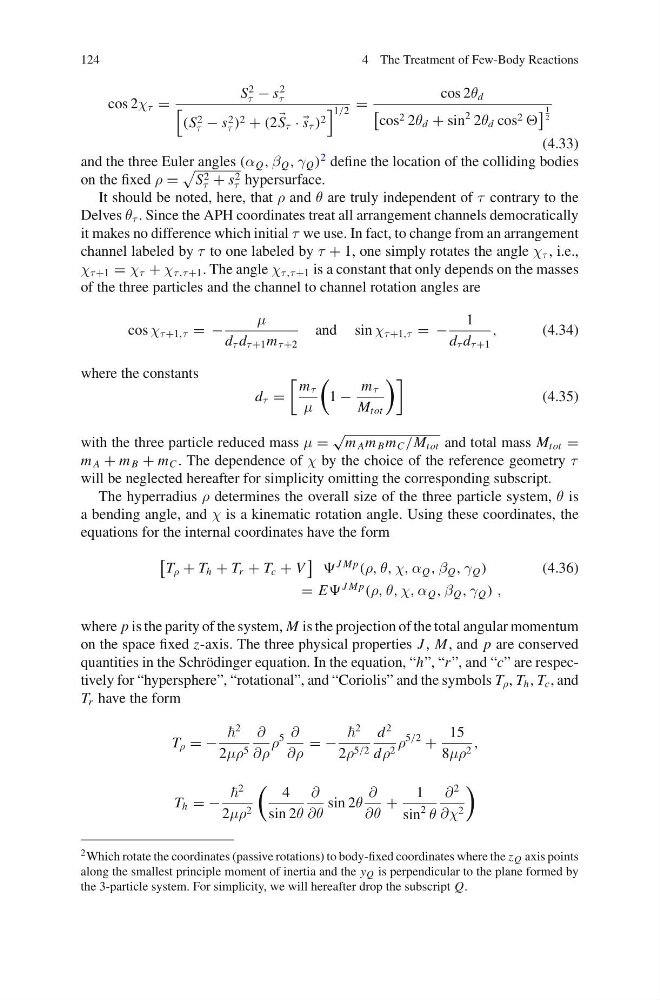
cos 2χ τ =
S
2
τ − s
2
τ
(S 2
τ − s 2
τ ) 2 + (2
S τ · ·
s τ ) 2
1/2 =
cos 2θ d
cos 2 2θ d + sin
2 2θ d cos 2
1
2
(4.33)
and the three Euler angles (α Q , β Q , γ Q )
2 define the location of the colliding bodies
on the fixed ρ =
S 2
τ + s 2
τ hypersurface.
It should be noted, here, that ρ and θ are truly independent of τ contrary to the
Delves θ τ . Since the APH coordinates treat all arrangement channels democratically
it makes no difference which initial τ we use. In fact, to change from an arrangement
channel labeled by τ to one labeled by τ + 1, one simply rotates the angle χ τ , i.e.,
χ τ +1 = χ τ + χ τ ,τ +1 . The angle χ τ ,τ +1 is a constant that only depends on the masses
of the three particles and the channel to channel rotation angles are
cos χ τ +1,τ = −
μ
d τ d τ +1 m τ +2
and sin χ τ +1,τ = −
1
d τ d τ +1
,
(4.34)
where the constants
d τ =
m τ
μ
1 −
m τ
M tot
(4.35)
with the three particle reduced mass μ =
√
m A m B m C /M tot and total mass M tot =
m A + m B + m C . The dependence of χ by the choice of the reference geometry τ
will be neglected hereafter for simplicity omitting the corresponding subscript.
The hyperradius ρ determines the overall size of the three particle system, θ is
a bending angle, and χ is a kinematic rotation angle. Using these coordinates, the
equations for the internal coordinates have the form
T ρ + T h + T r + T c + V
J Mp
(ρ, θ, χ, α Q , β Q , γ Q )
(4.36)
= E
J Mp
(ρ, θ, χ, α Q , β Q , γ Q ) ,
where p is the parity of the system, M is the projection of the total angular momentum
on the space fixed z-axis. The three physical properties J , M, and p are conserved
quantities in the Schrödinger equation. In the equation, “h”, “r ”, and “c” are respectively for “hypersphere”, “rotational”, and “Coriolis” and the symbols T ρ , T h , T c , and
T r have the form
T ρ = −
2
2μρ 5
∂
∂ρ
ρ
5 ∂
∂ρ
= −
2
2ρ 5/2
d
2
dρ 2 ρ
5/2
+
15
8μρ 2 ,
T h = −
2
2μρ 2
4
sin 2θ
∂
∂θ
sin 2θ
∂
∂θ
+
1
sin
2
θ
∂
2
∂χ 2
2 Which rotate the coordinates (passive rotations) to body-fixed coordinates where the z Q axis points
along the smallest principle moment of inertia and the y Q is perpendicular to the plane formed by
the 3-particle system. For simplicity, we will hereafter drop the subscript Q.
4 The Treatment of Few-Body Reactions
cos 2χ τ =
S
2
τ − s
2
τ
(S 2
τ − s 2
τ ) 2 + (2
S τ · ·
s τ ) 2
1/2 =
cos 2θ d
cos 2 2θ d + sin
2 2θ d cos 2
1
2
(4.33)
and the three Euler angles (α Q , β Q , γ Q )
2 define the location of the colliding bodies
on the fixed ρ =
S 2
τ + s 2
τ hypersurface.
It should be noted, here, that ρ and θ are truly independent of τ contrary to the
Delves θ τ . Since the APH coordinates treat all arrangement channels democratically
it makes no difference which initial τ we use. In fact, to change from an arrangement
channel labeled by τ to one labeled by τ + 1, one simply rotates the angle χ τ , i.e.,
χ τ +1 = χ τ + χ τ ,τ +1 . The angle χ τ ,τ +1 is a constant that only depends on the masses
of the three particles and the channel to channel rotation angles are
cos χ τ +1,τ = −
μ
d τ d τ +1 m τ +2
and sin χ τ +1,τ = −
1
d τ d τ +1
,
(4.34)
where the constants
d τ =
m τ
μ
1 −
m τ
M tot
(4.35)
with the three particle reduced mass μ =
√
m A m B m C /M tot and total mass M tot =
m A + m B + m C . The dependence of χ by the choice of the reference geometry τ
will be neglected hereafter for simplicity omitting the corresponding subscript.
The hyperradius ρ determines the overall size of the three particle system, θ is
a bending angle, and χ is a kinematic rotation angle. Using these coordinates, the
equations for the internal coordinates have the form
T ρ + T h + T r + T c + V
J Mp
(ρ, θ, χ, α Q , β Q , γ Q )
(4.36)
= E
J Mp
(ρ, θ, χ, α Q , β Q , γ Q ) ,
where p is the parity of the system, M is the projection of the total angular momentum
on the space fixed z-axis. The three physical properties J , M, and p are conserved
quantities in the Schrödinger equation. In the equation, “h”, “r ”, and “c” are respectively for “hypersphere”, “rotational”, and “Coriolis” and the symbols T ρ , T h , T c , and
T r have the form
T ρ = −
2
2μρ 5
∂
∂ρ
ρ
5 ∂
∂ρ
= −
2
2ρ 5/2
d
2
dρ 2 ρ
5/2
+
15
8μρ 2 ,
T h = −
2
2μρ 2
4
sin 2θ
∂
∂θ
sin 2θ
∂
∂θ
+
1
sin
2
θ
∂
2
∂χ 2
2 Which rotate the coordinates (passive rotations) to body-fixed coordinates where the z Q axis points
along the smallest principle moment of inertia and the y Q is perpendicular to the plane formed by
the 3-particle system. For simplicity, we will hereafter drop the subscript Q.