

126
4 The Treatment of Few-Body Reactions
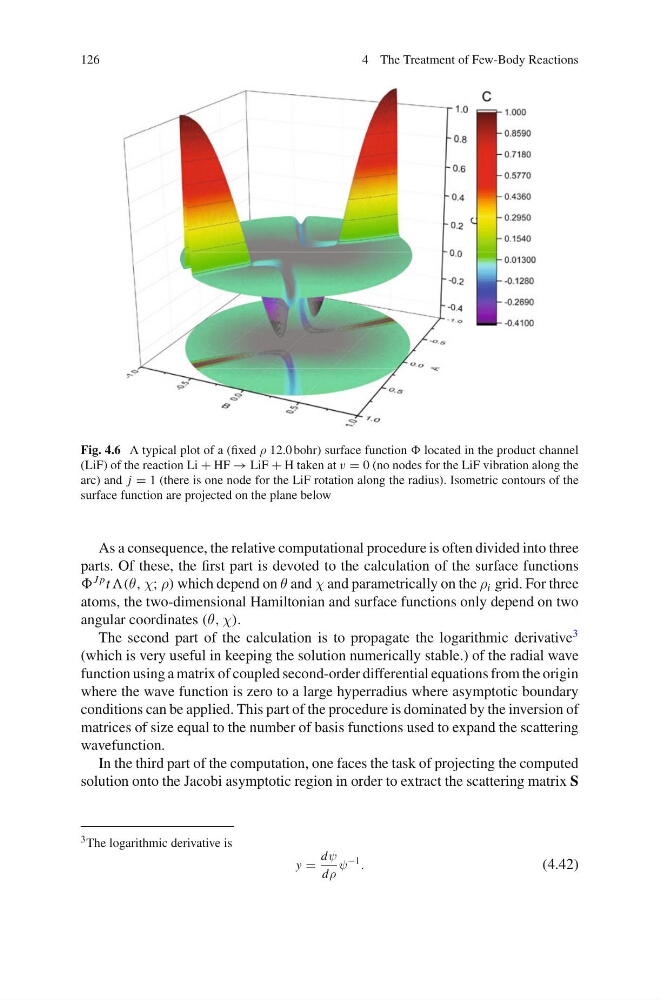
Fig. 4.6 A typical plot of a (fixed ρ 12.0 bohr) surface function located in the product channel
(LiF) of the reaction Li + HF → LiF + H taken at v = 0 (no nodes for the LiF vibration along the
arc) and j = 1 (there is one node for the LiF rotation along the radius). Isometric contours of the
surface function are projected on the plane below
As a consequence, the relative computational procedure is often divided into three
parts. Of these, the first part is devoted to the calculation of the surface functions
J p t(θ, χ; ρ) which depend on θ and χ and parametrically on the ρ i grid. For three
atoms, the two-dimensional Hamiltonian and surface functions only depend on two
angular coordinates (θ, χ).
The second part of the calculation is to propagate the logarithmic derivative
3
(which is very useful in keeping the solution numerically stable.) of the radial wave
function using a matrix of coupled second-order differential equations from the origin
where the wave function is zero to a large hyperradius where asymptotic boundary
conditions can be applied. This part of the procedure is dominated by the inversion of
matrices of size equal to the number of basis functions used to expand the scattering
wavefunction.
In the third part of the computation, one faces the task of projecting the computed
solution onto the Jacobi asymptotic region in order to extract the scattering matrix S
3 The logarithmic derivative is
y =
dψ
dρ
ψ
−1 .
(4.42)
4 The Treatment of Few-Body Reactions
Fig. 4.6 A typical plot of a (fixed ρ 12.0 bohr) surface function located in the product channel
(LiF) of the reaction Li + HF → LiF + H taken at v = 0 (no nodes for the LiF vibration along the
arc) and j = 1 (there is one node for the LiF rotation along the radius). Isometric contours of the
surface function are projected on the plane below
As a consequence, the relative computational procedure is often divided into three
parts. Of these, the first part is devoted to the calculation of the surface functions
J p t(θ, χ; ρ) which depend on θ and χ and parametrically on the ρ i grid. For three
atoms, the two-dimensional Hamiltonian and surface functions only depend on two
angular coordinates (θ, χ).
The second part of the calculation is to propagate the logarithmic derivative
3
(which is very useful in keeping the solution numerically stable.) of the radial wave
function using a matrix of coupled second-order differential equations from the origin
where the wave function is zero to a large hyperradius where asymptotic boundary
conditions can be applied. This part of the procedure is dominated by the inversion of
matrices of size equal to the number of basis functions used to expand the scattering
wavefunction.
In the third part of the computation, one faces the task of projecting the computed
solution onto the Jacobi asymptotic region in order to extract the scattering matrix S
3 The logarithmic derivative is
y =
dψ
dρ
ψ
−1 .
(4.42)