

122
4 The Treatment of Few-Body Reactions
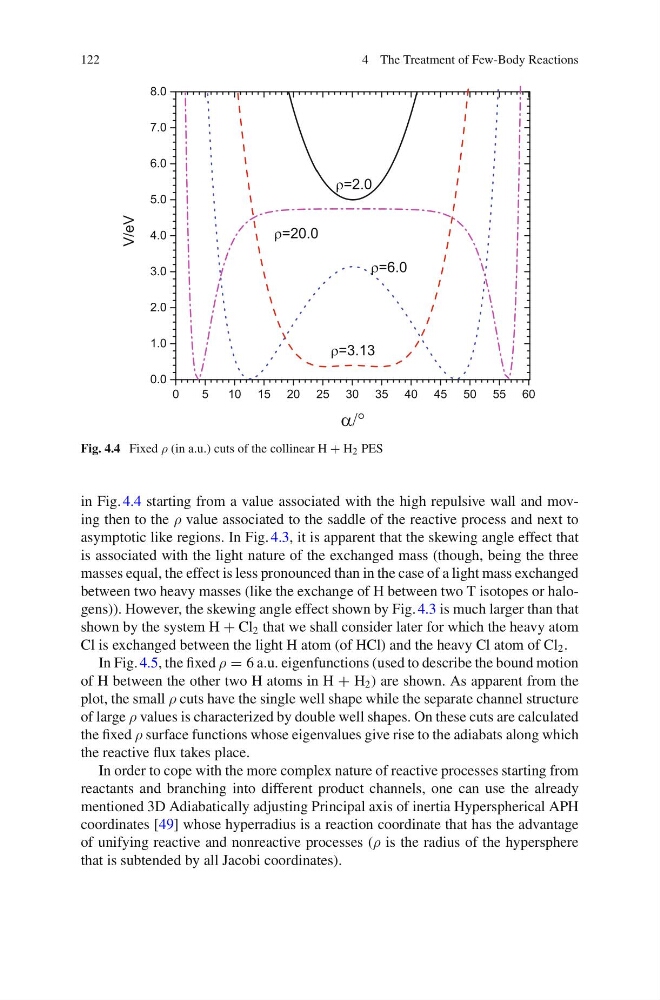
Fig. 4.4 Fixed ρ (in a.u.) cuts of the collinear H + H 2 PES
in Fig. 4.4 starting from a value associated with the high repulsive wall and moving then to the ρ value associated to the saddle of the reactive process and next to
asymptotic like regions. In Fig. 4.3, it is apparent that the skewing angle effect that
is associated with the light nature of the exchanged mass (though, being the three
masses equal, the effect is less pronounced than in the case of a light mass exchanged
between two heavy masses (like the exchange of H between two T isotopes or halogens)). However, the skewing angle effect shown by Fig. 4.3 is much larger than that
shown by the system H + Cl 2 that we shall consider later for which the heavy atom
Cl is exchanged between the light H atom (of HCl) and the heavy Cl atom of Cl 2 .
In Fig. 4.5, the fixed ρ = 6 a.u. eigenfunctions (used to describe the bound motion
of H between the other two H atoms in H + H 2 ) are shown. As apparent from the
plot, the small ρ cuts have the single well shape while the separate channel structure
of large ρ values is characterized by double well shapes. On these cuts are calculated
the fixed ρ surface functions whose eigenvalues give rise to the adiabats along which
the reactive flux takes place.
In order to cope with the more complex nature of reactive processes starting from
reactants and branching into different product channels, one can use the already
mentioned 3D Adiabatically adjusting Principal axis of inertia Hyperspherical APH
coordinates [49] whose hyperradius is a reaction coordinate that has the advantage
of unifying reactive and nonreactive processes (ρ is the radius of the hypersphere
that is subtended by all Jacobi coordinates).
4 The Treatment of Few-Body Reactions
Fig. 4.4 Fixed ρ (in a.u.) cuts of the collinear H + H 2 PES
in Fig. 4.4 starting from a value associated with the high repulsive wall and moving then to the ρ value associated to the saddle of the reactive process and next to
asymptotic like regions. In Fig. 4.3, it is apparent that the skewing angle effect that
is associated with the light nature of the exchanged mass (though, being the three
masses equal, the effect is less pronounced than in the case of a light mass exchanged
between two heavy masses (like the exchange of H between two T isotopes or halogens)). However, the skewing angle effect shown by Fig. 4.3 is much larger than that
shown by the system H + Cl 2 that we shall consider later for which the heavy atom
Cl is exchanged between the light H atom (of HCl) and the heavy Cl atom of Cl 2 .
In Fig. 4.5, the fixed ρ = 6 a.u. eigenfunctions (used to describe the bound motion
of H between the other two H atoms in H + H 2 ) are shown. As apparent from the
plot, the small ρ cuts have the single well shape while the separate channel structure
of large ρ values is characterized by double well shapes. On these cuts are calculated
the fixed ρ surface functions whose eigenvalues give rise to the adiabats along which
the reactive flux takes place.
In order to cope with the more complex nature of reactive processes starting from
reactants and branching into different product channels, one can use the already
mentioned 3D Adiabatically adjusting Principal axis of inertia Hyperspherical APH
coordinates [49] whose hyperradius is a reaction coordinate that has the advantage
of unifying reactive and nonreactive processes (ρ is the radius of the hypersphere
that is subtended by all Jacobi coordinates).