

4.2 Three-Atom Systems
121
(primed coordinates are those of the products while, the unprimed ones are those
of the reagents). In Eq. (4.28), P r λ (θ
) is the associated Legendre polynomial the
angular part of the wave function of the rotational state j
of the products. From
the Fourier transform of the coefficients C, one can obtain the energy dependent
coefficients A
A ν jλ,ν j λ (E) =
1
2π
∞
t=0
dt exp (i Et/) · C ν jλ,ν j λ (t)
(4.29)
from which the reactive scattering S matrix element is numerically evaluated using
the relationship
S ν jλ,ν j λ (E) =
k ν j
μμ
1/2
g(−k ν j )
e
−k ν j R ∞ A ν jλ,ν j λ (E).
(4.30)
4.2.3 Atom–Diatom Time-Independent APH Method
The above-mentioned transformation from the reactant to the product formalism can
be avoided using the so-called hyperspherical coordinates. In order to illustrate the
hyperspherical coordinates, let us consider first the collinear (three atoms on a row)
case and, in particular, the H + H 2 system.
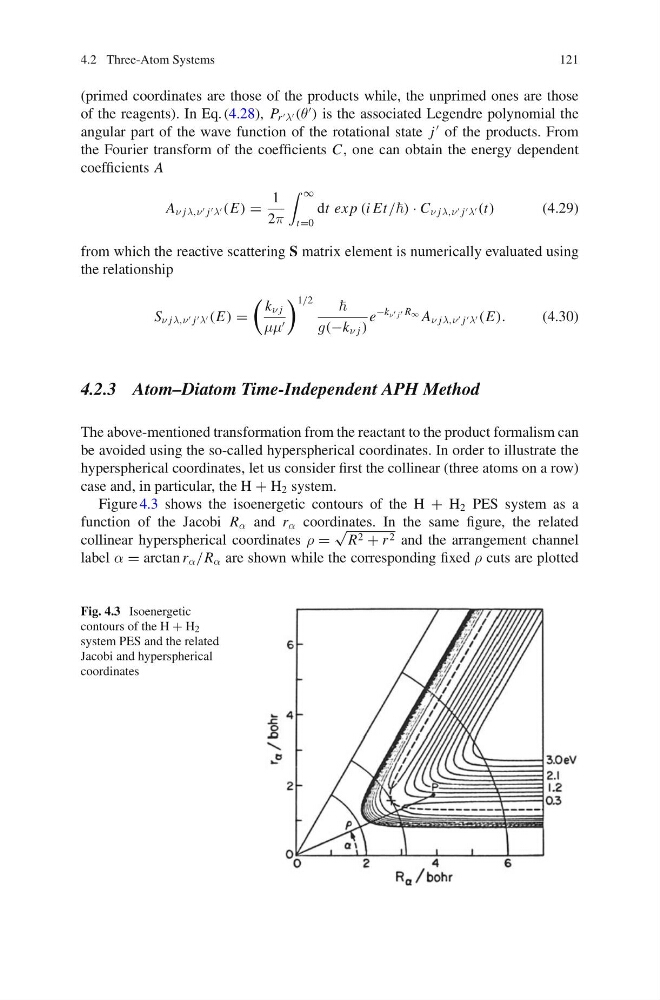
Figure 4.3 shows the isoenergetic contours of the H + H 2 PES system as a
function of the Jacobi R α and r α coordinates. In the same figure, the related
collinear hyperspherical coordinates ρ =
√
R 2 + r 2 and the arrangement channel
label α = arctan r α /R α are shown while the corresponding fixed ρ cuts are plotted
Fig. 4.3 Isoenergetic
contours of the H + H 2
system PES and the related
Jacobi and hyperspherical
coordinates
121
(primed coordinates are those of the products while, the unprimed ones are those
of the reagents). In Eq. (4.28), P r λ (θ
) is the associated Legendre polynomial the
angular part of the wave function of the rotational state j
of the products. From
the Fourier transform of the coefficients C, one can obtain the energy dependent
coefficients A
A ν jλ,ν j λ (E) =
1
2π
∞
t=0
dt exp (i Et/) · C ν jλ,ν j λ (t)
(4.29)
from which the reactive scattering S matrix element is numerically evaluated using
the relationship
S ν jλ,ν j λ (E) =
k ν j
μμ
1/2
g(−k ν j )
e
−k ν j R ∞ A ν jλ,ν j λ (E).
(4.30)
4.2.3 Atom–Diatom Time-Independent APH Method
The above-mentioned transformation from the reactant to the product formalism can
be avoided using the so-called hyperspherical coordinates. In order to illustrate the
hyperspherical coordinates, let us consider first the collinear (three atoms on a row)
case and, in particular, the H + H 2 system.
Figure 4.3 shows the isoenergetic contours of the H + H 2 PES system as a
function of the Jacobi R α and r α coordinates. In the same figure, the related
collinear hyperspherical coordinates ρ =
√
R 2 + r 2 and the arrangement channel
label α = arctan r α /R α are shown while the corresponding fixed ρ cuts are plotted
Fig. 4.3 Isoenergetic
contours of the H + H 2
system PES and the related
Jacobi and hyperspherical
coordinates