

114
4 The Treatment of Few-Body Reactions
with all orbitals being constrained to be orthonormal during propagation. At each
point of the calculation, the norm and the energy of the wavepacket are monitored in
order to ensure conservation. Moreover, the error introduced (into both orbitals and
coefficients) by time discretization is estimated and the time step is modified accordingly. There is no restriction imposed (in principle) on the number of coordinates or
their nature. Thus, one can use appropriate coordinates for the problem considered.
In the following, by having chosen a spherical cavity, we can exploit the advantage
of using spherical polar coordinates to describe both the electron (r, θ, φ) and the
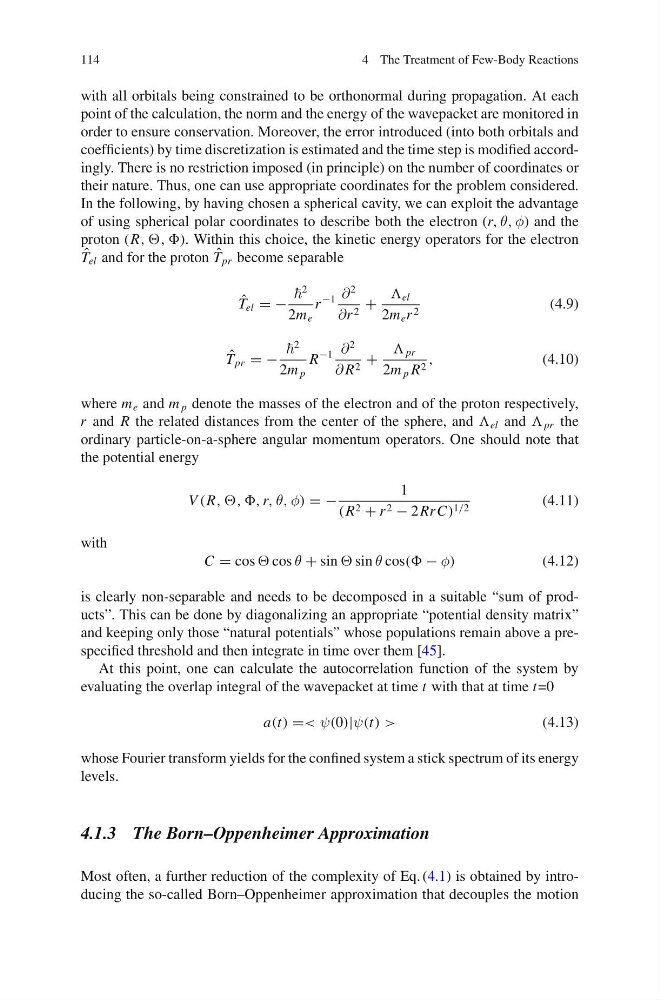
proton (R, ,, ,). Within this choice, the kinetic energy operators for the electron
ˆ
T el and for the proton ˆ
T pr become separable
ˆ
T el = −
2
2m e
r
−1 ∂
2
∂r 2 +
el
2m e r 2
(4.9)
ˆ
T pr = −
2
2m p
R
−1 ∂
2
∂ R 2 +
pr
2m p R 2 ,
(4.10)
where m e and m p denote the masses of the electron and of the proton respectively,
r and R the related distances from the center of the sphere, and el and pr the
ordinary particle-on-a-sphere angular momentum operators. One should note that
the potential energy
V (R, ,, ,, r, θ, φ) = −
1
(R 2 + r 2 − 2RrC) 1/2
(4.11)
with
C = cos cos θ + sin sin θ cos(( − φ)
(4.12)
is clearly non-separable and needs to be decomposed in a suitable “sum of products”. This can be done by diagonalizing an appropriate “potential density matrix”
and keeping only those “natural potentials” whose populations remain above a prespecified threshold and then integrate in time over them [45].
At this point, one can calculate the autocorrelation function of the system by
evaluating the overlap integral of the wavepacket at time t with that at time t=0
a(t) =< ψ(0)|ψ(t) >
(4.13)
whose Fourier transform yields for the confined system a stick spectrum of its energy
levels.
4.1.3 The Born–Oppenheimer Approximation
Most often, a further reduction of the complexity of Eq. (4.1) is obtained by introducing the so-called Born–Oppenheimer approximation that decouples the motion
4 The Treatment of Few-Body Reactions
with all orbitals being constrained to be orthonormal during propagation. At each
point of the calculation, the norm and the energy of the wavepacket are monitored in
order to ensure conservation. Moreover, the error introduced (into both orbitals and
coefficients) by time discretization is estimated and the time step is modified accordingly. There is no restriction imposed (in principle) on the number of coordinates or
their nature. Thus, one can use appropriate coordinates for the problem considered.
In the following, by having chosen a spherical cavity, we can exploit the advantage
of using spherical polar coordinates to describe both the electron (r, θ, φ) and the
proton (R, ,, ,). Within this choice, the kinetic energy operators for the electron
ˆ
T el and for the proton ˆ
T pr become separable
ˆ
T el = −
2
2m e
r
−1 ∂
2
∂r 2 +
el
2m e r 2
(4.9)
ˆ
T pr = −
2
2m p
R
−1 ∂
2
∂ R 2 +
pr
2m p R 2 ,
(4.10)
where m e and m p denote the masses of the electron and of the proton respectively,
r and R the related distances from the center of the sphere, and el and pr the
ordinary particle-on-a-sphere angular momentum operators. One should note that
the potential energy
V (R, ,, ,, r, θ, φ) = −
1
(R 2 + r 2 − 2RrC) 1/2
(4.11)
with
C = cos cos θ + sin sin θ cos(( − φ)
(4.12)
is clearly non-separable and needs to be decomposed in a suitable “sum of products”. This can be done by diagonalizing an appropriate “potential density matrix”
and keeping only those “natural potentials” whose populations remain above a prespecified threshold and then integrate in time over them [45].
At this point, one can calculate the autocorrelation function of the system by
evaluating the overlap integral of the wavepacket at time t with that at time t=0
a(t) =< ψ(0)|ψ(t) >
(4.13)
whose Fourier transform yields for the confined system a stick spectrum of its energy
levels.
4.1.3 The Born–Oppenheimer Approximation
Most often, a further reduction of the complexity of Eq. (4.1) is obtained by introducing the so-called Born–Oppenheimer approximation that decouples the motion