

3.4 Full Range Process Potentials
101
examples at the end of the next chapter). As shown by its functional formulation the
LEPS was derived for the family of atom–diatom systems by an oversimplified ab
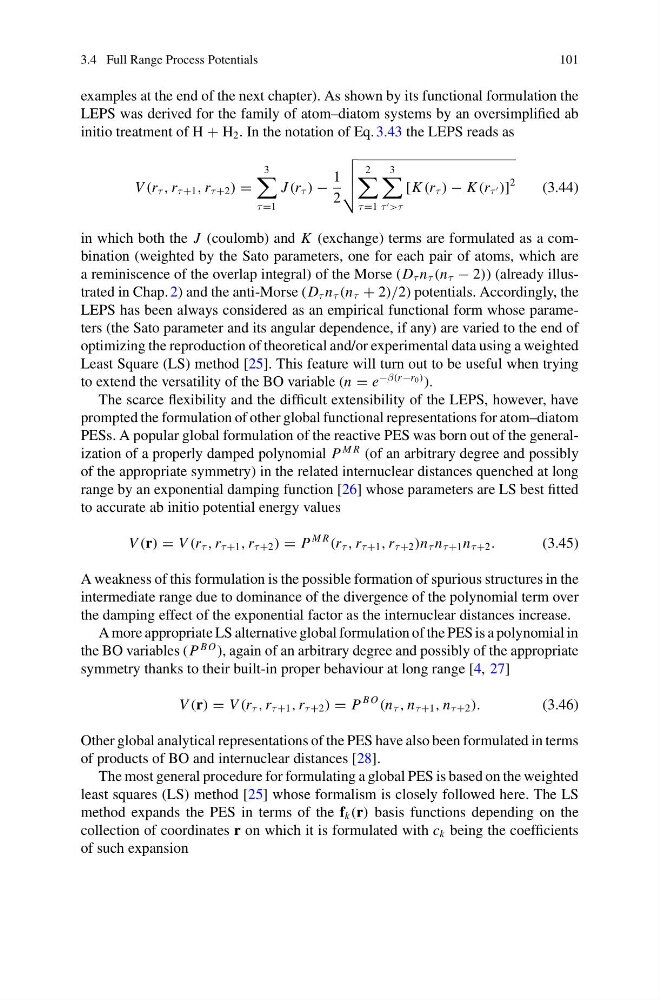
initio treatment of H + H 2 . In the notation of Eq. 3.43 the LEPS reads as
V (r τ , r τ +1 , r τ +2 ) =
3
τ =1
J (r τ ) −
1
2
2
τ =1
3
τ >τ
[K (r τ ) − K (r τ )]
2
(3.44)
in which both the J (coulomb) and K (exchange) terms are formulated as a combination (weighted by the Sato parameters, one for each pair of atoms, which are
a reminiscence of the overlap integral) of the Morse (D τ n τ (n τ − 2)) (already illustrated in Chap. 2) and the anti-Morse (D τ n τ (n τ + 2)/2) potentials. Accordingly, the
LEPS has been always considered as an empirical functional form whose parameters (the Sato parameter and its angular dependence, if any) are varied to the end of
optimizing the reproduction of theoretical and/or experimental data using a weighted
Least Square (LS) method [25]. This feature will turn out to be useful when trying
to extend the versatility of the BO variable (n = e
−β(r −r 0 ) ).
The scarce flexibility and the difficult extensibility of the LEPS, however, have
prompted the formulation of other global functional representations for atom–diatom
PESs. A popular global formulation of the reactive PES was born out of the generalization of a properly damped polynomial P
M R (of an arbitrary degree and possibly
of the appropriate symmetry) in the related internuclear distances quenched at long
range by an exponential damping function [26] whose parameters are LS best fitted
to accurate ab initio potential energy values
V (r) = V (r τ , r τ +1 , r τ +2 ) = P
M R
(r τ , r τ +1 , r τ +2 )n τ n τ +1 n τ +2 .
(3.45)
A weakness of this formulation is the possible formation of spurious structures in the
intermediate range due to dominance of the divergence of the polynomial term over
the damping effect of the exponential factor as the internuclear distances increase.
A more appropriate LS alternative global formulation of the PES is a polynomial in
the BO variables (P
B O ), again of an arbitrary degree and possibly of the appropriate
symmetry thanks to their built-in proper behaviour at long range [4, 27]
V (r) = V (r τ , r τ +1 , r τ +2 ) = P
B O
(n τ , n τ +1 , n τ +2 ).
(3.46)
Other global analytical representations of the PES have also been formulated in terms
of products of BO and internuclear distances [28].
The most general procedure for formulating a global PES is based on the weighted
least squares (LS) method [25] whose formalism is closely followed here. The LS
method expands the PES in terms of the f k (r) basis functions depending on the
collection of coordinates r on which it is formulated with c k being the coefficients
of such expansion
101
examples at the end of the next chapter). As shown by its functional formulation the
LEPS was derived for the family of atom–diatom systems by an oversimplified ab
initio treatment of H + H 2 . In the notation of Eq. 3.43 the LEPS reads as
V (r τ , r τ +1 , r τ +2 ) =
3
τ =1
J (r τ ) −
1
2
2
τ =1
3
τ >τ
[K (r τ ) − K (r τ )]
2
(3.44)
in which both the J (coulomb) and K (exchange) terms are formulated as a combination (weighted by the Sato parameters, one for each pair of atoms, which are
a reminiscence of the overlap integral) of the Morse (D τ n τ (n τ − 2)) (already illustrated in Chap. 2) and the anti-Morse (D τ n τ (n τ + 2)/2) potentials. Accordingly, the
LEPS has been always considered as an empirical functional form whose parameters (the Sato parameter and its angular dependence, if any) are varied to the end of
optimizing the reproduction of theoretical and/or experimental data using a weighted
Least Square (LS) method [25]. This feature will turn out to be useful when trying
to extend the versatility of the BO variable (n = e
−β(r −r 0 ) ).
The scarce flexibility and the difficult extensibility of the LEPS, however, have
prompted the formulation of other global functional representations for atom–diatom
PESs. A popular global formulation of the reactive PES was born out of the generalization of a properly damped polynomial P
M R (of an arbitrary degree and possibly
of the appropriate symmetry) in the related internuclear distances quenched at long
range by an exponential damping function [26] whose parameters are LS best fitted
to accurate ab initio potential energy values
V (r) = V (r τ , r τ +1 , r τ +2 ) = P
M R
(r τ , r τ +1 , r τ +2 )n τ n τ +1 n τ +2 .
(3.45)
A weakness of this formulation is the possible formation of spurious structures in the
intermediate range due to dominance of the divergence of the polynomial term over
the damping effect of the exponential factor as the internuclear distances increase.
A more appropriate LS alternative global formulation of the PES is a polynomial in
the BO variables (P
B O ), again of an arbitrary degree and possibly of the appropriate
symmetry thanks to their built-in proper behaviour at long range [4, 27]
V (r) = V (r τ , r τ +1 , r τ +2 ) = P
B O
(n τ , n τ +1 , n τ +2 ).
(3.46)
Other global analytical representations of the PES have also been formulated in terms
of products of BO and internuclear distances [28].
The most general procedure for formulating a global PES is based on the weighted
least squares (LS) method [25] whose formalism is closely followed here. The LS
method expands the PES in terms of the f k (r) basis functions depending on the
collection of coordinates r on which it is formulated with c k being the coefficients
of such expansion