

100
3 Ab initio Electronic Structure for Few-Body Systems
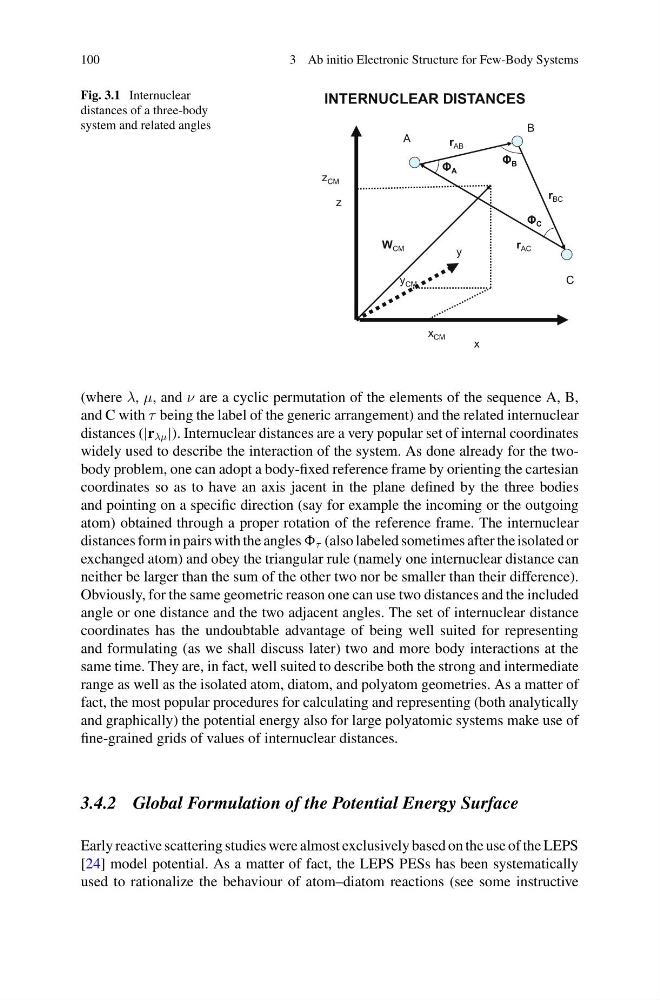
Fig. 3.1 Internuclear
distances of a three-body
system and related angles
x
y
z
A
B
W CM
INTERNUCLEAR DISTANCES
x CM
y CM
z CM
r BC
C
r AB
r AC
C
B
A
(where λ, μ, and ν are a cyclic permutation of the elements of the sequence A, B,
and C with τ being the label of the generic arrangement) and the related internuclear
distances (|r λμ |). Internuclear distances are a very popular set of internal coordinates
widely used to describe the interaction of the system. As done already for the twobody problem, one can adopt a body-fixed reference frame by orienting the cartesian
coordinates so as to have an axis jacent in the plane defined by the three bodies
and pointing on a specific direction (say for example the incoming or the outgoing
atom) obtained through a proper rotation of the reference frame. The internuclear
distances form in pairs with the angles τ (also labeled sometimes after the isolated or
exchanged atom) and obey the triangular rule (namely one internuclear distance can
neither be larger than the sum of the other two nor be smaller than their difference).
Obviously, for the same geometric reason one can use two distances and the included
angle or one distance and the two adjacent angles. The set of internuclear distance
coordinates has the undoubtable advantage of being well suited for representing
and formulating (as we shall discuss later) two and more body interactions at the
same time. They are, in fact, well suited to describe both the strong and intermediate
range as well as the isolated atom, diatom, and polyatom geometries. As a matter of
fact, the most popular procedures for calculating and representing (both analytically
and graphically) the potential energy also for large polyatomic systems make use of
fine-grained grids of values of internuclear distances.
3.4.2 Global Formulation of the Potential Energy Surface
Early reactive scattering studies were almost exclusively based on the use of the LEPS
[24] model potential. As a matter of fact, the LEPS PESs has been systematically
used to rationalize the behaviour of atom–diatom reactions (see some instructive
3 Ab initio Electronic Structure for Few-Body Systems
Fig. 3.1 Internuclear
distances of a three-body
system and related angles
x
y
z
A
B
W CM
INTERNUCLEAR DISTANCES
x CM
y CM
z CM
r BC
C
r AB
r AC
C
B
A
(where λ, μ, and ν are a cyclic permutation of the elements of the sequence A, B,
and C with τ being the label of the generic arrangement) and the related internuclear
distances (|r λμ |). Internuclear distances are a very popular set of internal coordinates
widely used to describe the interaction of the system. As done already for the twobody problem, one can adopt a body-fixed reference frame by orienting the cartesian
coordinates so as to have an axis jacent in the plane defined by the three bodies
and pointing on a specific direction (say for example the incoming or the outgoing
atom) obtained through a proper rotation of the reference frame. The internuclear
distances form in pairs with the angles τ (also labeled sometimes after the isolated or
exchanged atom) and obey the triangular rule (namely one internuclear distance can
neither be larger than the sum of the other two nor be smaller than their difference).
Obviously, for the same geometric reason one can use two distances and the included
angle or one distance and the two adjacent angles. The set of internuclear distance
coordinates has the undoubtable advantage of being well suited for representing
and formulating (as we shall discuss later) two and more body interactions at the
same time. They are, in fact, well suited to describe both the strong and intermediate
range as well as the isolated atom, diatom, and polyatom geometries. As a matter of
fact, the most popular procedures for calculating and representing (both analytically
and graphically) the potential energy also for large polyatomic systems make use of
fine-grained grids of values of internuclear distances.
3.4.2 Global Formulation of the Potential Energy Surface
Early reactive scattering studies were almost exclusively based on the use of the LEPS
[24] model potential. As a matter of fact, the LEPS PESs has been systematically
used to rationalize the behaviour of atom–diatom reactions (see some instructive