

102
3 Ab initio Electronic Structure for Few-Body Systems
V (r) = c
T f(r) = f
T
(r)c =
L
l=1
c l f l (r).
(3.47)
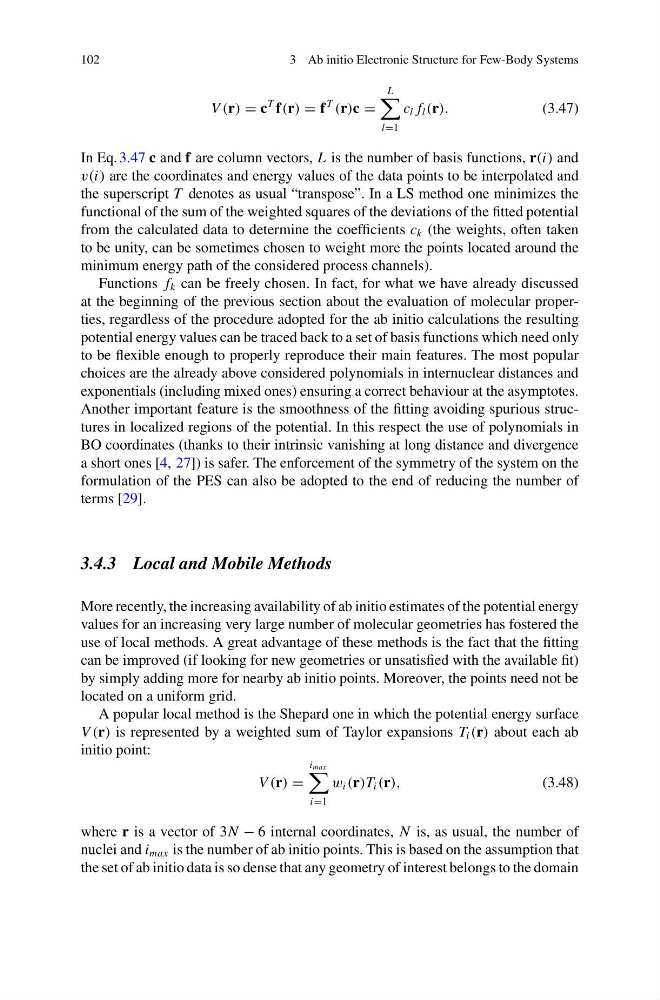
In Eq. 3.47 c and f are column vectors, L is the number of basis functions, r(i) and
v(i) are the coordinates and energy values of the data points to be interpolated and
the superscript T denotes as usual “transpose”. In a LS method one minimizes the
functional of the sum of the weighted squares of the deviations of the fitted potential
from the calculated data to determine the coefficients c k (the weights, often taken
to be unity, can be sometimes chosen to weight more the points located around the
minimum energy path of the considered process channels).
Functions f k can be freely chosen. In fact, for what we have already discussed
at the beginning of the previous section about the evaluation of molecular properties, regardless of the procedure adopted for the ab initio calculations the resulting
potential energy values can be traced back to a set of basis functions which need only
to be flexible enough to properly reproduce their main features. The most popular
choices are the already above considered polynomials in internuclear distances and
exponentials (including mixed ones) ensuring a correct behaviour at the asymptotes.
Another important feature is the smoothness of the fitting avoiding spurious structures in localized regions of the potential. In this respect the use of polynomials in
BO coordinates (thanks to their intrinsic vanishing at long distance and divergence
a short ones [4, 27]) is safer. The enforcement of the symmetry of the system on the
formulation of the PES can also be adopted to the end of reducing the number of
terms [29].
3.4.3 Local and Mobile Methods
More recently, the increasing availability of ab initio estimates of the potential energy
values for an increasing very large number of molecular geometries has fostered the
use of local methods. A great advantage of these methods is the fact that the fitting
can be improved (if looking for new geometries or unsatisfied with the available fit)
by simply adding more for nearby ab initio points. Moreover, the points need not be
located on a uniform grid.
A popular local method is the Shepard one in which the potential energy surface
V (r) is represented by a weighted sum of Taylor expansions T i (r) about each ab
initio point:
V (r) =
i max
i=1
w i (r)T i (r),
(3.48)
where r is a vector of 3N − 6 internal coordinates, N is, as usual, the number of
nuclei and i max is the number of ab initio points. This is based on the assumption that
the set of ab initio data is so dense that any geometry of interest belongs to the domain
3 Ab initio Electronic Structure for Few-Body Systems
V (r) = c
T f(r) = f
T
(r)c =
L
l=1
c l f l (r).
(3.47)
In Eq. 3.47 c and f are column vectors, L is the number of basis functions, r(i) and
v(i) are the coordinates and energy values of the data points to be interpolated and
the superscript T denotes as usual “transpose”. In a LS method one minimizes the
functional of the sum of the weighted squares of the deviations of the fitted potential
from the calculated data to determine the coefficients c k (the weights, often taken
to be unity, can be sometimes chosen to weight more the points located around the
minimum energy path of the considered process channels).
Functions f k can be freely chosen. In fact, for what we have already discussed
at the beginning of the previous section about the evaluation of molecular properties, regardless of the procedure adopted for the ab initio calculations the resulting
potential energy values can be traced back to a set of basis functions which need only
to be flexible enough to properly reproduce their main features. The most popular
choices are the already above considered polynomials in internuclear distances and
exponentials (including mixed ones) ensuring a correct behaviour at the asymptotes.
Another important feature is the smoothness of the fitting avoiding spurious structures in localized regions of the potential. In this respect the use of polynomials in
BO coordinates (thanks to their intrinsic vanishing at long distance and divergence
a short ones [4, 27]) is safer. The enforcement of the symmetry of the system on the
formulation of the PES can also be adopted to the end of reducing the number of
terms [29].
3.4.3 Local and Mobile Methods
More recently, the increasing availability of ab initio estimates of the potential energy
values for an increasing very large number of molecular geometries has fostered the
use of local methods. A great advantage of these methods is the fact that the fitting
can be improved (if looking for new geometries or unsatisfied with the available fit)
by simply adding more for nearby ab initio points. Moreover, the points need not be
located on a uniform grid.
A popular local method is the Shepard one in which the potential energy surface
V (r) is represented by a weighted sum of Taylor expansions T i (r) about each ab
initio point:
V (r) =
i max
i=1
w i (r)T i (r),
(3.48)
where r is a vector of 3N − 6 internal coordinates, N is, as usual, the number of
nuclei and i max is the number of ab initio points. This is based on the assumption that
the set of ab initio data is so dense that any geometry of interest belongs to the domain