

3.3 From Micro to Macro: The Bottom-Up Approach
83
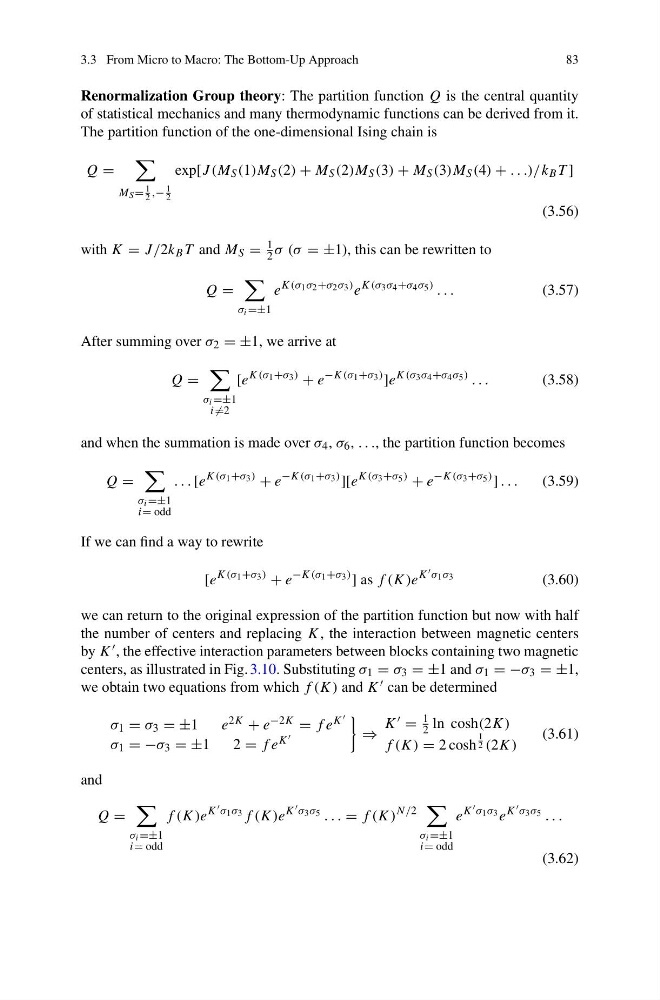
Renormalization Group theory: The partition function Q is the central quantity
of statistical mechanics and many thermodynamic functions can be derived from it.
The partition function of the one-dimensional Ising chain is
Q =
M S =
1
2 ,−
1
2
exp[J (M S (1)M S (2) + M S (2)M S (3) + M S (3)M S (4) + ...)/k B T ]
(3.56)
with K = J/2k B T and M S =
1
2 σ (σ =±1), this can be rewritten to
Q =
σ i =±1
e
K (σ 1 σ 2 +σ 2 σ 3 ) e
K (σ 3 σ 4 +σ 4 σ 5 ) ...
(3.57)
After summing over σ 2 =±1, we arrive at
Q =
σ i =±1
i =2
[e
K (σ 1 +σ 3 ) + e
−K (σ 1 +σ 3 ) ]e
K (σ 3 σ 4 +σ 4 σ 5 ) ...
(3.58)
and when the summation is made over σ 4 , σ 6 , ..., the partition function becomes
Q =
σ i =±1
i= odd
...[e
K (σ 1 +σ 3 ) + e
−K (σ 1 +σ 3 ) ][e
K (σ 3 +σ 5 ) + e
−K (σ 3 +σ 5 ) ] ...
(3.59)
If we can find a way to rewrite
[e
K (σ 1 +σ 3 ) + e
−K (σ 1 +σ 3 ) ] as f (K )e
K ′ σ 1 σ 3
(3.60)
we can return to the original expression of the partition function but now with half
the number of centers and replacing K , the interaction between magnetic centers
by K ′ , the effective interaction parameters between blocks containing two magnetic
centers, as illustrated in Fig. 3.10. Substituting σ 1 = σ 3 =±1 and σ 1 =−σ 3 =±1,
we obtain two equations from which f (K ) and K ′ can be determined
σ 1 = σ 3 =±1
e 2K + e −2K = fe K ′
σ 1 =−σ 3 =±12 = fe K ′
⇒
K ′ =
1
2 ln cosh(2K )
f (K ) = 2 cosh
1
2 (2K )
(3.61)
and
Q =
σ i =±1
i= odd
f (K )e
K ′ σ 1 σ 3 f (K )e
K ′ σ 3 σ 5 ... = f (K )
N /2
σ i =±1
i= odd
e
K ′ σ 1 σ 3 e
K ′ σ 3 σ 5 ...
(3.62)
83
Renormalization Group theory: The partition function Q is the central quantity
of statistical mechanics and many thermodynamic functions can be derived from it.
The partition function of the one-dimensional Ising chain is
Q =
M S =
1
2 ,−
1
2
exp[J (M S (1)M S (2) + M S (2)M S (3) + M S (3)M S (4) + ...)/k B T ]
(3.56)
with K = J/2k B T and M S =
1
2 σ (σ =±1), this can be rewritten to
Q =
σ i =±1
e
K (σ 1 σ 2 +σ 2 σ 3 ) e
K (σ 3 σ 4 +σ 4 σ 5 ) ...
(3.57)
After summing over σ 2 =±1, we arrive at
Q =
σ i =±1
i =2
[e
K (σ 1 +σ 3 ) + e
−K (σ 1 +σ 3 ) ]e
K (σ 3 σ 4 +σ 4 σ 5 ) ...
(3.58)
and when the summation is made over σ 4 , σ 6 , ..., the partition function becomes
Q =
σ i =±1
i= odd
...[e
K (σ 1 +σ 3 ) + e
−K (σ 1 +σ 3 ) ][e
K (σ 3 +σ 5 ) + e
−K (σ 3 +σ 5 ) ] ...
(3.59)
If we can find a way to rewrite
[e
K (σ 1 +σ 3 ) + e
−K (σ 1 +σ 3 ) ] as f (K )e
K ′ σ 1 σ 3
(3.60)
we can return to the original expression of the partition function but now with half
the number of centers and replacing K , the interaction between magnetic centers
by K ′ , the effective interaction parameters between blocks containing two magnetic
centers, as illustrated in Fig. 3.10. Substituting σ 1 = σ 3 =±1 and σ 1 =−σ 3 =±1,
we obtain two equations from which f (K ) and K ′ can be determined
σ 1 = σ 3 =±1
e 2K + e −2K = fe K ′
σ 1 =−σ 3 =±12 = fe K ′
⇒
K ′ =
1
2 ln cosh(2K )
f (K ) = 2 cosh
1
2 (2K )
(3.61)
and
Q =
σ i =±1
i= odd
f (K )e
K ′ σ 1 σ 3 f (K )e
K ′ σ 3 σ 5 ... = f (K )
N /2
σ i =±1
i= odd
e
K ′ σ 1 σ 3 e
K ′ σ 3 σ 5 ...
(3.62)