

84
3 Two (or More) Magnetic Centers
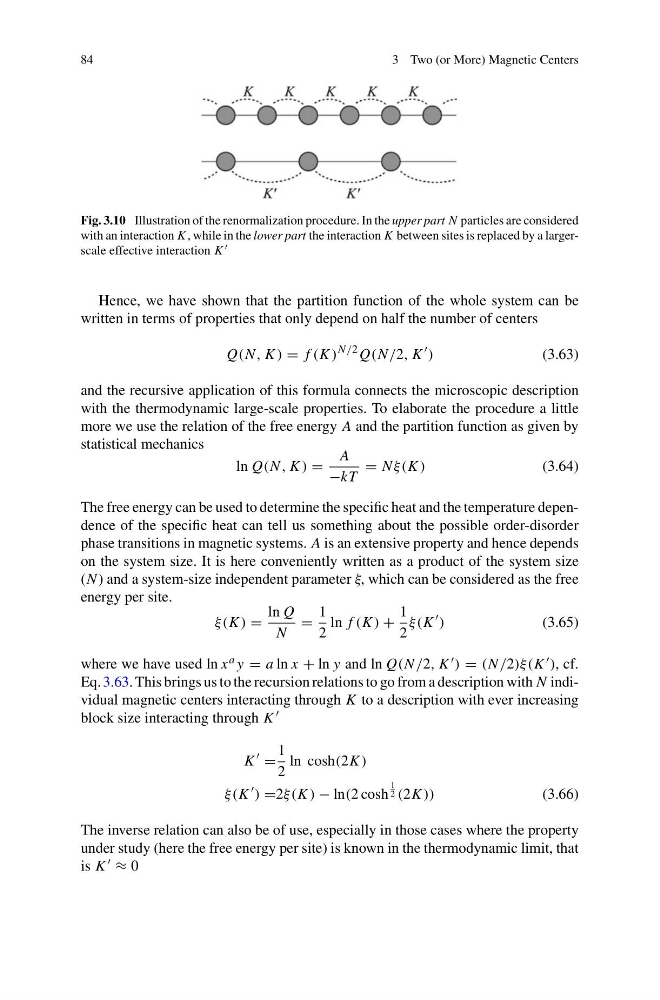
Fig. 3.10 Illustration of the renormalization procedure. In the upper part N particles are considered
with an interaction K , while in the lower part the interaction K between sites is replaced by a largerscale effective interaction K ′
Hence, we have shown that the partition function of the whole system can be
written in terms of properties that only depend on half the number of centers
Q(N , K ) = f (K )
N /2 Q(N /2, K
′ )
(3.63)
and the recursive application of this formula connects the microscopic description
with the thermodynamic large-scale properties. To elaborate the procedure a little
more we use the relation of the free energy A and the partition function as given by
statistical mechanics
ln Q(N , K ) =
A
−kT
= N ξ(K )
(3.64)
The free energy can be used to determine the specific heat and the temperature dependence of the specific heat can tell us something about the possible order-disorder
phase transitions in magnetic systems. A is an extensive property and hence depends
on the system size. It is here conveniently written as a product of the system size
(N ) and a system-size independent parameter ξ, which can be considered as the free
energy per site.
ξ(K ) =
ln Q
N
=
1
2
ln f (K ) +
1
2
ξ(K
′ )
(3.65)
wherewehaveusedlnx a y = a ln x + ln y and ln Q(N /2, K ′ ) = (N /2)ξ(K ′ ),cf.
Eq. 3.63. This brings us to the recursion relations to go from a description with N individual magnetic centers interacting through K to a description with ever increasing
block size interacting through K ′
K
′ =
1
2
ln cosh(2K )
ξ(K
′ ) =2ξ(K ) − ln(2 cosh
1
2 (2K ))
(3.66)
The inverse relation can also be of use, especially in those cases where the property
under study (here the free energy per site) is known in the thermodynamic limit, that
is K ′ ≈ 0
3 Two (or More) Magnetic Centers
Fig. 3.10 Illustration of the renormalization procedure. In the upper part N particles are considered
with an interaction K , while in the lower part the interaction K between sites is replaced by a largerscale effective interaction K ′
Hence, we have shown that the partition function of the whole system can be
written in terms of properties that only depend on half the number of centers
Q(N , K ) = f (K )
N /2 Q(N /2, K
′ )
(3.63)
and the recursive application of this formula connects the microscopic description
with the thermodynamic large-scale properties. To elaborate the procedure a little
more we use the relation of the free energy A and the partition function as given by
statistical mechanics
ln Q(N , K ) =
A
−kT
= N ξ(K )
(3.64)
The free energy can be used to determine the specific heat and the temperature dependence of the specific heat can tell us something about the possible order-disorder
phase transitions in magnetic systems. A is an extensive property and hence depends
on the system size. It is here conveniently written as a product of the system size
(N ) and a system-size independent parameter ξ, which can be considered as the free
energy per site.
ξ(K ) =
ln Q
N
=
1
2
ln f (K ) +
1
2
ξ(K
′ )
(3.65)
wherewehaveusedlnx a y = a ln x + ln y and ln Q(N /2, K ′ ) = (N /2)ξ(K ′ ),cf.
Eq. 3.63. This brings us to the recursion relations to go from a description with N individual magnetic centers interacting through K to a description with ever increasing
block size interacting through K ′
K
′ =
1
2
ln cosh(2K )
ξ(K
′ ) =2ξ(K ) − ln(2 cosh
1
2 (2K ))
(3.66)
The inverse relation can also be of use, especially in those cases where the property
under study (here the free energy per site) is known in the thermodynamic limit, that
is K ′ ≈ 0