

3.3 From Micro to Macro: The Bottom-Up Approach
81
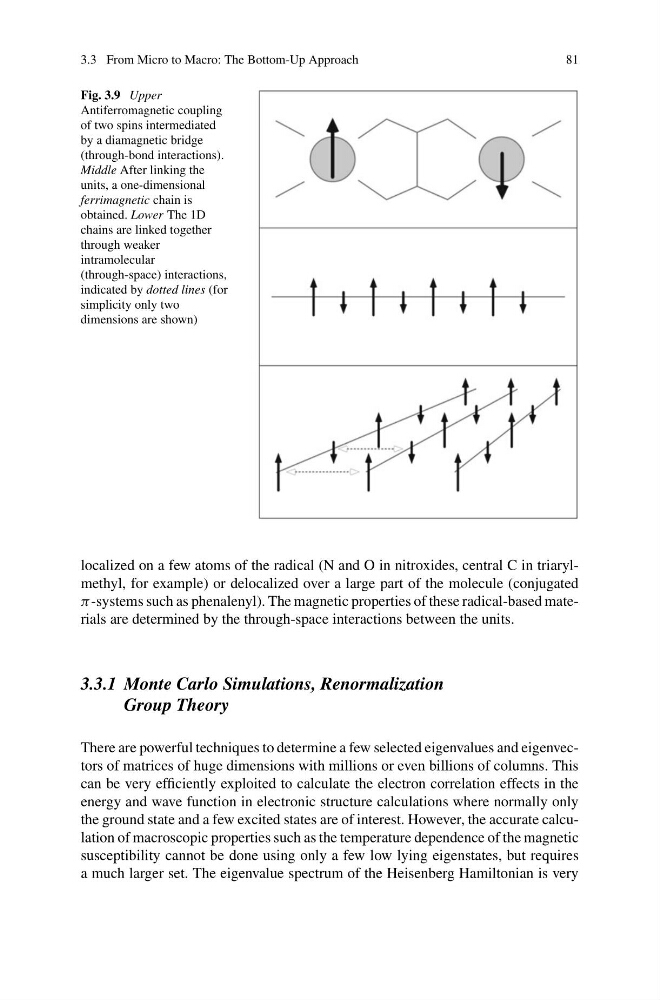
Fig. 3.9 Upper
Antiferromagnetic coupling
of two spins intermediated
by a diamagnetic bridge
(through-bond interactions).
Middle After linking the
units, a one-dimensional
ferrimagnetic chain is
obtained. Lower The 1D
chains are linked together
through weaker
intramolecular
(through-space) interactions,
indicated by dotted lines (for
simplicity only two
dimensions are shown)
localized on a few atoms of the radical (N and O in nitroxides, central C in triarylmethyl, for example) or delocalized over a large part of the molecule (conjugated
π -systems such as phenalenyl). The magnetic properties of these radical-based materials are determined by the through-space interactions between the units.
3.3.1 Monte Carlo Simulations, Renormalization
Group Theory
There are powerful techniques to determine a few selected eigenvalues and eigenvectors of matrices of huge dimensions with millions or even billions of columns. This
can be very efficiently exploited to calculate the electron correlation effects in the
energy and wave function in electronic structure calculations where normally only
the ground state and a few excited states are of interest. However, the accurate calculation of macroscopic properties such as the temperature dependence of the magnetic
susceptibility cannot be done using only a few low lying eigenstates, but requires
a much larger set. The eigenvalue spectrum of the Heisenberg Hamiltonian is very
81
Fig. 3.9 Upper
Antiferromagnetic coupling
of two spins intermediated
by a diamagnetic bridge
(through-bond interactions).
Middle After linking the
units, a one-dimensional
ferrimagnetic chain is
obtained. Lower The 1D
chains are linked together
through weaker
intramolecular
(through-space) interactions,
indicated by dotted lines (for
simplicity only two
dimensions are shown)
localized on a few atoms of the radical (N and O in nitroxides, central C in triarylmethyl, for example) or delocalized over a large part of the molecule (conjugated
π -systems such as phenalenyl). The magnetic properties of these radical-based materials are determined by the through-space interactions between the units.
3.3.1 Monte Carlo Simulations, Renormalization
Group Theory
There are powerful techniques to determine a few selected eigenvalues and eigenvectors of matrices of huge dimensions with millions or even billions of columns. This
can be very efficiently exploited to calculate the electron correlation effects in the
energy and wave function in electronic structure calculations where normally only
the ground state and a few excited states are of interest. However, the accurate calculation of macroscopic properties such as the temperature dependence of the magnetic
susceptibility cannot be done using only a few low lying eigenstates, but requires
a much larger set. The eigenvalue spectrum of the Heisenberg Hamiltonian is very