

80
3 Two (or More) Magnetic Centers
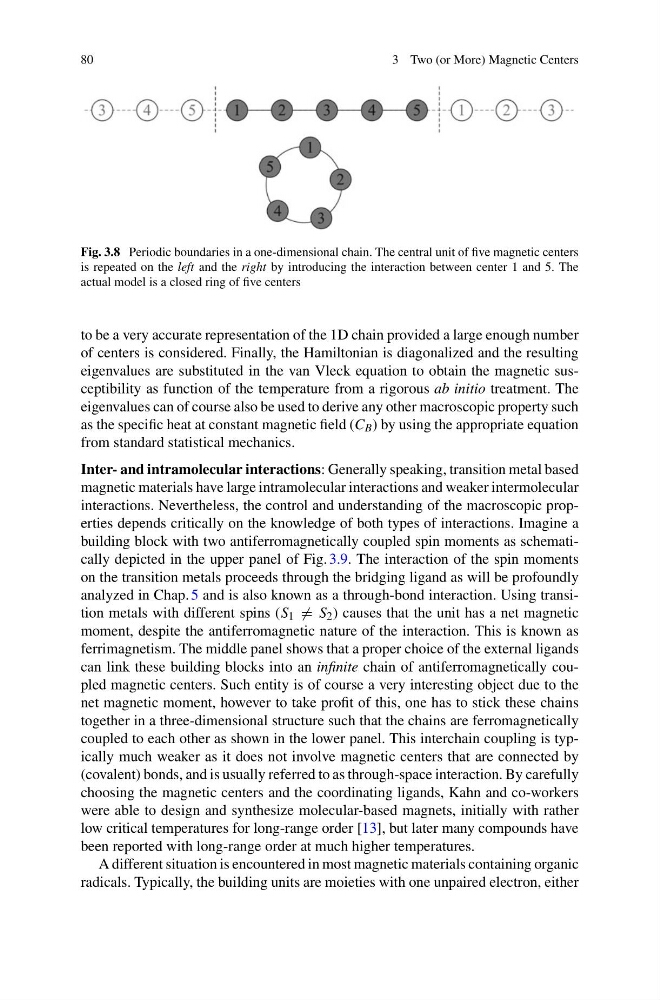
Fig. 3.8 Periodic boundaries in a one-dimensional chain. The central unit of five magnetic centers
is repeated on the left and the right by introducing the interaction between center 1 and 5. The
actual model is a closed ring of five centers
to be a very accurate representation of the 1D chain provided a large enough number
of centers is considered. Finally, the Hamiltonian is diagonalized and the resulting
eigenvalues are substituted in the van Vleck equation to obtain the magnetic susceptibility as function of the temperature from a rigorous ab initio treatment. The
eigenvalues can of course also be used to derive any other macroscopic property such
as the specific heat at constant magnetic field (C B ) by using the appropriate equation
from standard statistical mechanics.
Inter- and intramolecular interactions: Generally speaking, transition metal based
magnetic materials have large intramolecular interactions and weaker intermolecular
interactions. Nevertheless, the control and understanding of the macroscopic properties depends critically on the knowledge of both types of interactions. Imagine a
building block with two antiferromagnetically coupled spin moments as schematically depicted in the upper panel of Fig. 3.9. The interaction of the spin moments
on the transition metals proceeds through the bridging ligand as will be profoundly
analyzed in Chap. 5 and is also known as a through-bond interaction. Using transition metals with different spins (S 1 = S 2 ) causes that the unit has a net magnetic
moment, despite the antiferromagnetic nature of the interaction. This is known as
ferrimagnetism. The middle panel shows that a proper choice of the external ligands
can link these building blocks into an infinite chain of antiferromagnetically coupled magnetic centers. Such entity is of course a very interesting object due to the
net magnetic moment, however to take profit of this, one has to stick these chains
together in a three-dimensional structure such that the chains are ferromagnetically
coupled to each other as shown in the lower panel. This interchain coupling is typically much weaker as it does not involve magnetic centers that are connected by
(covalent) bonds, and is usually referred to as through-space interaction. By carefully
choosing the magnetic centers and the coordinating ligands, Kahn and co-workers
were able to design and synthesize molecular-based magnets, initially with rather
low critical temperatures for long-range order [13], but later many compounds have
been reported with long-range order at much higher temperatures.
A different situation is encountered in most magnetic materials containing organic
radicals. Typically, the building units are moieties with one unpaired electron, either
3 Two (or More) Magnetic Centers
Fig. 3.8 Periodic boundaries in a one-dimensional chain. The central unit of five magnetic centers
is repeated on the left and the right by introducing the interaction between center 1 and 5. The
actual model is a closed ring of five centers
to be a very accurate representation of the 1D chain provided a large enough number
of centers is considered. Finally, the Hamiltonian is diagonalized and the resulting
eigenvalues are substituted in the van Vleck equation to obtain the magnetic susceptibility as function of the temperature from a rigorous ab initio treatment. The
eigenvalues can of course also be used to derive any other macroscopic property such
as the specific heat at constant magnetic field (C B ) by using the appropriate equation
from standard statistical mechanics.
Inter- and intramolecular interactions: Generally speaking, transition metal based
magnetic materials have large intramolecular interactions and weaker intermolecular
interactions. Nevertheless, the control and understanding of the macroscopic properties depends critically on the knowledge of both types of interactions. Imagine a
building block with two antiferromagnetically coupled spin moments as schematically depicted in the upper panel of Fig. 3.9. The interaction of the spin moments
on the transition metals proceeds through the bridging ligand as will be profoundly
analyzed in Chap. 5 and is also known as a through-bond interaction. Using transition metals with different spins (S 1 = S 2 ) causes that the unit has a net magnetic
moment, despite the antiferromagnetic nature of the interaction. This is known as
ferrimagnetism. The middle panel shows that a proper choice of the external ligands
can link these building blocks into an infinite chain of antiferromagnetically coupled magnetic centers. Such entity is of course a very interesting object due to the
net magnetic moment, however to take profit of this, one has to stick these chains
together in a three-dimensional structure such that the chains are ferromagnetically
coupled to each other as shown in the lower panel. This interchain coupling is typically much weaker as it does not involve magnetic centers that are connected by
(covalent) bonds, and is usually referred to as through-space interaction. By carefully
choosing the magnetic centers and the coordinating ligands, Kahn and co-workers
were able to design and synthesize molecular-based magnets, initially with rather
low critical temperatures for long-range order [13], but later many compounds have
been reported with long-range order at much higher temperatures.
A different situation is encountered in most magnetic materials containing organic
radicals. Typically, the building units are moieties with one unpaired electron, either