

76
3 Two (or More) Magnetic Centers
In the general case of S 1 = S 2 , the gap between the lowest state and the group of
degenerate first excited states of the Ising Hamiltonian is given by the value of the
smallest spin. Figure 3.6 summarizes the energy levels of the Heisenberg and Ising
Hamiltonians for the two systems.
3.2.3 Comparing the Heisenberg and Ising Hamiltonians
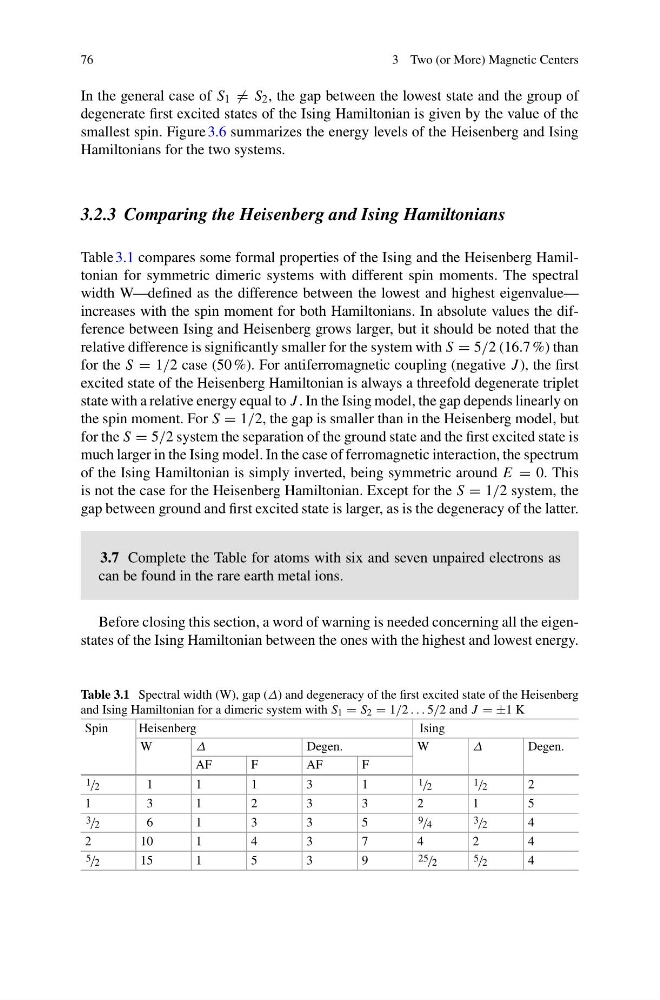
Table 3.1 compares some formal properties of the Ising and the Heisenberg Hamiltonian for symmetric dimeric systems with different spin moments. The spectral
width W—defined as the difference between the lowest and highest eigenvalue—
increases with the spin moment for both Hamiltonians. In absolute values the difference between Ising and Heisenberg grows larger, but it should be noted that the
relative difference is significantly smaller for the system with S = 5/2 (16.7 %) than
for the S = 1/2 case (50 %). For antiferromagnetic coupling (negative J ), the first
excited state of the Heisenberg Hamiltonian is always a threefold degenerate triplet
state with a relative energy equal to J . In the Ising model, the gap depends linearly on
the spin moment. For S = 1/2, the gap is smaller than in the Heisenberg model, but
for the S = 5/2 system the separation of the ground state and the first excited state is
much larger in the Ising model. In the case of ferromagnetic interaction, the spectrum
of the Ising Hamiltonian is simply inverted, being symmetric around E = 0. This
is not the case for the Heisenberg Hamiltonian. Except for the S = 1/2 system, the
gap between ground and first excited state is larger, as is the degeneracy of the latter.
3.7 Complete the Table for atoms with six and seven unpaired electrons as
can be found in the rare earth metal ions.
Before closing this section, a word of warning is needed concerning all the eigenstates of the Ising Hamiltonian between the ones with the highest and lowest energy.
Table 3.1 Spectral width (W), gap (∆) and degeneracy of the first excited state of the Heisenberg
and Ising Hamiltonian for a dimeric system with S 1 = S 2 = 1/2 ...5/2andJ =±1K
Spin
Heisenberg
Ising
W
∆
Degen.
W
∆
Degen.
AF
F
AF
F
1 /2
1
1
1
3
1
1 /2
1 /2
2
1
3
1
2
3
3
2
1
5
3 /2
6
1
3
3
5
9 /4
3 /2
4
2
10
1
4
3
7
4
2
4
5 /2
15
1
5
3
9
25 /2
5 /2
4
3 Two (or More) Magnetic Centers
In the general case of S 1 = S 2 , the gap between the lowest state and the group of
degenerate first excited states of the Ising Hamiltonian is given by the value of the
smallest spin. Figure 3.6 summarizes the energy levels of the Heisenberg and Ising
Hamiltonians for the two systems.
3.2.3 Comparing the Heisenberg and Ising Hamiltonians
Table 3.1 compares some formal properties of the Ising and the Heisenberg Hamiltonian for symmetric dimeric systems with different spin moments. The spectral
width W—defined as the difference between the lowest and highest eigenvalue—
increases with the spin moment for both Hamiltonians. In absolute values the difference between Ising and Heisenberg grows larger, but it should be noted that the
relative difference is significantly smaller for the system with S = 5/2 (16.7 %) than
for the S = 1/2 case (50 %). For antiferromagnetic coupling (negative J ), the first
excited state of the Heisenberg Hamiltonian is always a threefold degenerate triplet
state with a relative energy equal to J . In the Ising model, the gap depends linearly on
the spin moment. For S = 1/2, the gap is smaller than in the Heisenberg model, but
for the S = 5/2 system the separation of the ground state and the first excited state is
much larger in the Ising model. In the case of ferromagnetic interaction, the spectrum
of the Ising Hamiltonian is simply inverted, being symmetric around E = 0. This
is not the case for the Heisenberg Hamiltonian. Except for the S = 1/2 system, the
gap between ground and first excited state is larger, as is the degeneracy of the latter.
3.7 Complete the Table for atoms with six and seven unpaired electrons as
can be found in the rare earth metal ions.
Before closing this section, a word of warning is needed concerning all the eigenstates of the Ising Hamiltonian between the ones with the highest and lowest energy.
Table 3.1 Spectral width (W), gap (∆) and degeneracy of the first excited state of the Heisenberg
and Ising Hamiltonian for a dimeric system with S 1 = S 2 = 1/2 ...5/2andJ =±1K
Spin
Heisenberg
Ising
W
∆
Degen.
W
∆
Degen.
AF
F
AF
F
1 /2
1
1
1
3
1
1 /2
1 /2
2
1
3
1
2
3
3
2
1
5
3 /2
6
1
3
3
5
9 /4
3 /2
4
2
10
1
4
3
7
4
2
4
5 /2
15
1
5
3
9
25 /2
5 /2
4