

68
3 Two (or More) Magnetic Centers
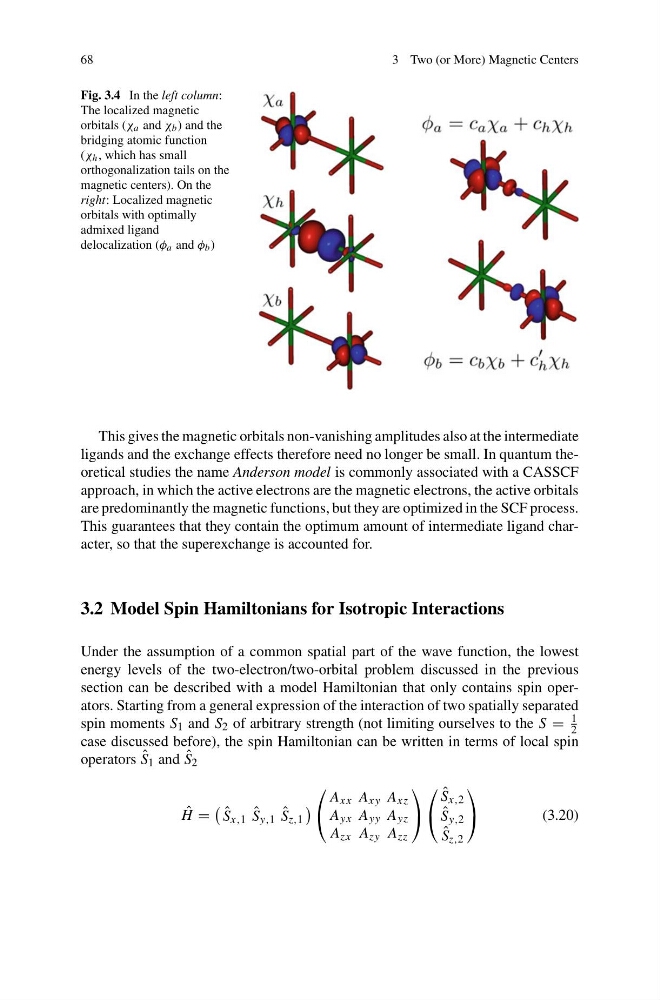
Fig. 3.4 In the left column:
The localized magnetic
orbitals (χ a and χ b )andthe
bridging atomic function
(χ h , which has small
orthogonalization tails on the
magnetic centers). On the
right: Localized magnetic
orbitals with optimally
admixed ligand
delocalization (φ a and φ b )
This gives the magnetic orbitals non-vanishing amplitudes also at the intermediate
ligands and the exchange effects therefore need no longer be small. In quantum theoretical studies the name Anderson model is commonly associated with a CASSCF
approach, in which the active electrons are the magnetic electrons, the active orbitals
are predominantly the magnetic functions, but they are optimized in the SCF process.
This guarantees that they contain the optimum amount of intermediate ligand character, so that the superexchange is accounted for.
3.2 Model Spin Hamiltonians for Isotropic Interactions
Under the assumption of a common spatial part of the wave function, the lowest
energy levels of the two-electron/two-orbital problem discussed in the previous
section can be described with a model Hamiltonian that only contains spin operators. Starting from a general expression of the interaction of two spatially separated
spin moments S 1 and S 2 of arbitrary strength (not limiting ourselves to the S =
1
2
case discussed before), the spin Hamiltonian can be written in terms of local spin
operators ˆ
S 1 and ˆ
S 2
ˆ
H =
ˆ
S x,1 ˆ
S y,1 ˆ
S z,1
⎛
⎝
A xx A xy A xz
A yx A yy A yz
A zx A zy A zz
⎞
⎠
⎛
⎝
ˆ
S x,2
ˆ
S y,2
ˆ
S z,2
⎞
⎠
(3.20)
3 Two (or More) Magnetic Centers
Fig. 3.4 In the left column:
The localized magnetic
orbitals (χ a and χ b )andthe
bridging atomic function
(χ h , which has small
orthogonalization tails on the
magnetic centers). On the
right: Localized magnetic
orbitals with optimally
admixed ligand
delocalization (φ a and φ b )
This gives the magnetic orbitals non-vanishing amplitudes also at the intermediate
ligands and the exchange effects therefore need no longer be small. In quantum theoretical studies the name Anderson model is commonly associated with a CASSCF
approach, in which the active electrons are the magnetic electrons, the active orbitals
are predominantly the magnetic functions, but they are optimized in the SCF process.
This guarantees that they contain the optimum amount of intermediate ligand character, so that the superexchange is accounted for.
3.2 Model Spin Hamiltonians for Isotropic Interactions
Under the assumption of a common spatial part of the wave function, the lowest
energy levels of the two-electron/two-orbital problem discussed in the previous
section can be described with a model Hamiltonian that only contains spin operators. Starting from a general expression of the interaction of two spatially separated
spin moments S 1 and S 2 of arbitrary strength (not limiting ourselves to the S =
1
2
case discussed before), the spin Hamiltonian can be written in terms of local spin
operators ˆ
S 1 and ˆ
S 2
ˆ
H =
ˆ
S x,1 ˆ
S y,1 ˆ
S z,1
⎛
⎝
A xx A xy A xz
A yx A yy A yz
A zx A zy A zz
⎞
⎠
⎛
⎝
ˆ
S x,2
ˆ
S y,2
ˆ
S z,2
⎞
⎠
(3.20)