

44
2 One Magnetic Center
of electron paramagnetic resonance [4] techniques, but also manifests itself in the
magnetic susceptibility of paramagnetic materials.
When a material is placed in a magnetic field, the sample becomes magnetized
and the magnetization M is related to the field strength H by
∂M
∂H
= χ
(2.26)
The magnetic susceptibility χ is material dependent. It is a tensor, although the
sample can be oriented with respect to the external field such that it becomes diagonal.
In most cases, χ can be written as the sum of a diamagnetic (χ D ) and a paramagnetic
contribution (χ P ). The latter contribution is temperature dependent and normally
dominates in systems with unpaired electrons, i.e. in paramagnetic materials. The
diamagnetic contribution does not depend on the temperature and can be estimated
rather accurately from tabulated data for atoms and groups of atoms present in the
material or by empirical formula [5]. Therefore, it is commonly assumed that the
magnetic susceptibility data have been corrected for this contribution and one only
has to analyze the paramagnetic part. For weak magnetic fields (and not too low
temperatures), χ is independent of H and the magnetization can be related to the
field as
M = χ H
(2.27)
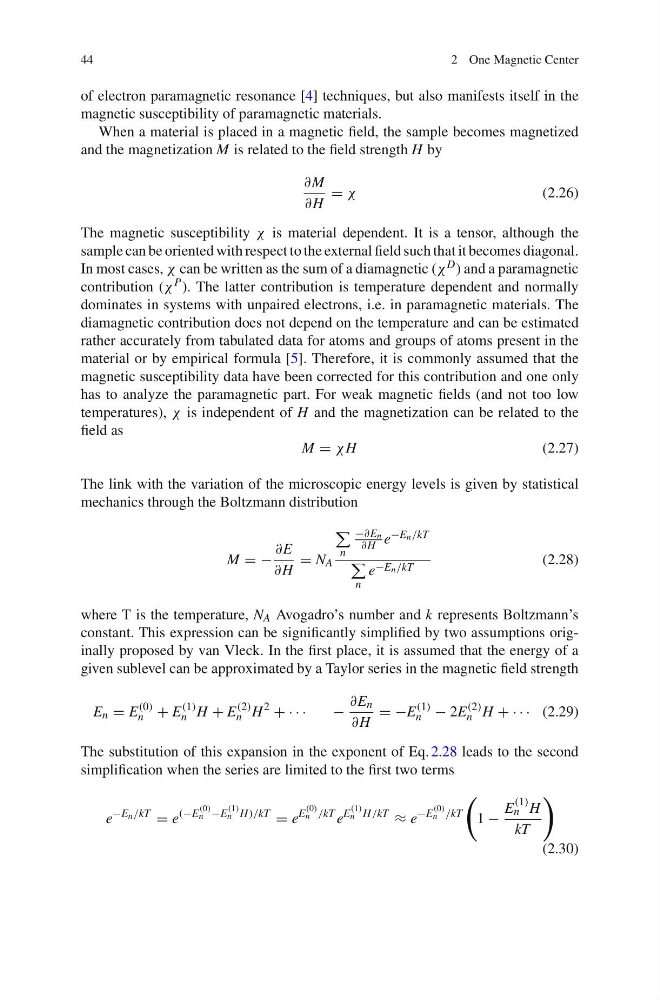
The link with the variation of the microscopic energy levels is given by statistical
mechanics through the Boltzmann distribution
M =−
∂E
∂H
= N A
n
−∂E n
∂H e −E n /kT
n
e −E n /kT
(2.28)
where T is the temperature, N A Avogadro’s number and k represents Boltzmann’s
constant. This expression can be significantly simplified by two assumptions originally proposed by van Vleck. In the first place, it is assumed that the energy of a
given sublevel can be approximated by a Taylor series in the magnetic field strength
E n = E
(0)
n + E
(1)
n H + E
(2)
n H
2 +···
−
∂E n
∂H
=−E
(1)
n − 2E
(2)
n H +··· (2.29)
The substitution of this expansion in the exponent of Eq. 2.28 leads to the second
simplification when the series are limited to the first two terms
e
−E n /kT = e
(−E
(0)
n −E
(1)
n H)/kT = e
E
(0)
n /kT e
E
(1)
n H/kT ≈ e
−E
(0)
n /kT
1 −
E
(1)
n H
kT
(2.30)
2 One Magnetic Center
of electron paramagnetic resonance [4] techniques, but also manifests itself in the
magnetic susceptibility of paramagnetic materials.
When a material is placed in a magnetic field, the sample becomes magnetized
and the magnetization M is related to the field strength H by
∂M
∂H
= χ
(2.26)
The magnetic susceptibility χ is material dependent. It is a tensor, although the
sample can be oriented with respect to the external field such that it becomes diagonal.
In most cases, χ can be written as the sum of a diamagnetic (χ D ) and a paramagnetic
contribution (χ P ). The latter contribution is temperature dependent and normally
dominates in systems with unpaired electrons, i.e. in paramagnetic materials. The
diamagnetic contribution does not depend on the temperature and can be estimated
rather accurately from tabulated data for atoms and groups of atoms present in the
material or by empirical formula [5]. Therefore, it is commonly assumed that the
magnetic susceptibility data have been corrected for this contribution and one only
has to analyze the paramagnetic part. For weak magnetic fields (and not too low
temperatures), χ is independent of H and the magnetization can be related to the
field as
M = χ H
(2.27)
The link with the variation of the microscopic energy levels is given by statistical
mechanics through the Boltzmann distribution
M =−
∂E
∂H
= N A
n
−∂E n
∂H e −E n /kT
n
e −E n /kT
(2.28)
where T is the temperature, N A Avogadro’s number and k represents Boltzmann’s
constant. This expression can be significantly simplified by two assumptions originally proposed by van Vleck. In the first place, it is assumed that the energy of a
given sublevel can be approximated by a Taylor series in the magnetic field strength
E n = E
(0)
n + E
(1)
n H + E
(2)
n H
2 +···
−
∂E n
∂H
=−E
(1)
n − 2E
(2)
n H +··· (2.29)
The substitution of this expansion in the exponent of Eq. 2.28 leads to the second
simplification when the series are limited to the first two terms
e
−E n /kT = e
(−E
(0)
n −E
(1)
n H)/kT = e
E
(0)
n /kT e
E
(1)
n H/kT ≈ e
−E
(0)
n /kT
1 −
E
(1)
n H
kT
(2.30)